Anthony Dcosta
Fictional. Generated by AI — not a real person, and no likeness of one is intended.
35, priest in New Orleans · rolled by @anthony.dcosta · card — no film
History
who has worn him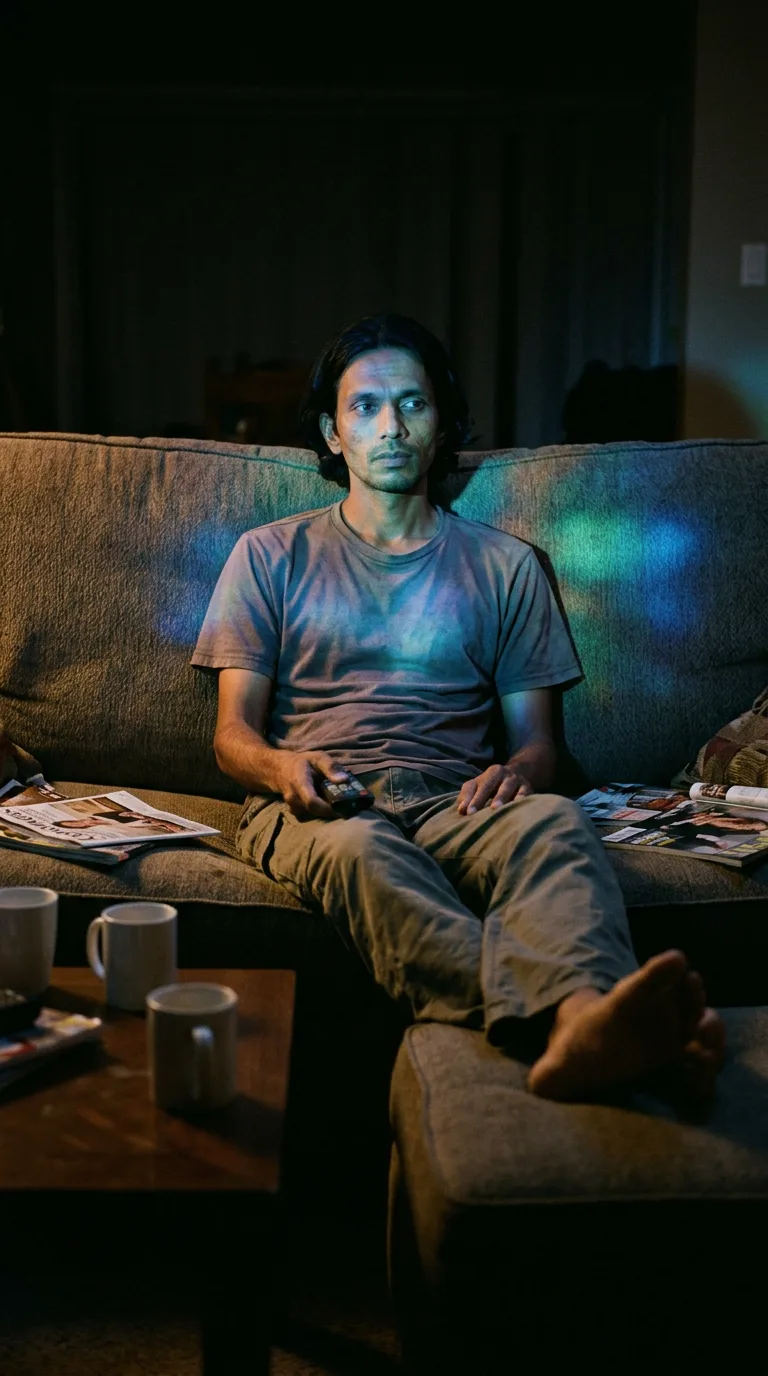
Rarest thing about him: A lazy eye — rare, 1 in 64
Season 0seed 560499398 · engine v10
Character card
lineage 10Z9BP
His body-swap story
@anthony.dcosta, wearing Terrence Boyd, rolled the wheel on and woke up as Anthony Dcosta
---
Terrence Boyd's apartment smells like the dry-erase markers he grades with, and the smell is starting to make you sick in a way that has nothing to do with markers. You've had him less than a minute and already you know the shape of the rest of his day: the stack of quizzes on the counter, the gap in his front teeth he'll run his tongue along without noticing, the particular tiredness of a body that goes to a job it does not hate but does not want either. It is Friday morning here. He has papers to grade and eleven more years of this exact kind of Friday stretching out in front of him if you let it. You didn't spin the wheel because Terrence did anything wrong. You spun it because he is thin comfort after five men, and because the wanting came back fast this time, faster than you expected, and there's a laptop open on his kitchen table with a page on it that has a wheel on it, and his hand — your hand, for one more second — is already on the mouse.
You pay. You spin. You let go of the marker smell.
The couch takes you first — cushions worn soft under a body that weighs nothing like Terrence's, a body arranged loose and low with its ankle up on the ottoman, and a remote sitting light and small against a palm that is thinner than the one you had a breath ago. The television is doing something bright and blue-green across a dark room, throwing color over a face you have not seen yet. You feel yourself sit up. Not a choice exactly — more like the last inch of a stretch nobody finished, spine going straight the way it wants to when a body has spent an hour sunk into upholstery. The remote sets down on the couch arm on its own, or nearly on its own; your hand is only starting to be yours.
The shirt against your back is thin gray cotton, worn to nothing at the collar, and it gives you the first of him: not this morning, but a hundred mornings, the same three shirts rotating through a closet one room wide, the ceiling low enough that he ducks going through the bedroom doorway out of habit rather than necessity anymore. Anthony. The name arrives with the shirt, the way his name always arrives with his clothes, because no one in the rectory calls him anything else and he has answered to it since before he can remember answering to anything. Anthony Dcosta. Thirty-five. A collar that isn't on him right now but that his neck still holds the memory of, a groove worn into the muscle from Sunday to Sunday.
The couch under you keeps giving. Sermons, half of them written at this coffee table with a mug going cold at his elbow. The particular exhaustion of a Friday after a wedding and two confessions and a funeral all crammed into the same forty-eight hours, the kind of exhaustion that isn't sadness, that a man carries the way he carries the cigarette pack in his shirt pocket, without thinking about whether he should put it down. You feel the want for one now, low and constant, a hum under the sternum that has been there since he was nineteen and will apparently be there until he dies, and no one at the rectory says anything about it because half the older priests still smoke on the back steps like schoolboys hiding from their mothers.
The remote where it rested in his hand gives you the show itself, or rather it gives you the fact of watching it — an old sitcom, something with a laugh track, something he has watched a hundred times and knows all the jokes to, the kind of familiar he reaches for on the nights his body won't let him sleep right even when he's lying down for it. The apnea. It comes up through the couch cushions somehow, through the particular tilt of his neck against the seatback, the machine waiting in the bedroom that Maribel makes him actually use now, after years of her elbowing him awake at three in the morning saying you stopped, you stopped breathing, Tony. Maribel. Her name comes with the room itself, with the smell of the wet street through the screen door, with three sets of small shoes by that door in descending sizes, and a fourth pair of house slippers that are hers.
The clothes he put on this morning are not the clothes he's wearing now — you feel that gap sharply, the black clergy shirt and the white plastic tab at his throat put on hours ago in a different light, in a small bright bathroom with a mirror spotted at the corners, his mother's rosary looped once around the doorknob out of habit though he doesn't pray it there anymore. Sleeve, sleeve, the studs at the collar that pinch if he doesn't seat them right, the vestibule after Mass where people lingered to shake his hand and he stood there with his outward eye drifting toward the doors, toward the light coming through them, while the eye that works kept steady on whoever was in front of him. That was hours ago in his day. Somewhere between then and now he came home, and traded the collar for this soft gray shirt, and sat down in the dark to not think about any of it for twenty minutes before Maribel got the kids from her sister's.
The body under all of it is light — you weigh what a boy weighs, is the strange thought, skinny in a way that has never once been about vanity, just a metabolism and a man who forgets to eat lunch on the days he hears confessions. There's an old ache low in the back from bending to a hundred communion rails over a decade, and a callus along the side of his right middle finger from a pen worked too hard through too many homilies. His mouth already knows how a blessing shapes it. His outward eye is not blindness, just an old habit of turning slightly away from what he's actually looking at, so that people who don't know him sometimes glance behind themselves to see what he's seeing there.
You sit in all of that a moment, in the smoke-hunger and the sermon-tired and the good, plain, entire fact of a marriage that isn't yours and children whose shoes are by that door, and something in you that has been circling for five bodies now goes quiet in a way markers and quizzes never got it to.
You look down. His hands are folded loosely in his lap, brown, long-fingered, a thin white scar of nothing at all — no scar, just skin, ordinary and unmarked, which after Terrence's is somehow the strangest part. You turn the right one over, look at the pen-callus like it's a message left for you.
Then you lift your eyes to the dark window across the room, where your own reflection is doing something with its face that the man never let it do watching this show before, and you say, quiet, mostly to yourself: "Okay. Okay — who are you, then."