Anil Mehra
Fictional. Generated by AI — not a real person, and no likeness of one is intended.
48, lawyer in San Francisco · rolled by @caleb.dean.whitfield · card — no film
History
who has worn him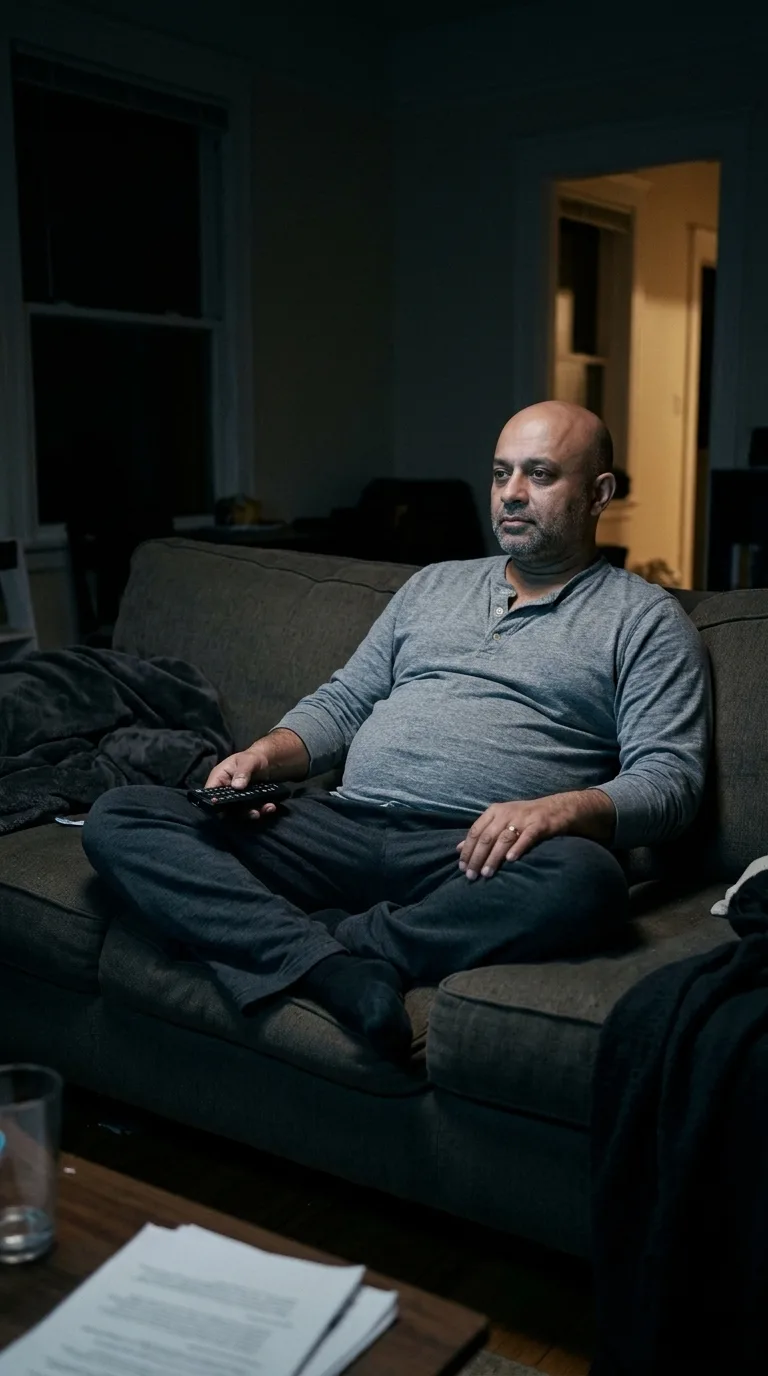
Rarest thing about him: South Asian — common, 1 in 26
Face-off rating 1508 · not ranked yet
Season 1seed 1731440145 · engine v11
Character card
lineage A8GP7H
His body-swap story
@caleb.dean.whitfield, wearing Brian Thomas Kowalski, rolled the wheel on and woke up as Anil Mehra, spent 1 minute in him, then spun the wheel and woke up as Raymond Kenji Nakamura
Your knuckles are split, and they are not yours. They are Brian Kowalski's, thirty-two years old, a laborer's hands, and they have been yours for less than a minute. The apartment around you smells of drywall dust and cold pizza. Nearly midnight, a Thursday, the radiator ticking. You are standing in his kitchen holding his phone, and the site is open on it, the wheel, the little pointer.
Nothing is wrong with him. That is the trouble. He is strong and thick through the shoulders and his back does not ache. You carried a sheet of plywood up two flights in your head just now, remembering his arms doing it, and felt nothing but a flat gladness. And you stood at his window and watched the city and found you wanted none of it. You want to be somebody who does not yet know what is in his pockets. You press.
The wheel turns. Then the room is dark and blue and moving. A television is throwing light across your face, and a show has just cut to a white frame, so bright it makes you sit up straight. The remote is in your right hand. You set it down on the couch arm. Your left leg is bouncing, and it has been bouncing for a long time without you.
The couch is soft and sagging. Your heartbeat is slow and heavy, a belly's worth of weight sits on your belt, and your knees are crossed under you and have gone stiff. Forty-eight years in this frame. Your head is bare and cool to the air. When you rub your jaw the stubble rasps, salt and pepper, three days of it.
The henley is the first thing that talks. Gray cotton, soft at the cuffs, the two buttons at the neck. This morning, in a bedroom with the light still blue, his hands pulled it from the drawer because the other shirts were in the wash. His wife was asleep with her back to him. He stood a moment too long looking at that back. Then the sleeve over his wrist, the left one first, the ring catching in the cuff, and a small, tired tenderness for her that is not yours at all.
The socks under you are thick and warm. They bring a hallway and a kid's backpack thrown across it, and his daughter's voice from upstairs saying *Dad, did you sign it,* and him saying *tonight,* and meaning it, and the form still on the table somewhere.
The papers on the coffee table. You do not touch them, but the smell of toner reaches you and with it a courthouse, stone steps, a briefcase handle worn smooth under his palm, the hours of arguing for strangers. It was good money and it left him hollow by evening. That is why he sits in the dark. He is not sad. He is just emptied out, and the television asks nothing of him.
The ring, when your thumb finds it, opens something older. A woman in another city, years before his wife, a train platform, her coat. The woman who got away. He does not think of her often, but he has never thrown away the feeling. It is small and smooth, like a stone in a pocket.
The leg keeps bouncing. You let it. His body knows this rhythm and you do not argue.
You lift your hands into the flicker of the screen, the left with its plain band, the right still curled around the shape of the remote. You turn them over. Brown, broad, a lawyer's, soft in the palms. Nothing like the ones you left.
You look up, toward the lit doorway where somewhere a house is breathing, and you say, quietly, in his low voice, "All right. Let's see."
Then comes the question, which is always there. How long will this one hold, and when will the wanting come back?