Andrew Cho
Fictional. Generated by AI — not a real person, and no likeness of one is intended.
25, sheriff's deputy in Los Angeles · rolled by @connor.waskiewicz · card — no film
History
who has worn him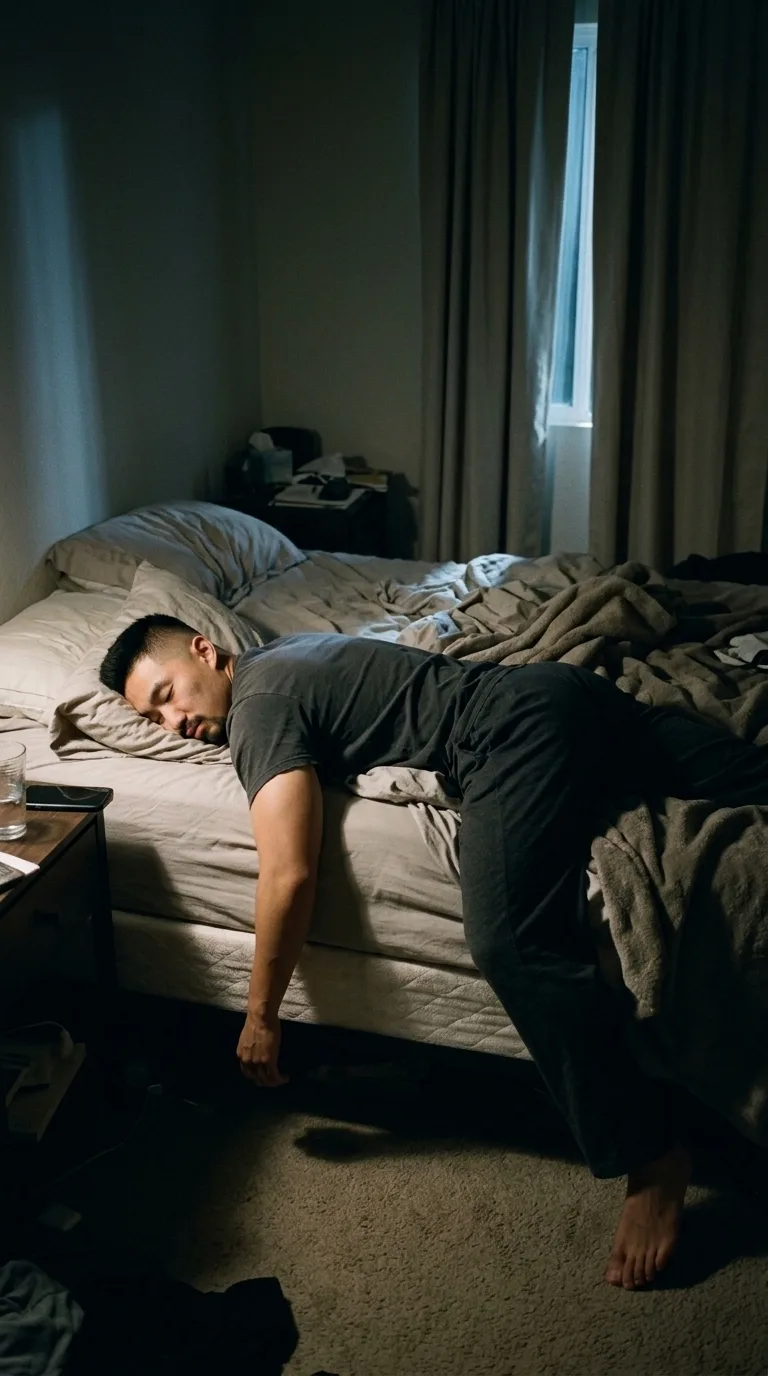
Rarest thing about him: Sheriff's deputy — common, 1 in 585
Season 1seed 272971933 · engine v11
Character card
lineage 2NZHHJ
His body-swap story
@connor.waskiewicz, wearing Brian Kessler, rolled the wheel on and woke up as Andrew Cho, spent 6 minutes in him, then spun the wheel and woke up as Amir Haddad
You are standing at a sink in Pittsburgh, in Brian Kessler's kitchen, with Brian Kessler's wet hands. It is the dead middle of a Tuesday night and the house breathes around you: a furnace ticking, a wife or a roommate or no one upstairs, you have not bothered to find out. The glass you are rinsing is his. Your thumb knows its chip.
He worked. That is the trouble. Forty-three, six-one, a body that did every small thing asked of it, and nothing in it asking back. Twelve minutes ago a man named Dave sent a message about a quarterly review and you answered in Brian's voice, in Brian's easy sentences, and felt nothing move. Nothing in him could be wanted. He was a closed door that opened perfectly. You dry your hands on his shirt and go sit at the glowing page, and the wheel is already turning before you have decided, the way it is every time, and the last thing you notice of him is the beard, short and blond, rasping under your palm as you rub your face.
Then the click, and the dark is a different dark.
You are face-down. Your breath is ragged, tearing in and out against cotton, and then in one pull it evens out, and you are heavy, so heavy. Your left arm hangs off the mattress with blood pooling in the fingers. A thin streetlight comes through a gap in the curtains and lies across the carpet. You draw the arm up. You roll. Your hands fold on your chest, and the posture is wrong, you can feel it is wrong, some muscle in the shoulders complaining that this is not how it sleeps.
You lie there as the body settles around you. Then the pillow, under your cheek, gives him up.
It is a flash in his feeling, not yours: a girlfriend's hair across this same pillowcase, her laughing about how he sleeps like he was dropped from a height. Warmth, familiar and stupid and total. And under it a smaller thing, cooler: the ex, the recent one, her name arriving like a stone in a shoe, and the sense that he checks his phone more than he admits. The phone is on the nightstand beside a glass of water. You do not touch it yet.
The T-shirt against your back is soft from washing, and it gives you the morning before the last one. His hands pulling it on over a damp head after a shower, the left sleeve turned inside out and fixed with two fingers, habit. Before that the uniform, hung on the closet door, tan shirt creased along the pockets. Each button, each pocket flap, the badge pinned through the cloth with its small stubborn resistance. The belt going on last, every pouch in its order: cuffs, radio, the weight settling onto the hips like a hand. He loves that weight and does not know he loves it. Twenty-five, and the belt makes him feel like a man.
The sheet under your calves is coarse, the carpet beneath your heels is cheap and old, and the road comes up through it: a county road at dusk, the cruiser ticking as it cools, dry grass, a driver's window rolled down, a farmer's son with a taillight out who called him sir. He was kind to the boy. He gave a warning. He thought about it all the way home, whether kindness was a failure of the job or the job itself.
Your body is strong. The thighs are tired in a clean way, the shoulders loose, the knuckles dry and nicked. The right hand has calluses at the base of the fingers from the grip of something, a flashlight, a firearm, a steering wheel at ten and two. The goatee is thick against your fingers when you touch your chin, the cheeks smooth. You are hungry. Somewhere a refrigerator hums, and the girl is somewhere near, breathing, asleep, and you know without knowing that she is the reason he saves money, the twenty-some thousand he does not tell her he has.
Then you lift your hands in the streetlight, and turn them over.
They are good hands. Warm. They are not yours and not anyone's you have been. You look up at the dark ceiling and say, quietly, to the room, "Okay. Hello, Andrew."
The word sits in the air a moment. Down the hall a floorboard settles. You close the hand and open it again, and wonder, as you always do, how long before the wanting comes back.