Amit Sarraf
Fictional. Generated by AI — not a real person, and no likeness of one is intended.
30, tailor in Small-town Ohio · rolled by @colby.marsh · card — no film
History
who has worn him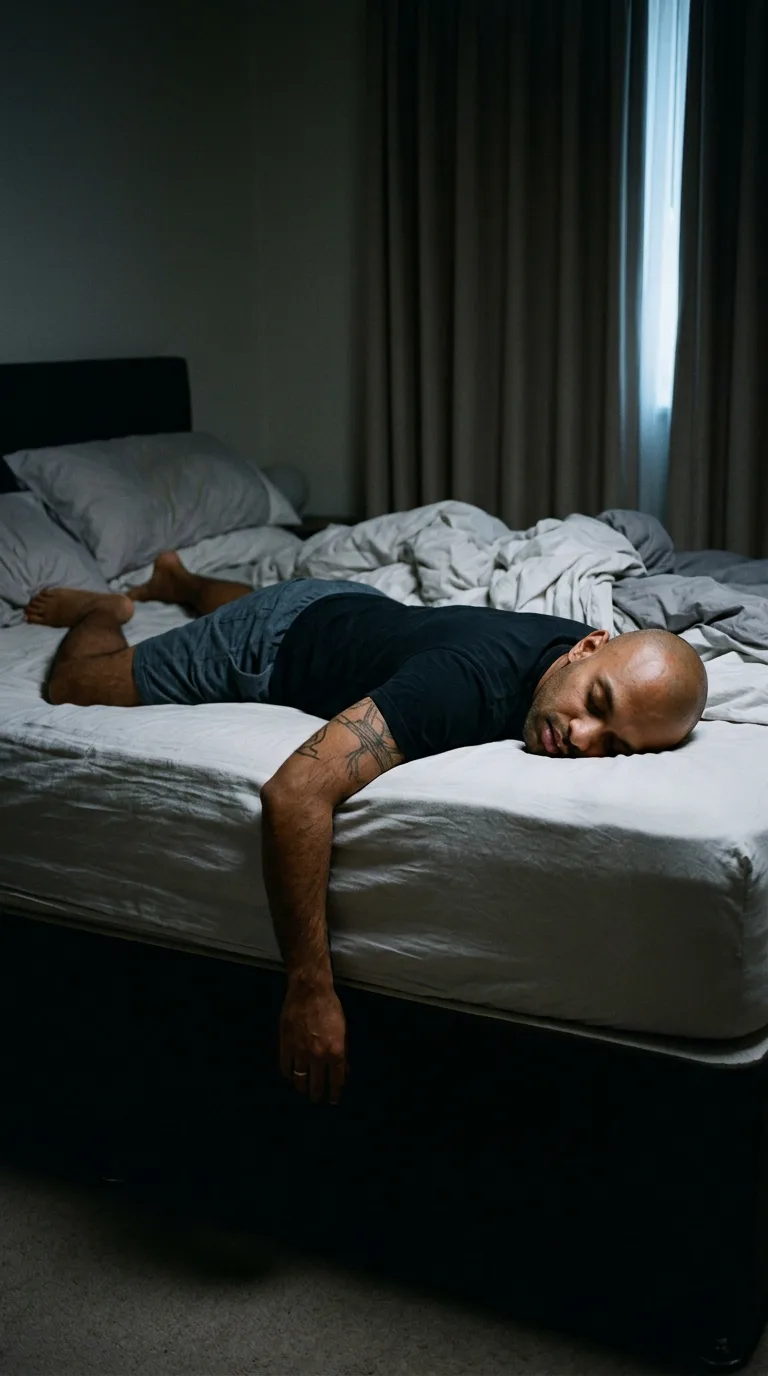
Rarest thing about him: Dip or chew — rare, 1 in 40
Season 0seed 639113769 · engine v10
Character card
lineage PYNCV3
His body-swap story
@colby.marsh (admin), wearing Marcus Tillery, rolled the wheel on and woke up as Amit Sarraf, spent 2 minutes in him, then spun the wheel and woke up as Dakota Whitehorse
The clippers are already cool in your hand by the time the wanting comes back, which is how you know it's real and not just the boredom talking. Marcus Tillery's kitchen smells like burnt coffee and clipper oil. Two days and ten hours is not long enough to learn a man but it's long enough to know the shape of his mornings, the ache low in his back from bending over chairs all day, the way his knees pop on the third stair. Good body. Strong hands, a barber's hands, sure of themselves. But you didn't spin forty-two times to sit still in something that works. You spin because it's Saturday and the apartment is quiet and there is a whole world of men you have not been yet, and somewhere among them, always, one more. You set the clippers down on the counter without turning them off. You are already thinking about someone else's teeth.
The wheel loads. It always takes a half-second longer than it should, like it wants you to feel yourself deciding. You feel Marcus's thumb come down on the screen, and then you don't feel Marcus at all.
Breath goes even before you understand you have breath. The arm that was hanging off the mattress lifts on its own, folds up onto a chest that is not the chest you had a second ago — narrower, no tattoo, warm from sleep — and you are rolling face-up into a room gray with midmorning light leaking around a gap in the curtains. Somewhere outside, close, a car idles at a stoplight that is, you will learn, the only one in town.
The shirt isn't on you — you're in shorts, bare-chested, the sheet twisted at your waist — so the first thing that comes isn't cloth, it's the mattress under your shoulder blades, and with it, faint, a flash of him working late, standing at a cutting table until his lower back seized, driving home half-blind with fatigue, falling into this bed at four in the morning without brushing his teeth. That's why eleven a.m. finds him horizontal. Tailors don't punch a clock. He'd had three fittings back to back the day before, a bridesmaid's dress taken in, a suit jacket that wouldn't sit right in the shoulder no matter what he did to it, and by the time he locked the shop he was moving like a man twice his age.
Your hand finds the pillow beside you, still faintly dented, and that's where it opens wider — not empty, just recently vacated, and with it a whole year comes up at once, the size and mess of it: a wedding three summers back in a hall with a rented arch, his mother crying into a napkin, his wife's laugh loud enough to embarrass him in the best way. A baby, seven months old now, sleeping two rooms over — you feel that in your chest like a held breath, a fear you didn't bring with you, that a father's fear of not doing enough. And underneath it, guiltily, another face: a woman who is not his wife, who he stopped seeing four months ago, who still texts sometimes about nothing, whose name comes up in his chest like a stitch pulling loose. He never told anyone how much that almost cost him. His hand, this hand, remembers hers in a way it does not perform, only knows.
You sit up. The wedding band is already on the left hand — he sleeps in it, never takes it off, not since the day a jeweler two towns over sized it to fit. Your gums ache faintly where the front teeth gap; his tongue goes to it without thinking, an old habit, a thing kids used to tease him about that he stopped minding around age twenty-two. Your jaw wants tobacco, a low buzzing want, dip tin probably on the nightstand — you don't reach for it yet.
Bare feet find the carpet, and from the carpet: a version of this exact room from years ago, before the ring, before the baby, thinner walls, a mattress on the floor, him twenty-four and cutting his first commissioned jacket at a card table because he couldn't afford a real one yet. The smell of chalk. The smell of steam off a press. His whole trade rises up through the soles of his feet — how his hands know a seam by touch before his eyes confirm it, how he can eyeball an inseam within a quarter inch, how satisfying it is, still, after all these years, to see a jacket close clean over a stranger's shoulders like it was always meant to live there.
Your blood pressure medication is a small orange bottle you have not yet touched but already know is there, third shelf, bathroom, taken most mornings and forgotten some, a small guilt riding along with it.
You look down. The hand on your knee has a nail bitten close on the thumb, raw at the edge, a habit he can't break no matter how many times his wife swats it away from his mouth at dinner.
You turn it over once, like it might tell you something new, and it doesn't, because it's his now, all the way down.
"Okay," you say, out loud, to the empty room, to the light through the curtain gap, to nobody. "Okay."
Downstairs a baby starts to cry, and somewhere past that a whole life is waiting to be touched into being remembered, and you don't know yet how long you get to stand in it before the wanting turns over again.