Amir Haddad
Fictional. Generated by AI — not a real person, and no likeness of one is intended.
19, student in Seattle · rolled by @colin.hasbrook · card — no film
History
who has worn him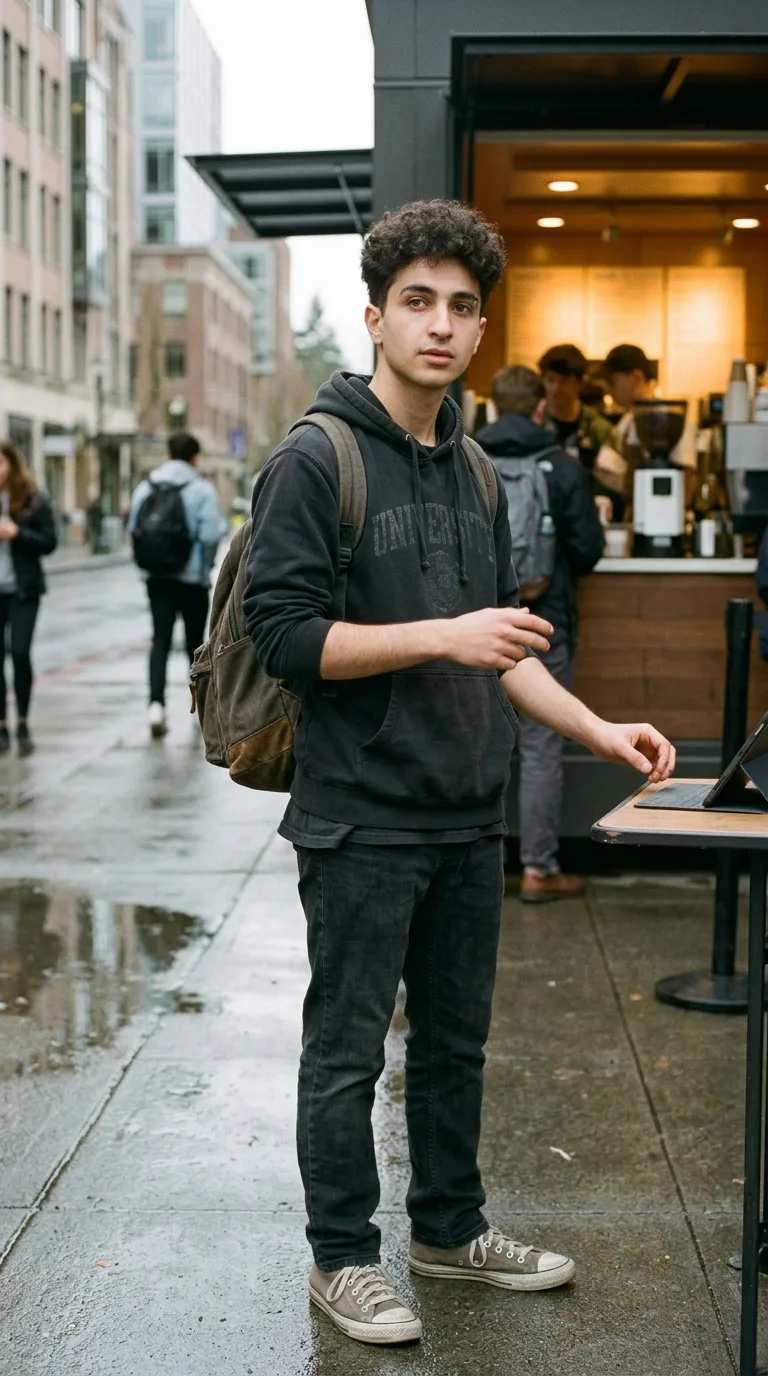
Rarest thing about him: Eyebrow — uncommon, 1 in 141
Season 1seed 1524848240 · engine v11
Character card
lineage 2NZHHJ
His body-swap story
@colin.hasbrook, wearing Todd Marchetti, rolled the wheel on and woke up as Amir Haddad, spent 1 minute in him, then spun the wheel and woke up as Warren Castellano
The office chair under Todd Marchetti creaks the same way it creaked yesterday, and the day before, and the six hundred-odd days you've spent scattered through him since you found this body worth keeping around for a while. Blond, tall, easy in a room. You liked him for the height at first. Now you're looking at your own hand — his hand — on the mouse, and the cursor hasn't moved in eleven minutes, and the quarterly numbers on the screen are the same numbers they were an hour ago: fine. Comfortable. Nobody's numbers. You spun into a man who closes deals in his sleep and it turns out that's the whole trick of him, closing deals in his sleep, and you have been awake inside that sleep for the better part of a year of scattered minutes and it has started to feel less like living in a big house and more like living in a big empty one. Boredom isn't a good enough word for it but it's the word you've got. Your thumb finds the beauty mark at his jaw, out of habit, his habit, not yours, and that's the thing that decides it — a gesture that isn't even yours going through the motions without you. You open the laptop. The wheel is already loading before you've admitted to yourself why.
The spin lands you mid-reach, and the reach doesn't stop — it's already going, someone else's momentum you've been dropped into like stepping onto a moving belt. A paper cup, warm, held wrong for a half-second, fingers not yet knowing where its balance is, and then knowing. The correction happens before you do: the hand rights itself, sets the cup down square on a little round café table, and does it again, slower, checking, the way a man checks a stair he's climbed a thousand times after nearly missing it once. Rain smell. Espresso machine hissing behind you. Your knees are wrong — lower to the ground than Todd's, a different center of gravity entirely, weight sitting soft over a frame that isn't built for the height it isn't. A backpack strap cuts into your shoulder. Somewhere behind your face, muscle memory keeps finishing the shift you interrupted, three more cups, four, each one checked and re-checked, a hand that has done this ten thousand times suddenly negotiating with itself.
The hoodie is what opens first — worn cotton at the cuffs, and under it: pulling this exact sweatshirt over his head this morning, the fabric catching for a second on the eyebrow barbell before he laughed once, alone, and yanked it through. He'd been up since four for the opening shift, which is why the sun outside now feels like an insult, thin gray daylight when his body still thinks it's the dead hour before dawn. He remembers — you remember, wearing him — the walk from the apartment in the dark, backpack heavier with the laptop than it needed to be because there's a paper due and he was going to write it between orders if the manager wasn't looking. Amir Haddad. The name arrives with the strap of the backpack, worn smooth at the buckle where his thumb runs over it waiting for buses.
More comes with the jeans, black, soft at the knee from being knelt in — a February morning, months back, on a wet campus lawn, laptop balanced on his thighs while he tried to make himself care about a discussion post, and Layla texted him a photo of a dog in a raincoat and he laughed loud enough that a stranger looked over, and he didn't mind. Layla. Her name is a whole warm room by itself — eight months of her, a girl who teases him about the crooked nose and means it kindly, who touched the break in it once with one finger like she was reading braille and said it suited him. He'd gotten it at fifteen, an elbow in a pickup basketball game, nothing dramatic, and it healed a few degrees off-true and he stopped minding around the same time she started liking it.
The apron ties come next — a memory of tying them badly for the first three weeks of this job, the manager retying them for him without a word, the small daily humiliation of it curdling slowly into competence nobody had to hand him. His hands know the portafilter, the tamp, the exact half-turn of the steam wand, all of it sitting in muscle below thought, which is exactly why the wheel arriving inside him didn't stop his hands so much as make them, for one motion, ask a question they hadn't asked in years. He is nineteen. He has never once used a cigarette. He drinks too much maybe once a month, at a party, and is loud and sweet and useless the next morning about it, and Layla drives him home. He has $0 he'd call real money but his parents are comfortable and he doesn't think about it because he's never had to. He believes in nothing beyond the espresso machine's hiss and the next assignment and Layla's laugh, and it has never once felt like a lack.
Your hand — his hand, and you are inside the difference now, feeling both at once — comes up unbidden and picks at a cuticle on the thumb, worrying it, a thing he does without deciding to, a small nervous engine that runs under everything he is. You watch it happen. You didn't tell it to.
You look down at that hand. It is narrower than the one you had an hour ago in a different city, softer at the knuckle, a thin white worry-mark at the thumb's edge where the cuticle's been picked raw and healed raw a dozen times over. You turn it over once, like checking it isn't someone else's glove.
"Okay," you say, out loud, to no one, to the rain, to the espresso machine, "that's new."