Wesley Dale Crowder
Fictional. Generated by AI — not a real person, and no likeness of one is intended.
24, trucker in El Paso · rolled by @marco.villagrana · card — no film
History
who has worn him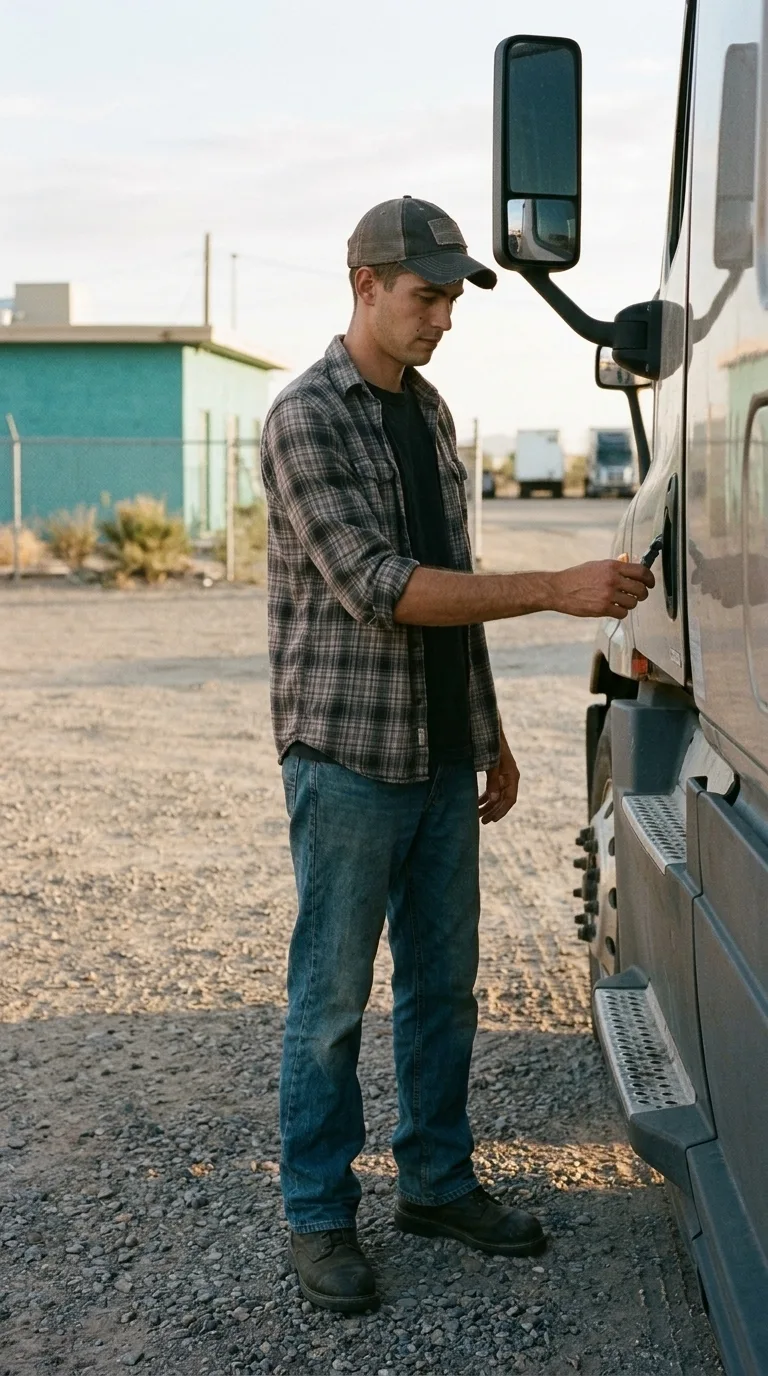
Rarest thing about him: Another world religion — legendary, 1 in 665
Face-off rating 1500 · not ranked yet
Season 1seed 1268591895 · engine v11
Character card
lineage LJL8SV
His body-swap story
@marco.villagrana, wearing Walter Chen Hsu, rolled the wheel on and woke up as Wesley Dale Crowder, spent 5 days in him, then spun the wheel and woke up as Glenn Hideo Tanabe
You are standing in a hallway in Pittsburgh with a dead man's reading glasses pushed up into your hair, and they are not even his. They are Walter's. They came with him. You have been Walter Hsu for three minutes, and already your feet hurt in the way his feet hurt, a low flat ache in the arches from carrying all that weight on so short a frame. The phone in his hand is open to the page with the wheel.
You do not say why. Not even here, not even to the hallway. It has to do with the stairs. With the fact that the fourth step creaked, and your knee, his knee, made a sound back, and that for one second you stood at the top and understood exactly how many years of this were in the body, and that none of them were yours and all of them were now your problem. You wanted something with a long back and no complaints. That is the clean version. The other version has to do with the photograph on the landing, a woman with his eyes, and you did not look at it, and you are still not looking at it.
You press the wheel. It turns.
A latch under your fingers. Cold metal, the grit of the lot on the pad of your thumb. You are mid-motion, arm out, a key-shaped tool in your hand, and your wrist has just done something wrong. A half second of wrongness. The hand slips off its rhythm like a foot missing a step.
So you do it again, slowly. Correctly. Then ten more times, each one checked, and you cannot tell yet whether the checking is yours or whether it is the last thing he did.
The air is dry and tastes of dust and diesel. Light is coming up flat and pale behind the turquoise wall across the fence. You are tall. Enormously tall. The ground is a long way down and the ache of it sits in your shoulders, where a thin man carries his height like a coat hung on a nail. Your stomach is empty and your jaw is smooth, you can feel the air on it, a fresh shave done by someone in a hurry or someone careful.
The cap first. You touch its brim and it hands you a kitchen: a counter, a yellow bulb, a coffee can of change, and him setting the cap on his head at the door because his mother used to say a man leaves the house covered. Not his mother's words in your head, his embarrassment about them, a small warm wince.
The flannel next, soft with washing, one sleeve rolled and one not. You feel him roll the left cuff twice in the truck cab in the dark, the heater ticking, because the right one always stays down. The shirt remembers a night: a bar with a low ceiling, a drink or two, only ever a drink or two, and a girl laughing at something he said badly, and him going home alone anyway, pleased, rehearsing it. Nobody waits for him. It is a quiet house with chain-link around it, and he likes it that way, mostly.
The jeans are stiff at the knee. Bending to the step, you get a flash of a prayer mat, a different faith than the town's, learned from a friend and kept up out of loyalty and then out of need; his lips know a few words you do not. Money, too: a ledger kept in his head, a number that never gets above the line. Scraping by, he would say, and not mind saying it.
Then the hand. You lift it and the thumbnail is bitten to the quick, the skin around it raw. The other hand too. He did this at red lights, at weigh stations, at the edge of sleep. You turn it over, palm up. Calluses across the base of the fingers, a ridge from the wheel. A mole you cannot see but can feel as a faint awareness high on the cheek, a place the wind keeps finding.
You look up, into the lot, into the light, and say, quietly, "Well. Let's see how long you last."
Somewhere in this long borrowed body the wanting is already folded small, patient, waiting to unfold. An hour. A year. You close the fingers of his hand and do not know.