Warren Petrosky
Fictional. Generated by AI — not a real person, and no likeness of one is intended.
33, bartender in Phoenix · rolled by @tyler.iverson · card — no film
History
who has worn him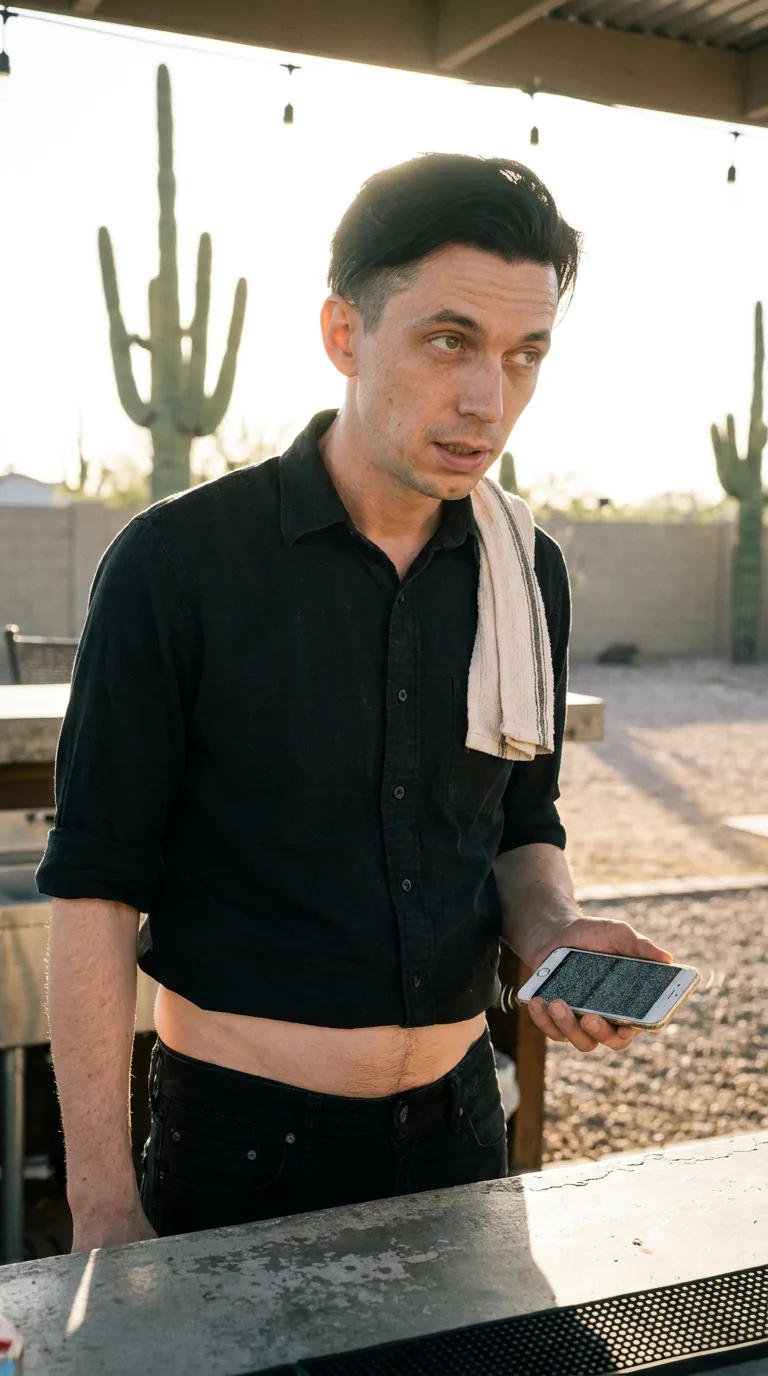
Rarest thing about him: A lazy eye — rare, 1 in 64
Legacyseed 286834248 · engine v8
Character card
His body-swap story
---
You have been in the wire a long time. Long enough that you stopped keeping the years and started keeping the sounds — dial tones, the click of a switchboard, the flat hiss between stations. Somewhere in there you had a body. You are not sentimental about it. What you remember is your hands, and how a glass felt when it was cold enough to sweat.
So you went looking for hands.
You find him on a Tuesday in April, in Phoenix, in the worst hour of the day. Five-forty in the afternoon and the sun is still coming in sideways under the patio roof like it's trying to get in under a door. Gravel yard. Saguaros out past the block wall standing around in their patient way. A run of string lights not turned on yet because the light is still murdering everything. He's behind an outdoor bar — a slab of concrete counter, a steel well under it, ice not in yet — and he is stocking it. Well vodka, well tequila, three kinds of nothing. A dish towel over his right shoulder, hanging down the front of his black shirt like a stole.
You watch him for eleven minutes before you call. You want to be sure.
Here is what you learn in eleven minutes. He is thirty-three and skinny everywhere except the middle, where the years have quietly filed a claim; his shirt rides up when he bends for a bottle and he doesn't notice and doesn't care, and there's something almost restful in a man who has stopped monitoring himself. His hair is black, long and pushed back on top, and clipped short on the sides with a hard line between the two — no fade, no blend, a border. He cut it himself, or somebody did it in a kitchen. He has that kind of decisiveness in only that one place. His hands are ruined nicely: knuckles dry, a callus on the right index from the same bottle opener for years, a nail on the left thumb gone dull from being crushed once and coming back wrong. He smokes. He smokes constantly — you can hear it in the way he breathes when he squats down, a pack a day at least, and he ashes into a beer bottle full of sand because the ashtray has walked off.
And he does not drink. Not a sip, not a taste, not a check-the-batch swallow. He builds a whiskey sour and pours it down the drain and rinses the tin. You watch him do this three times. He does not have to think about not drinking; there's no muscle in it, no little battle. It is simply the shape of him. Later you'll find the reason in his own head — a prayer rug rolled and standing in a closet corner in a rented house on the west side, dust on the top of the roll, and a Ramadan he kept badly last year and kept anyway, and a mother in Tucson who says *alhamdulillah* on the phone and means it, and a father who converted before Warren was born and never quite explained it to him. The name says one country, the faith says another, the accent says here. He does not talk about any of it. It is not a secret, it is just not a topic. He'd tell you he isn't much of a Muslim and he'd be wrong in a way you find interesting: he keeps the one hard thing and lets the soft ones go.
At six-oh-two he does the thing that decides it.
He takes out a phone that is not his phone. His phone is in his back pocket. This one is an old cracked thing, screen spidered from the corner, and he has it because it was hers — the ex, the one from eight years ago, the one whose name he doesn't say out loud but says internally about once a week like clearing his throat. She left it in his glovebox in 2017 and he has kept it charged. He does not tell his girlfriend. His girlfriend is a good woman named Delia who works nights at a hospital and has never asked him a question he couldn't answer, which is its own kind of love and its own kind of distance. The dead phone lives in a coffee can on a shelf above the well, and about once a month, before service, he takes it out and turns it on to see whether anything comes through. Nothing ever comes through. It is not hope. It is closer to what people do with a scab.
That is the door. Not the phone — the habit. A man who keeps a line open to somebody who isn't going to call.
You go into the tower two miles up the road and you go into the little handshake of protocols between it and that cracked, obsolete radio, and you *call*.
It buzzes in his hand and the screen goes to a wall of static. Not a number. Not a name. Snow, edge to edge, moving, with a shimmer in it like heat off blacktop. He looks at it and his mouth opens slightly and his eyebrows do something confused and hopeful and he says, out loud, to nobody, in the dumb bare voice of a man alone on a patio: "The hell."
He looks up and off to his left. This is the last thing he does with that face. His right eye goes with him and his left eye drifts out a little wide, the way it always does when he's caught off guard, and you love it immediately, that small failure of alignment, that one part of him that never agreed to look where the rest of him looks. You have wanted a body for a long time and you had not known you would be choosy, and here you are being choosy, and what chose it is a wandering eye and a callus and a man who pours out the drinks he makes.
He raises it to his ear. He listens.
You come across as sound. That's the only way you know how to travel. You go into the ear like water finding a crack, into the small bones, along the nerve, and you spread. And the strange thing — the thing you were not prepared for and will remember longer than any dial tone — is that for a second and a half you are *both*. You get everything at once, the whole flat of him: the Tuesday, the ice that hasn't come, the cigarette he wants, the cost of the crown on his back molar, Delia's shift ending at seven, the fact that he prayed maghrib in his truck last week and cried a little for no reason he could name, the smell of well tequila, the pack in his shirt pocket, the girl on the other end of a phone that has never once rung.
And he thinks — clearly, in a voice you will be using for the rest of your life — *oh, it's you.*
He means her.
Then he is out and you are in and the light comes off the concrete counter into your borrowed eyes and it *hurts*, God, the sun hurts, nobody warned you about the sun, and your head has already snapped back and something is going out of your mouth and eyes like a struck match, and then it isn't, and you are standing slack on a patio in Phoenix with a dead phone against your ear and a towel on your shoulder.
You lower the phone.
The first thing is weight. You had forgotten weight — the exact heaviness of a hand at the end of an arm, how a wrist is a hinge that has to be paid for. The second thing is the breath, and how bad it is; he has been smoking a pack a day since he was nineteen and the bottom of these lungs is a rusted room. You breathe anyway. You breathe like a man drinking.
The third thing is the towel. It slides half an inch and you feel the cotton drag on the shirt and you nearly make a sound.
You look down at the hand holding the phone. His hand. Your hand. Wide flat nail, the thumb that came back wrong, gravel dust in the creases, the pale shine of the callus. You turn it over. Palm up. There's a line of dried lime on the heel of it. You close the fingers and open them and they go where you send them and that is the whole thing, that is everything, that is what you came out of the wire for.
Somewhere past the wall a mourning dove says its four notes. Two miles off, a car alarm. The saguaros do not care. The sun goes down another inch and the string lights come on their timer, weak little beads against all that gold, and the patio becomes a place that could sell drinks.
You've got him for good. There's no back and there's no term. In an hour a truck will bring ice and you will have to know what to do with it, and at seven Delia will text *what do you want for dinner* and you will have to answer in a way that doesn't scare her, and on Friday you will have to stand in a room and be a bartender in front of people who have known him for six years. You'll manage. You have his hands and you have his voice and what you don't have you'll invent. Men reinvent themselves constantly; nobody ever checks.
But you'll keep two things of his, and you'll never fully know why.
You'll keep the not-drinking. Every night, all night, glass after glass, and never one for yourself. It's the only part of him you can still feel, and you don't want to put it down.
And you'll keep the coffee can on the shelf above the well with the cracked phone in it, charged.
Just in case somebody calls.