Warren Nishida
Fictional. Generated by AI — not a real person, and no likeness of one is intended.
45, prison guard in San Francisco · rolled by @warren.nishida · card — no film
History
who has worn him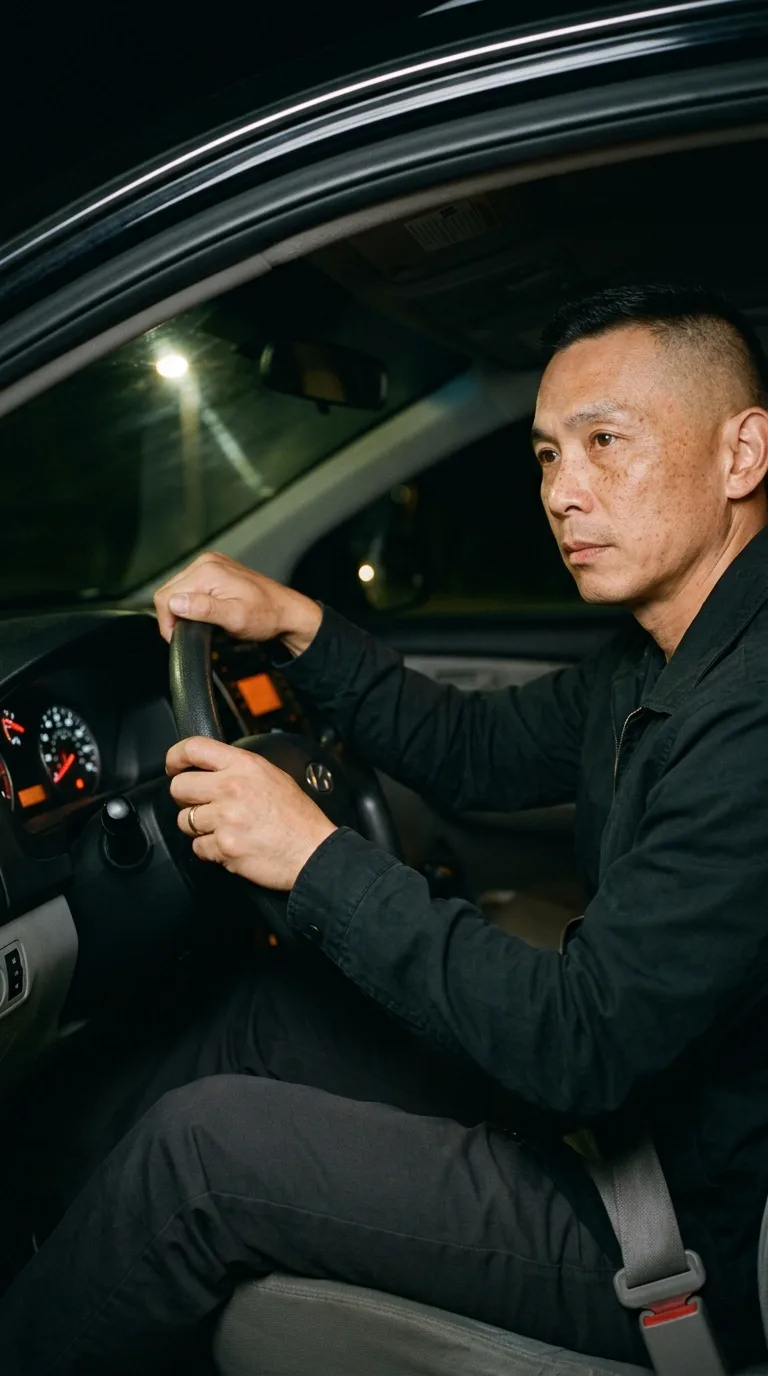
Rarest thing about him: Prison guard — uncommon, 1 in 131
Season 0seed 1037276934 · engine v10
Character card
lineage V4T0PR
His body-swap story
@warren.nishida rolled the wheel on and woke up as Warren Nishida — their first
The evening had that particular emptiness that makes a person go looking for something. Nothing on. Feed scrolled dry twice over. And then, the way these things happen, not through search but through drift — a link, a page, a wheel rendered in flat gray with a button underneath it that just said SPIN. You'd known about wanting this for so long it had stopped feeling like wanting and started feeling like a fact about you, the way some people know they want children or want to live near water. This was the shape your wanting had taken instead. You did not expect it to be real. You paid anyway, the way you'd pay for anything you expected to be a joke on you.
It is not a joke.
The wheel gives, and you are behind a windshield you did not put there, both your hands — his hands — coming off a leather wheel and resettling lower and wider, like the body knows something you don't yet. Dash light is green-gold across the knuckles. There's a wedding band catching it. The turn signal ticks on, clicking for an exit that doesn't belong to this drive, and you don't correct it because you don't know yet that it's wrong. There is a seatbelt cutting a diagonal across a chest that isn't yours, hasn't ever been yours, and a smell of coffee gone cold in a cupholder.
You are sitting in a stranger's weight, which is the first sensation, before anything else: shorter than whatever you're used to being, compact, a body coiled tight even at rest, low-slung stiffness in the lower back that says decades of standing on concrete. Your jaw is clenched. You didn't do that. It's just how the muscles were left.
Then the shirt.
Gray uniform poly-cotton, short sleeve, and touching it — no, not touching, wearing, being it — brings something up out of nowhere, unbidden: an image of buttoning this exact shirt in a bathroom mirror with the fan going to cover the sound so it wouldn't wake her, the epaulet catching, a pen already clipped in the breast pocket. Warren. That's the shape the memory arrives in, a name spoken by no one, just known. Warren Nishida, forty-five, four years off cigarettes and going on nine off the drink, though nobody at the facility remembers him as ever having been anything but dry, upright, punctual to the minute.
The radio mic clipped at your shoulder gives you the corridor: cinderblock painted the color of hospital gauze, gate after gate, the particular echo of boots on that floor at five-forty in the morning, the smell of it — bleach and someone else's breakfast microwaving three rooms over. You've walked it eleven years. Your knees know the fourth gate is heavier than the rest and you lean into it half a step before you reach it, every single time, without deciding to.
The keys on the chain at your belt open something else — an afternoon, not so long ago, your ex-girlfriend's kitchen, laughing at something you don't fully recover, only the warmth of it, the guilt-shaped warmth of it, because you are a married man and were not always careful about where your attention went even when your hands were. That's over now, has been over, and your wife doesn't know how close it came, and some nights that not-knowing sits in your chest like a stone you swallowed on purpose.
The ring is the one that gives the most, because it never comes off, not for showers, not for the range, not for anything. It gives you a wedding fifteen years back in a church in the Sunset with her mother crying into a tissue and your mother not crying at all, holding her missal like she might need it. It gives you Sunday Mass you still half-believe, half-attend, the incense doing something to your chest that nothing else does anymore. It gives you the ache low in your spine that has been there since a fall on wet concrete seven years ago, and how you never told anyone how bad it still gets by the end of a double, just clenched your jaw against it and clocked out anyway.
Your foot, on the brake now without you willing it, remembers thirty years of standing.
Your face — you can't see it, but you can feel where the freckles sit, a spray of them your mother used to say came from her side, and how self-conscious you were of them once, twenty years old and hating them, and how you don't think about them at all anymore, which might be its own kind of peace.
The car is stopped. The wrong blinker still ticking, patient, useless.
You lift both hands off the wheel and look at them in the green dash light — his hands, broad-knuckled, a thin white scar along one thumb you don't have the memory for yet, the ring catching light like it's trying to say something. You turn them over, both of them, like you're checking they're real, which in a way you are.
"Okay," you say, out loud, to the empty car, in his voice, low and a little rough with morning that hasn't happened yet where he lives. "Okay. Who's driving."
You don't turn off the signal. You don't know yet if you're going to need it.