Warren Nakamura
Fictional. Generated by AI — not a real person, and no likeness of one is intended.
59, store manager in Honolulu · rolled by @connor.waskiewicz · card — no film
History
who has worn him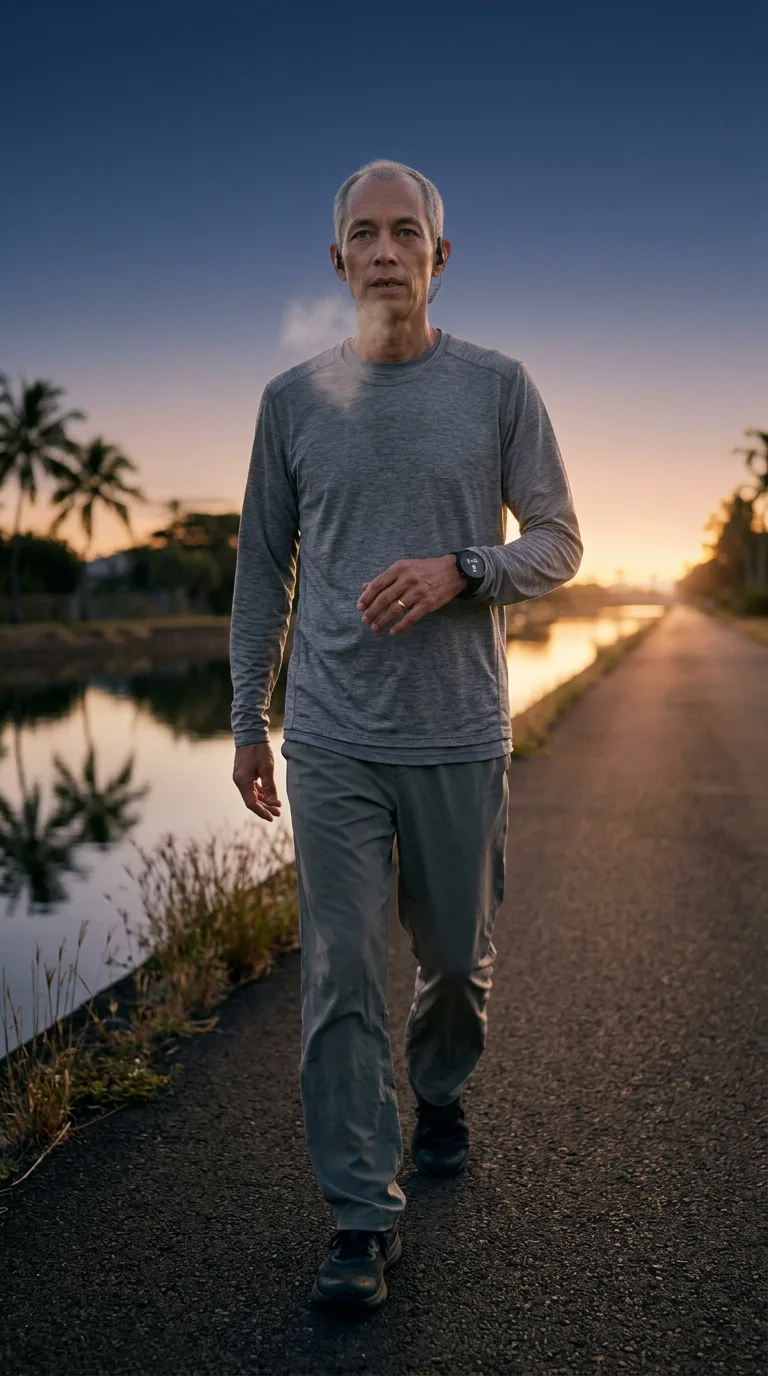
Rarest thing about him: East Asian — common, 1 in 349
Season 1seed 476600318 · engine v11
Character card
lineage 2NZHHJ
His body-swap story
@connor.waskiewicz, wearing Gabriel Almaraz, rolled the wheel on and woke up as Warren Nakamura, spent under a minute in him, then spun the wheel and woke up as Dwight Pruett
You are standing in Gabriel Almaraz at a desk in Houston, noon pressing on the window, and you are bored of his knees. They are good knees. He is thirty-one and nothing in him hurts, and that is the whole trouble: you have used all of what he can do by lunchtime. The stapler. The phone headset warm against his ear. A woman two desks over laughs, and he laughs, and you hear it from inside the laugh like a coin in a drawer. Less than a minute of him, and already you know what he sounds like wanting nothing. So you open the page with the wheel on it, and you pay, and you spin.
Cold air, and your breath is a cloud in front of you. Your foot is already in the air when you arrive, and the stumble never lands. The other foot catches the path, the run goes on, your arms drop low, your head stays level. Something buzzes on the left wrist. A canal lies on your left, orange where the sun is coming up behind the palms, and there is music in both ears from small hooks of plastic.
Then the shirt starts in on you. The long-sleeved gray thing is damp at the collar and soft from a hundred washes, and the sleeve over the wrist gives you a morning: a kitchen with the light off, a woman asleep, and him pulling this shirt over his head in the dark so as not to wake her. He leaves it a little twisted at the hem, and it is still twisted. The care in it is his, and it comes up in you like warmth.
The shoes slap the asphalt, and the path gives you the years. He started running when he quit smoking. The first week he coughed into a hedge on this same stretch, and then he did not cough, and he told no one but the dog. The lungs are strong now and the hips are not. There is a hitch in the left one, a dull wire at each footfall, and a tightness in the thin calves that he has learned to run around like a rock in a stream.
The ring on your left hand turns against the swing of your arm. Two children, grown or nearly. A call last Sunday, one of them asking for money in the careful voice of someone who has practiced. Under it lies the house on posts with the rusted roof, and a number he does not say aloud: more owed than the place is worth. He carries it on this path like a second watch. He is the manager of a store, and in an hour there will be pallets in the aisle, shrink wrap and box cutter and the smell of cardboard. He is good at that. Everyone arrives at his door with a problem, and he fixes it, and nobody asks whether he is all right.
The mouth is dry, and your tongue finds the gap between the front teeth. It is a small door that he has always been faintly embarrassed by. His wife told him once it was the thing she would know him by in the dark. The memory is so tender that it hurts more than the hip.
The watch buzzes again. You look down at the lit face, a split he has no record of, mile four, and you lift your hand and turn it over. The wedding band catches the orange light. The palm is dry, ridged, and not yours.
You look up, and you say, to the water, to the long gold road, "Well. Hello, Warren."
Somewhere under the breath and the buzzing wrist is a thin question: how long. An hour, a year, or until the wanting comes back and you reach for the page. The hip hurts with each step. You keep running.