Walter Pruszynski
Fictional. Generated by AI — not a real person, and no likeness of one is intended.
65, contractor in New York · rolled by @yusuf.brannick · card — no film
History
who has worn him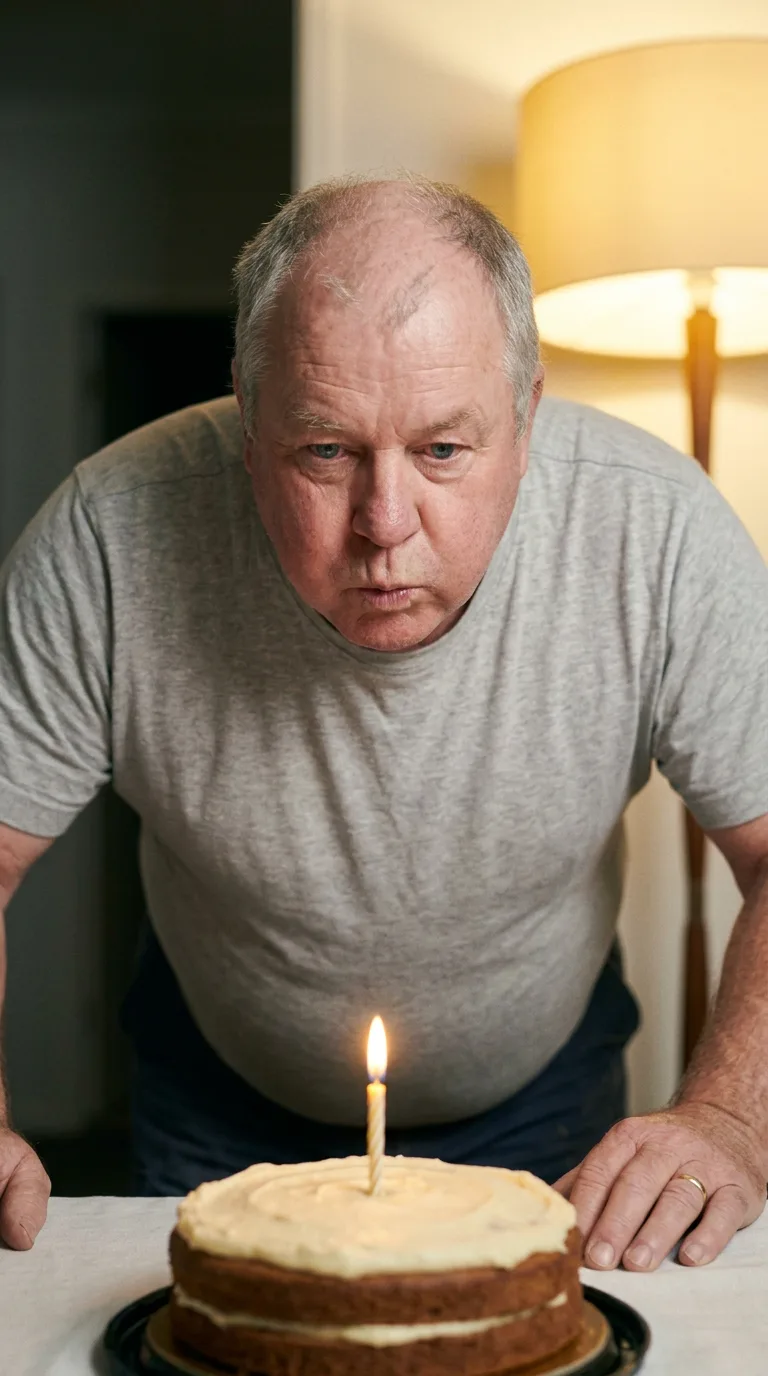
Rarest thing about him: A tic — a hard blink, a throat clear — epic, 1 in 153
Legacyseed 1816628476 · engine v8
Character card
His body-swap story
---
You don't know him. That's the first thing to be clear about, because you'll be him for the rest of his life and people will assume there was history. There wasn't. You were nowhere in particular, the way you have been for a long time, and then somebody in Brooklyn lit a candle and made a wish with real want behind it, and want that strong makes a hole.
He's sixty-five tonight. Gray T-shirt, no party, no hats. There's a lamp behind him with a cream shade throwing that soft nicotine-colored light onto the wall, and the doorway to his left is black, and the tablecloth is white and slightly crooked because he laid it himself. The cake is homemade — you can tell, the frosting has trowel marks in it, swirled flat like he did it with a spatula and a contractor's patience. One candle. His wife made it, or he made it; either way it's a cake for two people and one of them is somewhere in the back of the apartment finishing a phone call with the daughter, who has a life in Denver now and a reason not to fly.
He leans over it with both hands flat on the table. Heavy man, and he leans the way heavy men who work do — arms braced, weight on the palms, sparing the knees. His hands are the kind you get from forty-odd years of framing houses: thick, seamed, one nail dark from a hammer. Wedding band on the left. Nothing else on him. No ink, no scars he'd tell you about. Nothing about him to notice, which is precisely why you noticed him — nobody's looking at Walter Pruszynski. Nobody looks at Walter Pruszynski but his wife, and she's in the other room.
He's frowning at the flame. That's the thing you get to see and nobody else does — the face he makes when he's alone with a wish. Not a party face. His brows are low and his mouth is pursed and his eyes are absolutely fixed on that small light, and he looks like a man reading a bid he can't afford to lose. Whatever he's asking for, he's asking hard.
You hear it. You hear all of it in the second before he blows.
*Give me one more good year.* Not for himself, or not mostly. His pressure's up again, the pills have him getting up twice a night, and last week he went dizzy at the top of a stairwell on a framed-out third floor in Bushwick and had to sit down in the sawdust with his heart going like a nail gun, and he didn't tell her. He's got maybe sixty grand put away and a mortgage that outlives him. He quit drinking at forty-one and he's proud of that in a quiet way he's never said out loud to anyone. He quit smoking at fifty-five and still reaches for a shirt pocket sometimes. He is not religious. He believes, in the way a man believes who's watched joists carry loads they shouldn't, that there is something in the arrangement of things that pays attention. So he asks it. *One more good year. Let me see her through, let me get the roof done, let me be here.*
That's the hole. Not fear — want. He wants to be *here*, in the body, in the apartment, on the job. He wants it so hard that for one second he's practically holding the door for anybody.
You go in on the exhale.
The flame lies down and goes out. Smoke gets up off the black wick in a thin white thread and curls up past his cheek, past the shine of his forehead, and it takes a full second to clear, and in that second the eyes underneath it change owners.
Not the color. The color's still blue, still that pale watery blue with the red rim of a man who works in dust. What changes is that they stop being *aimed*. For half a heartbeat there's nothing behind them at all, the way a house is nothing the night before anyone moves in. Then you sit down in him.
God, the weight of it. You'd forgotten. Two hundred and fifty-some pounds of tired man, one knee that clicks, a spine that has taken a thousand sheets of plywood up a thousand ladders, and the blood pushing at the inside of him like water behind a wall. His heart is going fast from the effort of leaning. There's a burn under the sternum from the coffee. Sawdust in the nose, still, from this morning, that dry sweet pine smell living somewhere in the sinuses. His mouth tastes of nothing but breath.
And the tic — you get that too, before you know what it is. A hard blink, both eyes squeezing shut like a man taking a face full of grit, then a throat clear, low, *hnn-hm*, entirely involuntary. His body does it and you're just along for it. You'll be doing it at his funeral. You'll be doing it in the shower for the next twenty years and never once decide to.
You straighten up. That takes some doing. You push off the table with those hands, and you look at them.
Left hand first, because of the ring. You turn it over. The palm is like tooled leather, a callus ridge along the base of the fingers, the fingerprints half worn off the pads. The band is thin and scratched to a dull gray and it has been on that finger so long the flesh has come up around it slightly on both sides. Forty years, maybe. You don't know her name yet. You'll learn it in about eleven seconds, when she comes out of the hallway holding the phone and says something to you in that shorthand people build over decades, and you'll have to answer.
There's no way out of this. That's not a threat someone's made to you; it's just the shape of it. The candle burned once and it's out and the wax is going hard on the frosting and there's no wick left to light. This is the address now. You will get up at five-forty and you will put on the vest and you will stand in the sawdust and hold the end of a tape measure and someone will call you Walt, and you will answer to it because it's yours.
He wanted one more good year in this body.
You'll take it from here. You'll take all of them.
In the dark doorway there's the sound of her hanging up. Smoke is still hanging in the lamplight, going slowly sideways. You lift your eyes off the ring and look at where she'll come from and you find, to your surprise, that the face knows how to arrange itself — that it has done a certain small tired welcoming thing ten thousand times and will do it now without being asked, the way the lungs do, the way the blink does.
You let it.
Later, on the stoop, in that orange sodium light with the wet street shining and the garbage bags out and the rain finished, you'll sit down on the third step the way he always did and reach for a shirt pocket that hasn't had a cigarette in it for ten years. Nothing there. You'll put the hand down on your knee.
Sixty-five years old and you're brand new.