Walter Grzeski
Fictional. Generated by AI — not a real person, and no likeness of one is intended.
60, tailor in New York · rolled by @colin.tarwater · card — no film
History
who has worn him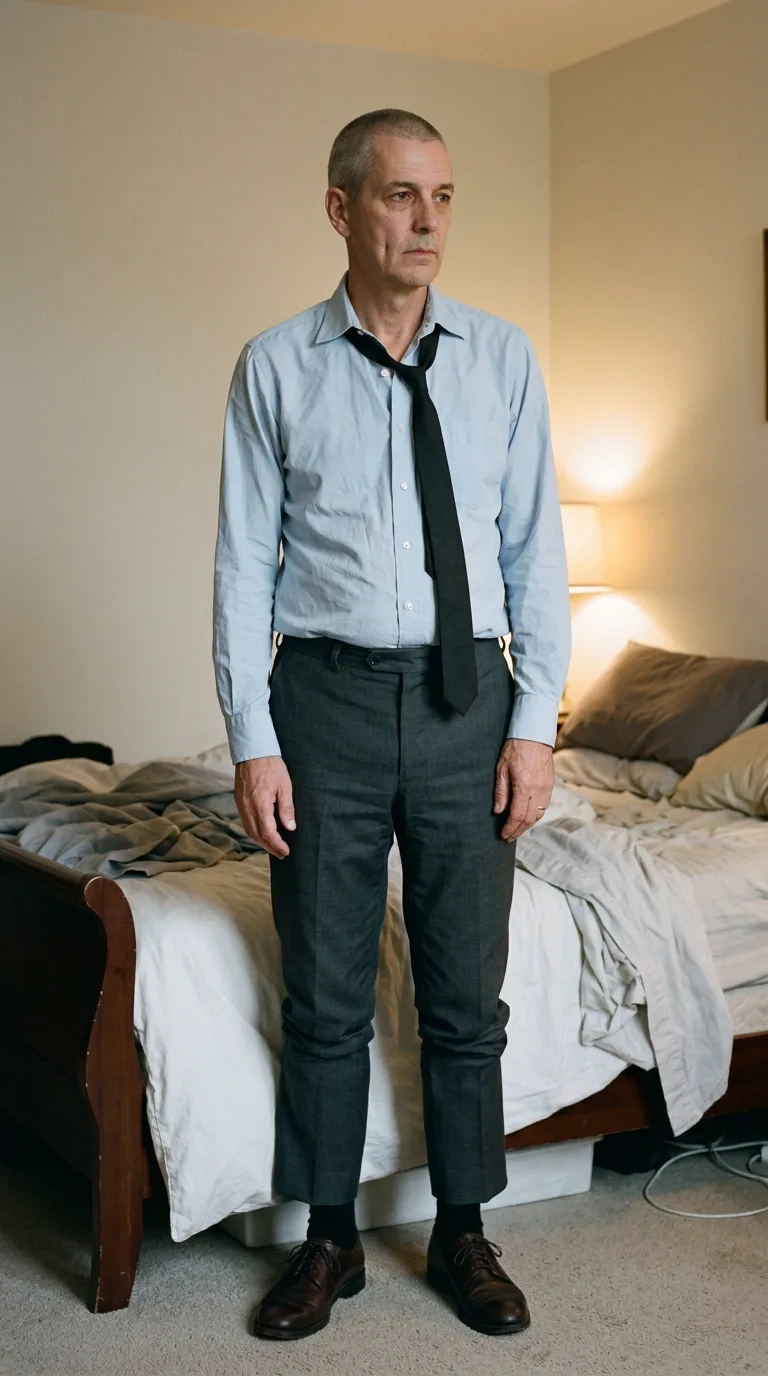
Rarest thing about him: A pack a day — rare, 1 in 18
Season 0seed 1143685876 · engine v10
Character card
lineage COEU7T
His body-swap story
@colin.tarwater, wearing Marcos Villanueva, rolled the wheel on and woke up as Walter Grzeski, spent under a minute in him, then spun the wheel and woke up as Gary Halvorsen
---
Marcos Villanueva's hands don't feel like yours yet, even after four minutes of standing in them. They're smaller than what you're used to, quicker, the knuckles scarred from a warehouse floor you've never walked. You're sitting on the edge of somebody's unmade bed on a Saturday that belongs to nobody you know, in an apartment that smells like instant coffee and drywall dust, and you already know you're not staying. It isn't boredom exactly — 25 is young, muscular fat has its uses, and you spent maybe ninety seconds enjoying the freckles in the bathroom mirror. It's that this body has a shift starting in three hours and a supervisor who will notice if Marcos doesn't show, and you have never once in sixty spins wanted to punch a clock as somebody else. You want the version of Saturday where nobody is waiting on you. You open the site on his phone with his thumbprint, which works because you are, for these seconds, his thumb. You spin.
The wheel is still turning somewhere behind your eyes when it isn't anymore, and you're standing at the foot of a bed you've never seen, in a bedroom lit gold from a lamp that should be off by now, and your hand — flat, wide, the fingers longer, the skin looser at the knuckle — is resting on your own sternum, feeling ribs that are not the ribs you had a second ago. The shirt under your palm is pale blue, half-buttoned wrong, the collar points crooked. A tie hangs open around your neck like it gave up on itself. You are much taller now. Everything aches faintly in a low, general way that has nothing to do with age and everything to do with something old.
The buttons go first. Your fingers — his fingers — find the misaligned one without your telling them to, undo it, redo it, and as they do, something comes up through the cotton like heat off a sidewalk: a narrow shop on a street with a green awning, the bell over the door, a boy — no, a young man, this young man — pinning a hem while an old Sicilian named Reyes barks corrections in two languages at once. Walter. The name arrives with the memory, stitched to it. Walter Grzeski, twenty-two years old, pins in his mouth, learning that a lapel roll is a decision and not an accident.
The shirt keeps talking. It's his good shirt, the one Marianne likes, and touching the placket brings back the morning eleven years ago when she stood behind him in this same bedroom — different paint, same bed frame — and retied a tie he'd botched three times, laughing at him, saying you can set a sleeve to the eighth of an inch and you can't do a four-in-hand, and him saying that's different, Mare, that's cloth that argues back. Your chest — his chest — does something at that, some old fondness sitting where a smile would be if the face weren't yours to command yet.
The tie itself, once it's in your hands, gives you more: not this morning but a thousand mornings, the felt memory of a half-Windsor his father taught him and that this closet, this life, has never once seen him tie any other way — until now, your hands doing something narrower, something with an extra pass, a knot from nowhere that Walter's fingers nonetheless complete with total, uncanny competence, because whatever is happening to him has not touched what his hands know. There's real skill down in that muscle. A tailor's hands don't forget, whoever's asking.
Standing there, weight settling into a body sixty years lived-in, you feel the rest of him arrive off the room itself — the carpet under socked feet is soft in a way that says a house with children raised and mostly gone; the low ache in one hip that has been wrong since a ladder gave out under him in 1994, patched by a doctor who called it good enough and meant it; the itch in his lungs that wants a cigarette before he's even downstairs. Three kids, or more — you get a flash of a table too small for the number of plates on it, someone's wedding, a graduation gown the wrong shade of blue — and a wife whose side of the bed is still warm-shaped in the sheets behind you. Skinny fat, sixty, dimples he didn't ask for and that show even now, at rest, like the face is fonder of the world than the man necessarily is this morning. The window light says late, which is wrong for a man who should already be at the cutting table — some Saturday delivery, a rush job, a groom who waited too long — and the wrongness of the hour sits in him too, a small hurry under everything else.
You look down. The hand on your chest has a plain gold band on it, worn thin on one side the way rings get when a man works with them on. It is not your hand. It has never been your hand. You turn it over once, slow, watching the tendons move like you're checking that they will.
"Okay," you say, out loud, to the empty room, in a voice with thirty-five more years in it than you've ever spoken with. "Okay."
Somewhere in Detroit, Marcos Villanueva's shift starts without him and nobody will ever explain why. Somewhere in this room, a wife is running water two doors down, thinking her husband is running late the way he always does on delivery mornings.
You reach for the vest hanging on the closet door, and you don't know yet if you'll still be the one wearing it tonight.