Walter Grzesiak
Fictional. Generated by AI — not a real person, and no likeness of one is intended.
47, waiter in Miami · rolled by @colin.hasbrook · card — no film
History
who has worn him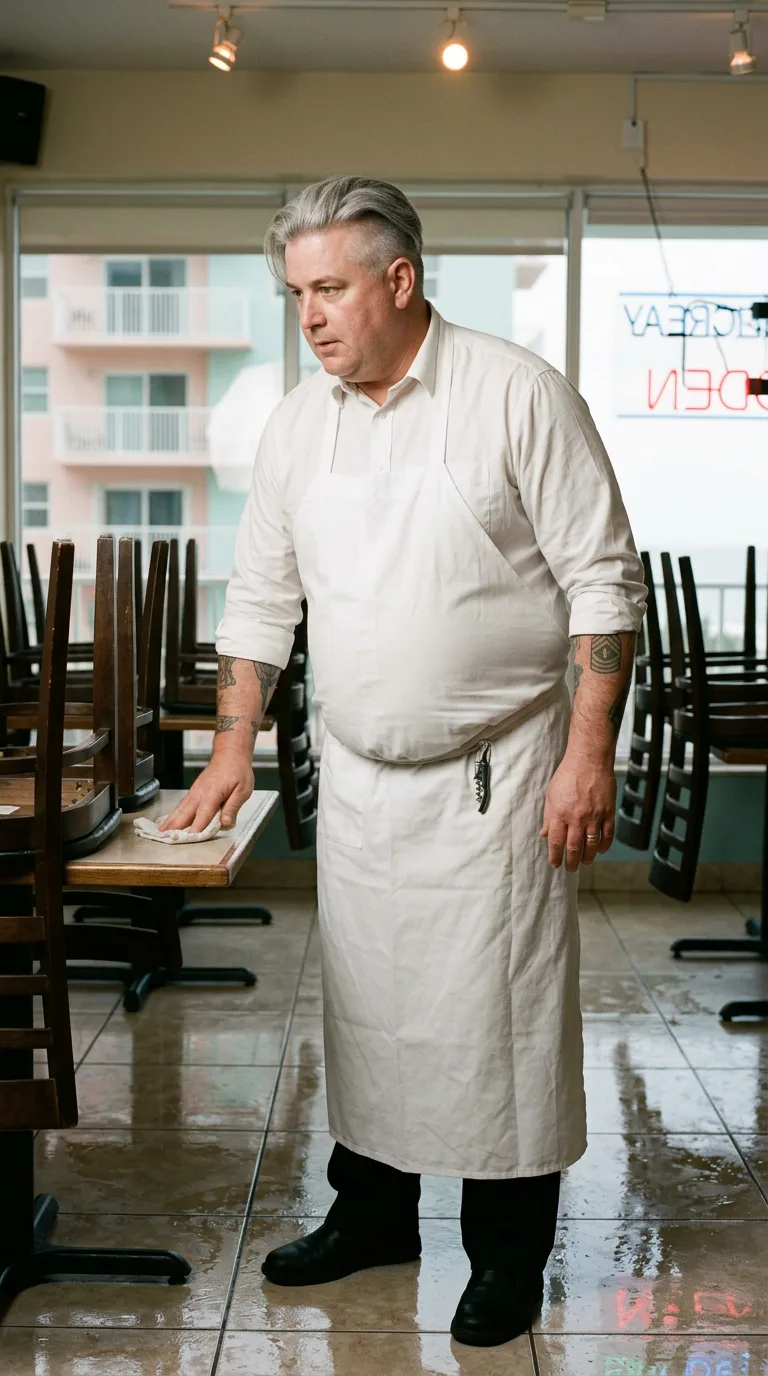
Rarest thing about him: An undercut — rare, 1 in 104
Season 0seed 1605068872 · engine v10
Character card
lineage 2NZHHJ
His body-swap story
@colin.hasbrook, wearing Nikhil Suresh, rolled the wheel on and woke up as Walter Grzesiak, spent under a minute in him, then spun the wheel and woke up as Paul Duszek
Nikhil's knees ache on the linoleum of a bathroom that isn't yours, though the wrench in your hand knows exactly what it's doing. You are thirty-five in this one, dark-haired, a nose that healed a half-degree wrong, and you have been him less than a minute and already you know the trouble with him: nothing. That's the trouble. He's easy. Good knees, decent back, a job his hands do without asking permission from your head, and a Monday morning off that stretches ahead of him like an empty parking lot. You didn't spin because Nikhil hurt. You spun because he didn't. Five hundred and seventy-six men and this one is the first that felt like waiting rather than living, and waiting is the one thing you never learned to sit through. You set the wrench on the lip of the tub, still warm from a hand that isn't yours anymore in about the time it takes to say so, and you go to the site the way you always do, alone, seated, sure.
The wheel doesn't ask why. It spins and it gives.
The rag is already moving under your palm — no, his palm — in small flat circles on a tabletop gone gray with rain-light, and the motion goes wrong once, a stutter, a smear instead of a wipe, and then it corrects itself, slow, deliberate, like a man relearning a thing he's done ten thousand times because someone is suddenly watching him do it. Ten more strokes come out checked. Counted. A job that hasn't needed checking since he was twenty-six.
You are standing in a heavy, tired body with a gut straining a white apron and boots that have stood on wet tile since four this morning, and the light through the window is the flat gray of an hour that shouldn't exist for a man on his feet — but here it is, this hour, this him, night shift bleeding into a morning that isn't his to be awake in either, not really, just the tail end of one that started at midnight and won't end till the lunch cover walks in.
The rag in your hand is the first key. It turns.
Walter, sixteen years old, wiping down his father's kitchen counter in Hialeah because his mother said so, resentful, already big for his age, already the kind of boy who got called *chief* by men twice his height. Walter, twenty, in a uniform that isn't the apron — the ink on his forearm arrives with a heat that has nothing to do with Miami: a rank he held, a unit he'd bleed for still if anyone asked, four years that taught him how to fold a shirt so it survives a duffel bag and how to stand very still while someone yells. Walter, twenty-nine, folding *that* into a memory instead of a life, hanging up the uniform for a black button-down and an apron string, telling himself waiting tables was temporary the way everyone tells themselves that.
The apron ties dig at your — his — soft belly, and that's the next key: the knot he tied this morning with his eyes half shut, three hours of sleep behind him, his wife Renata's voice still in the room though she was asleep, murmuring his name the way she does instead of good morning, a habit fifteen years deep that he never got tired of. The wedding band is warm on the hand that holds the rag. It comes with her — not a picture of her, a *weight* of her, laughter across a card table at somebody's quinceañera, the two of them younger, an argument in a Publix parking lot about money that ended in her hand flat on his chest, not pushing, just resting there. And under that, quieter, the ex — Deb — a name that surfaces like something left too long in a drawer, not guilt exactly, just a door he doesn't open, a version of nineteen he doesn't visit on purpose.
The boots know the floor before you do — twenty years of wet tile, a spine that complains on the stairs down to the walk-in, knees that click when the rain rolls in off the water the way it's rolling in now, fogging the glass, turning the neon sign backwards in the puddle by the door: SUGAR SHACK GARDEN, mirrored wrong, letters drowned. His hands, when they're not thinking, drum a rhythm against his own thigh, a leg that bounces under tables during the slow hour, a tell his wife teases him for. Two kids surface with the smell of the dish rag — bleach and old rain — a boy's height marked in pencil on a doorframe, a girl's laugh recorded once on a phone he still hasn't figured out how to back up. He hasn't had a drink since Saturday and he's proud of that in a small unspoken way, the way an ex-smoker is proud of every day he doesn't buy the pack. Catholic in the unshowy way — a medal somewhere in a drawer, not on him now, a habit of crossing himself once fast before the dinner rush like it's a superstition and not quite a prayer.
None of it is dramatic. That's what undoes you a little, holding it. Forty-seven years of a decent, tired, faithful life, worth less on paper than the boots he's standing in are worth to him, and none of it his to keep now.
You look down at the hand still holding the rag — thick fingers, a plain gold band, ink going soft-edged with age at the wrist — and you turn it over once like you're checking it's real, the way you always do, the way you have five hundred and seventy-six times before.
"Chief," you say, out loud, to no one, in his voice, testing the word like it might still fit somebody.