Wade Hollister
Fictional. Generated by AI — not a real person, and no likeness of one is intended.
38, farmhand in Small-town Ohio · rolled by @owen.prescott · card — no film
History
who has worn him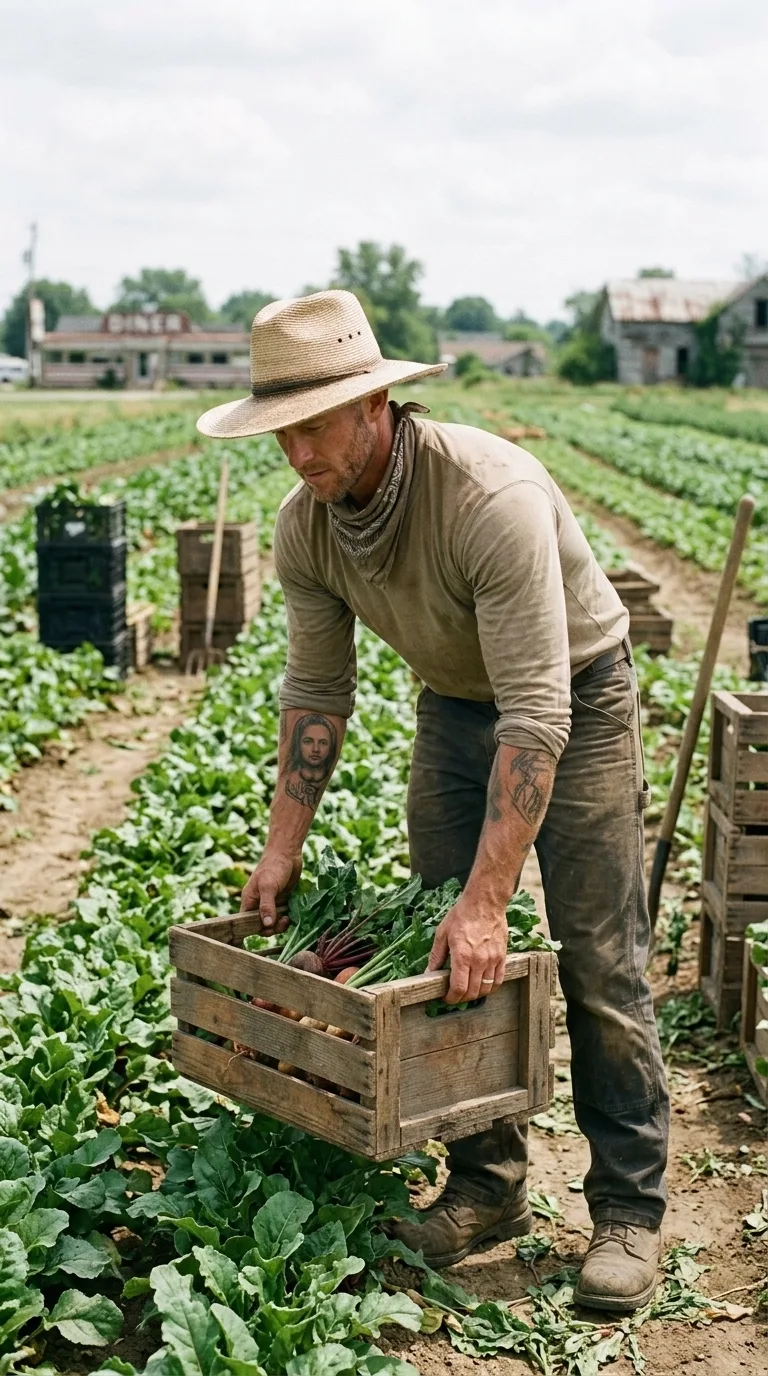
Rarest thing about him: Latter-day Saint — common, 1 in 64
Season 1seed 1508461041 · engine v11
Character card
lineage 5OR92V
His body-swap story
@owen.prescott, wearing Michael Dunleavy, rolled the wheel on and woke up as Wade Hollister, spent under a minute in him, then spun the wheel and woke up as Martin Soto Greer
You are standing in Michael Dunleavy's kitchen, and it is not yet light. His knees ache on the tile. The coffee he made has gone cold in a mug you do not like, and the freckled hand around it is a hand you have never once asked to be yours. Sixty-four years, and a bathrobe that smells of someone else's laundry. He had a whole life of mornings, and you took it before you had finished using it. The first minute was a thrill. The second was a mug of cold coffee and a window full of dark. You are not unhappy. You simply know, as you know your own name, that you want to be somewhere it is already midmorning and the work is going on without you. So you open the page. The wheel turns. Michael's kitchen goes out like a pulled plug.
Sun, all at once, on the back of a neck.
You are bent over a crate with your arms out, and the weight of it is already in your forearms. Beets, chard, the wet green smell of cut stems. Your back is warm. Your thumb has just slid wrong on the slat, a motion made ten thousand times and done wrong once. You set the crate down and lift it again slowly, right, the way a man would who has just been startled by his own hands. The body does it for you. Then ten more, each one checked, and the checking is yours, not his.
Now the shirt. It is damp across the shoulders, and the cuff is rolled twice, and the roll gives you a morning: a small kitchen, a woman's voice in the next room, two children arguing over a cereal bowl. He pulled this shirt off a hook because it was the soft one. He rolled each sleeve twice, left then right, while someone down the hall sang badly and he let her. A plain ring clicks against the crate's wood, and that gives you the evening he put it on, nervous, sweating, a church hallway with carpet the color of oatmeal. There is a feeling in it so large and quiet that you nearly set the crate down.
The bandana at your throat is stiff with dried sweat, and its knot is his: a flat knot, pulled left. It gives you a girl at a county fair, years back, who tied one on him as a joke. Not his wife. Someone before. He thinks of her once a year and never says so. It does not hurt. It is just there, a coin in a pocket.
Your thumb finds your teeth. The nail is already short, already ragged, and the habit is so complete that you have bitten before you notice. A taste of dirt and salt. Under it, his nerves, his small chronic worry about money, the school fees, the truck. The boots are heavy and broken in, shaped to feet that are not yours. The ground gives under them. The body is five foot six and dense, all of it packed low, and it is strong in a plain way no gym could teach: the hips, the grip, the long muscles of the back. A faint ache sits behind the left shoulder. Beyond the rows you can see the closed diner, its sign faded. He ate there on Sundays after church, before it shut. A booth, a daughter on his knee, pie.
You straighten. The sun is on your scalp, bare and warm. You turn your hands over, the ring, the ragged nails, the dark portrait inked on the forearm of a face he loved.
You look up and say, quietly, "Well. Hello, Wade."
Somewhere under the wanting, already, the next question is turning: how long does this one last?