Vincent Santangelo
Fictional. Generated by AI — not a real person, and no likeness of one is intended.
52, construction laborer in Philadelphia · rolled by @connor.waskiewicz · card — no film
History
who has worn him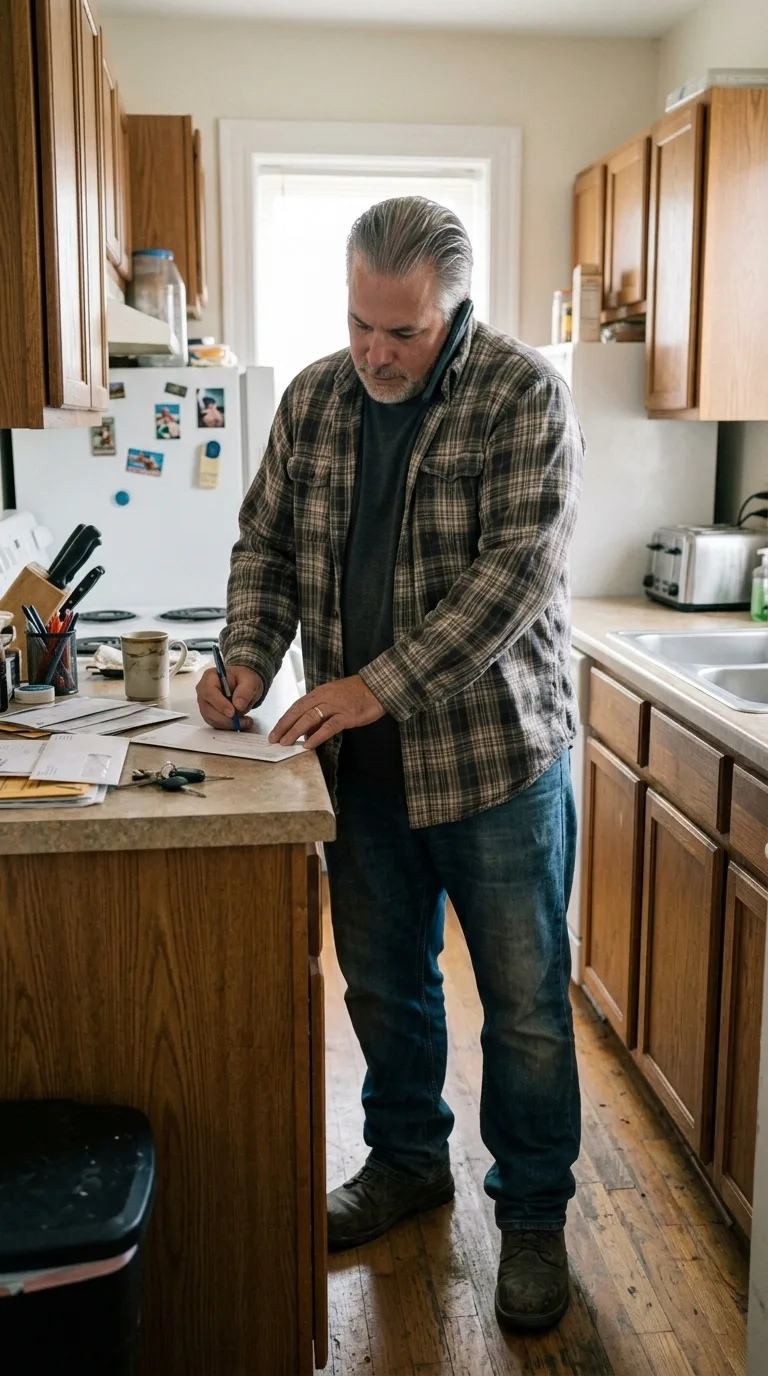
Rarest thing about him: On hold with someone — common, 1 in 70
Season 1seed 1348181555 · engine v11
Character card
lineage 2NZHHJ
His body-swap story
@connor.waskiewicz, wearing Frank Dolan, rolled the wheel on and woke up as Vincent Santangelo, spent under a minute in him, then spun the wheel and woke up as Karim Haddadi
You are standing in Frank Dolan's kitchen in Miami, and the fryer smell is still in his hair. He had been a man for under a minute when you decided. His knees hum from a shift you never worked. His green eyes catch in the toaster's chrome, and the dimples come up when you frown, which is somehow the worst part. He is fine. He works. It is not about him. Something under the ribs would not sit still, the way a tongue keeps going to a missing tooth, and you know the answer and will not say it. You open the page. The wheel is already turning.
Then the counter is under your left hand, laminate gone soft at the edge. A pen is in your right. The phone is warm against your neck, and a thin loop of music plays: a bar, a bar, the first bar again. The shoulder lets go. The phone drops into your palm and your thumb finds the envelope, and the pen has stopped on the second digit of a reference number. You do not start it again.
You are heavy and it is a settled heaviness, weight carried low, a belly pressed against the counter's edge. Your lower back has a dull, old complaint. The floorboards are cold and slightly uneven through the boots, and the kitchen smells of coffee gone stale in a mug and of dish soap.
The flannel comes first. Its cuffs are soft and pilled, and the cloth drags warm across your shoulder blades. A morning arrives in his hands, not yours. He is buttoning it in the dark at the foot of a bed, the middle buttons first because the top ones are stiff, and a woman's breathing is slow beside him. He lets her sleep. He thinks about the trench waiting and about how his knees will feel. He feels grateful, a plain gratitude with no words, that he gets to leave a warm room for work he knows.
Your thumb finds the ring and turns it. The gold is worn thin on the underside. A church basement comes, folding chairs, bad coffee, her laughing at something he said, and he was so scared. Then a long, quiet year in which they stopped waiting for a baby. The sorrow is old, smoothed over, carried like a stone in a pocket. It doesn't hurt anymore. It simply stays.
The keys on the counter bring a truck, a gearshift worn smooth, and a rosary swinging from the mirror. His mother's, black beads. He crosses himself at red lights without noticing. The envelope under your hand brings the weight of money, a house paid down, an account he never mentions, more than anyone on the crew would guess. He still eats a sandwich out of foil. He is not ashamed of any of it.
Then the shovel. The handle's worn grip lives in your palms: the D-grip, the bite of the blade into wet clay, the trench wall cool at his shoulder, the mini excavator ticking beside him while the spoil pile grows. His forearms know the rhythm without being asked. Down, lever, lift, turn. The body is strong in a stubborn way, a body that finishes things.
The music loops again. You lift your hand off the counter and turn it over. It is broad, with scarred knuckles, thick fingers, and a ring that does not belong to you.
You look up and say, to the window, to nobody, "Okay. Let's see how long you last."
Somewhere under the words is the question you can't answer: whether you are still him by tomorrow, or by lunch, or when the wanting comes back.