Vincent Lee
Fictional. Generated by AI — not a real person, and no likeness of one is intended.
44, electrician in Western Kansas · rolled by @colby.marsh · card — no film
History
who has worn him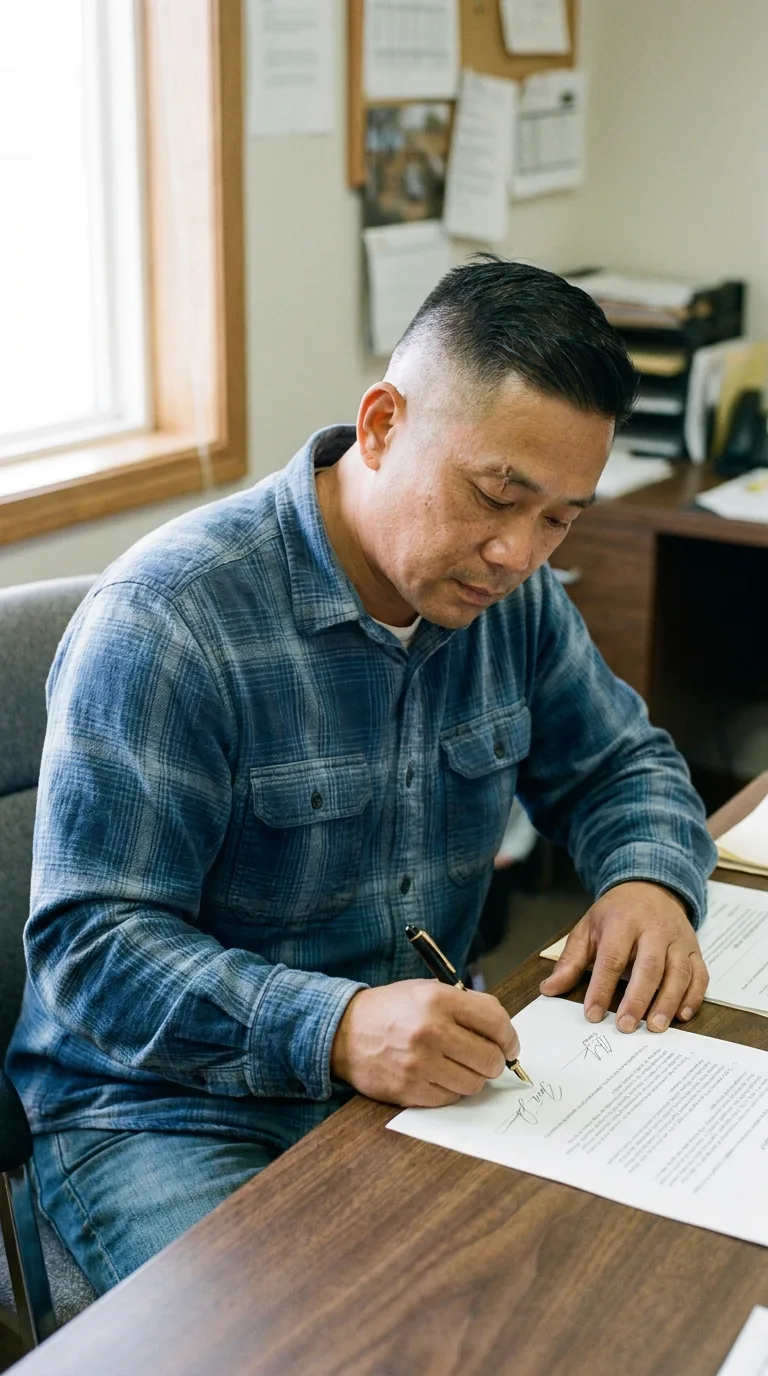
Rarest thing about him: Dark brown — rare, 1 in 14
Legacyseed 458398052 · engine v7
Character card
His body-swap story
---
You were the one who got the eyebrow.
That's how the story went in the family, and you let it go, because the story was better than the truth and the truth was only that you'd been eleven and he'd been nine and you'd swung the aluminum ladder around in the garage without looking. He never corrected anyone. He said he ran into the door frame. He said it so many times he probably believes it now, forty-odd years on, that pale line cutting up through the hair of his left brow like a seam in drywall that never got taped right. It's still the first thing anyone sees on him. You put it there. It's the only thing of yours he kept.
Everything else he built himself, out in Kansas, where the land is so flat that a thunderhead stacking up black in the west looks like a building going up. Vincent Lee, master electrician, license number he can recite in his sleep, four trucks, six guys, a shop off the highway with his name on the side in vinyl letters he squeegeed on himself because a sign guy wanted eleven hundred dollars. Half a million in the bank if you count the shop and the equipment, and he counts it every March like a man checking that the floor is still under him. You know all this. You know it because you asked, in the years when you were still allowed to ask.
He is a careful man. That's the thing about him you always came back to, the thing that made you crazy and the thing you'd have traded a lung for. Vincent labels the breakers. Vincent torques the lugs and then checks them again in the morning before he closes the panel. Vincent takes the little white pill every night at nine-forty with a glass of water and has for eleven years, no drama about it, no shame, the way he'd take a wire nut out of the pouch. He goes to Mass Saturday evenings because Sunday is the only morning he sleeps past five. He doesn't smoke, never did. He drinks maybe four times a year and stops after two. And he's alone in the house on the county road, because Ruthie left in 2013 and he has never once, in twelve years, said an unkind word about her, only that she wanted a life he couldn't make and he doesn't blame her for wanting it.
You were not careful. You were the one who went out to the world and came back needing things, and then came back needing more, and then came back and he stood in his own doorway with the storm door between you and said, Not this time, and you saw in his face that it cost him more than it cost you. That was the last time. There was a hospital after that, and a hallway, and a plastic bracelet with your name spelled wrong, and then nothing you can describe in any words that hold.
And then a room with a desk in it.
Here's what they don't tell you: it isn't hell that takes your papers. It's an office. Cheap paneling, a cork board with a fire-inspection card and somebody's kid's photo pinned crooked, a window with prairie light coming through it soft as milk. There's a chair. There's a man with a hand you never see the rest of. And there's a page with two signature lines and one of them already filled.
You signed first. You signed a long time ago, in the way that people like you sign — by wanting, by asking, by taking the shape of a hole and calling it a life. What you asked for was not to be dead and not to be nothing. What they offered you was a body, and you said yes before he finished the sentence, and only afterward did you learn whose.
Because the second signature has to be his. That's the whole architecture of it. They can't hand you a man; the man has to be handed over. So they went to Vincent, careful Vincent, in his own shop office on a Tuesday afternoon with the thunderhead coming, and they offered him something. You don't know exactly what. Something about you. Something worded in the way a man like Vincent — Catholic, guilty, forty-four and alone with the memory of a storm door between him and his brother — cannot walk away from. *Sign here and he isn't nothing anymore.* You know your brother. He read every line. Vincent reads every line, he checks his work, he has never in his life signed a thing he didn't understand.
Which means he understood.
That's the part that sits in you like a swallowed nail. He is not being tricked. He looked at the page in the yellow light off the window, and the pen was a good pen, a fountain pen with a gold nib somebody left on the desk like a joke about consequence, and he read what it said about a body being provided and no term specified and no provision for return. And he put his left hand flat on the paper to hold it steady the way he holds a junction box. And he wrote his name.
You watch him do it. From wherever you are — behind, beneath, in the seam of the room — you watch the top of his head, the fade tight at the sides, the gray coming in at the temple, the little dent of concentration between his brows and the scar riding above it. You watch his hand, which is your father's hand, calloused at the base of every finger, a thumbnail black from a hammer three weeks ago. You watch him finish the last letter and lift the nib and look at what he's done.
And you want to scream at him: *put it down. Tear it up. I made my own bed forty years running and I do not need your name on this, I never needed your name on anything, you have paid and paid and paid for one ladder swing that was mine.*
And you don't. Because you want it. God forgive you both — you want it, and you have wanted it since the second they said his name, and the wanting is the only thing that came through with you.
He caps the pen. There's a small click, and the sound of it is the loudest thing in the room. He slides the contract to the edge of the desk and a hand comes into the light and takes it and is gone.
And then he sits back a little, and lifts his eyes, and for about a second and a half your brother is simply a man alone in his office in Western Kansas with the wheat cut flat outside and the light gone yellow before the rain.
Then the light isn't outside anymore.
It comes up through him — through the eyes, the open mouth, white and hard, the way a service panel arcs when someone forgets to pull the meter. His head goes back against the chair. His hands open on the desk. The window rattles once with the front coming in.
Then it's out, and it's quiet, and the body is slack in the chair, and it is warm, and it is *breathing*, and the breathing is being done by you.
You come up into it the way a diver comes up. There's a weight in the left knee that he never mentioned to anyone. There's an ache behind the eyes that is eleven years of that little white pill wearing thin at four in the afternoon. There's the smell of him — sawdust and coffee and the cheap laundry soap he buys in the orange jug. There's his chest, and inside his chest is a thing you don't have a word for, a low steady hum of dread that has clearly been there so long he stopped calling it anything, and you understand all at once that *this* is what he has been carrying every day while you were out there taking. He never said. Careful Vincent. Never said a word about it.
You lift the right hand off the desk.
You turn it over. The palm is a map — the ridge under the fingers, the shine of old burn on the pad of the thumb, the crescent of grime under the nail that no soap gets. Forty-four years of a man doing it right. Your hand now. Your hand for good; there's no term on it, no door back, and the page that says so is already down the hall in a folder with your name spelled some way you'll never see.
You look up.
And the thing you are learning in this first second is that a stranger's face would have been mercy. A stranger's face you could have worn out into the yellow light and driven the truck and answered the phone *Lee Electric, this is Vince* and slept in the house on the county road and never once had to know what you'd taken.
But this is his. The eyebrow with your ladder in it. Your father's hand at the end of your arm.
*Thank you*, you say, out loud, in his voice, to the empty office, to the man who is not there to hear it.
And the rain comes on the metal roof like applause.