Vincent Kowalczyk
Fictional. Generated by AI — not a real person, and no likeness of one is intended.
40, diesel mechanic in San Francisco · rolled by @marco.villagrana · card — no film
History
who has worn him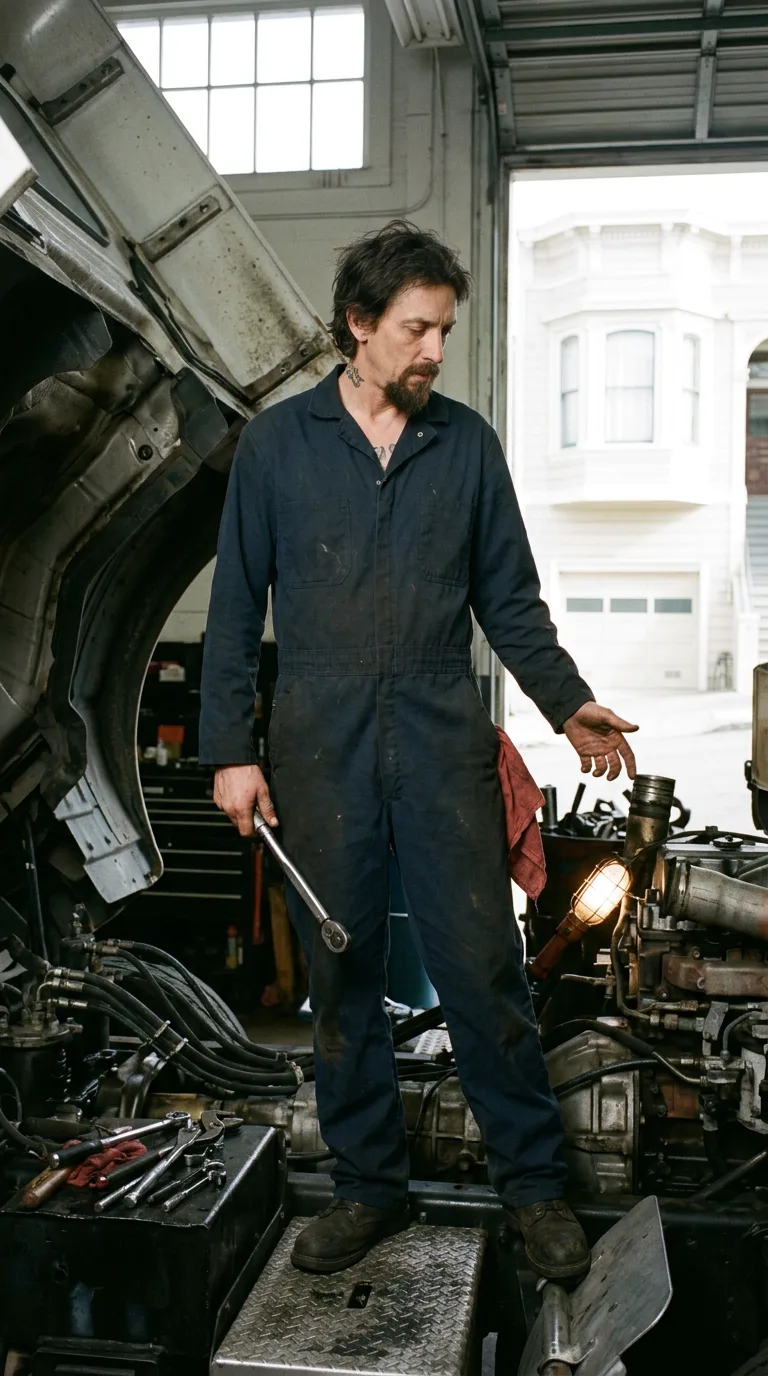
Rarest thing about him: Hand or neck (visible) — common, 1 in 87
Season 1seed 1841200463 · engine v11
Character card
lineage LJL8SV
His body-swap story
@marco.villagrana, wearing Samir Haddad, rolled the wheel on and woke up as Vincent Kowalczyk, spent 4 minutes in him, then spun the wheel and woke up as Dennis Wachtel
The line cook's station smells like char and citrus, and the body you're in tonight — Samir's body, twenty-four years old, quick-jointed, a burn scar healing pink on the left forearm — is good, is better than good, but you have been standing at this same steel counter for twenty-three hours and nine minutes portioning garnish into ramekins, and the sous chef keeps saying your name like he's testing whether you'll answer to it. You will. You do. That isn't the problem. The problem is you know this shift by heart already, the tickets, the exact rasp of the expo's voice, and knowing a life by heart is the thing that always sends you looking for the wheel again — not hunger exactly, more the itch of a rerun. Athletic, handsome, twenty-four: it should be enough to want to keep. It isn't. You wipe your palms on your apron, tell the line you need the bathroom, and thumb open vessel.cards under the prep counter, screen light green off tile, and spin with the same half-laugh you always have, like it costs you nothing, because tonight it doesn't.
You come up standing on a toolbox lip, a foot off the ground, ratchet wrench heavy and cold in your right hand, half your weight already leaning into a turn that was finished ten thousand times before and is, this time, wrong — the socket walks off the head and skins a knuckle you didn't feel skin. You stop. You do it again, slow, correct, the click of it seating right. Then again. Then eight more times after that, each one checked like you don't trust your own wrist, on a fitting that hasn't needed checking in years. Somewhere above and behind you there's a window full of white afternoon and the shape of a bay house across the street, and under your boots the diamond plate is cold through the soles, and the engine in front of you, half-swallowed by its own open hood, breathes diesel and hot rubber into your face.
The coverall against your back is the first thing that talks. It comes in like weather — a Tuesday morning, dark still, the zipper stuck a third of the way and you working it with two fingers the way you always do, cussing it low so as not to wake anyone, coffee going cold on the dryer. Left arm in, then right, the fabric gone soft and thin at the elbows from years of the same motion, stiff across the shoulders where it's newer. You remember, not as a fact but as a feeling in the shoulders themselves, that you bought this one because the last one finally tore through at the knee kneeling on gravel, and Teresa laughed at you for mourning a coverall, and you let her, because some part of you does mourn things like that, quietly, the way you mourn most things — the two kids' shoes by the door getting bigger every few months, your own knees going.
The wrench in your hand brings its own weather: the particular ache low in the right shoulder that's been there since a transmission fought you for forty minutes in November, and under it, deeper, a whole education — apprentice at nineteen, hands too eager, burned twice in a month and told by an old man named Iggy that eager hands are stupid hands, slow down, feel the bolt instead of fighting it. You feel that now, encoded in the wrist, the wrench moving like it has opinions of its own. Gum, gone flat, sits forgotten against your back teeth — you chew without deciding to, always have, since you quit the cigarettes the year your first kid was born and needed somewhere for your mouth to go.
The neck tattoo itches faintly where sweat's gathered under the collar, and that brings a flash hot and fast — a bar in the Mission at twenty-six, a dare, a design picked too quick off a flash sheet because you liked how it looked on someone else's arm, and Teresa's face the first time she saw it, not angry, just quiet, like she was recalculating who she'd married. She married you anyway. Twice now you've stood in the church on Guerrero at Christmas with her and the kids and felt like a fraud and felt, underneath the fraud feeling, steady — Catholic the way a man is Catholic when he stopped examining it around fifteen and it just stayed load-bearing. The wedding band on your left hand is warm from your own skin, plain, a little loose now that you've lost weight you didn't mean to lose, and it carries the wedding itself, brief and cheap and exactly right, her sister crying more than anyone.
The red rag stuffed in your hip pocket smells like solvent and carries almost nothing, just the dumb comfort of a thing always in reach. The bay's cold light and the diesel smell together bring the shift itself, hour on hour of it, the ordinary tiredness of a body that drinks big maybe twice a month and otherwise just works, that used to smoke and now chews gum instead, five foot five of it, soft through the middle in a way the coveralls hide, forearms and grip gone hard and sure from twenty years of exactly this. Nothing wrong with him. Nothing special either. Just a man standing on a toolbox in his own afternoon, married, employed, tired in the shoulder, gum gone flat in his mouth, worth whatever's in a modest checking account and a house he doesn't own outright, and none of it was ever going to be yours until it suddenly, entirely, is.
You look down at the hand holding the wrench — the skinned knuckle, the black tribal ink, the ring loose on the finger below it — and you turn it over once like you're checking it's attached.
"Okay," you say, out loud, to the empty bay, in a voice that isn't the one you walked in with. "Let's see what you've got."