Travis Wade Thibodeau
Fictional. Generated by AI — not a real person, and no likeness of one is intended.
36, farmhand in Nashville · rolled by @caleb.dean.whitfield · card — no film
History
who has worn him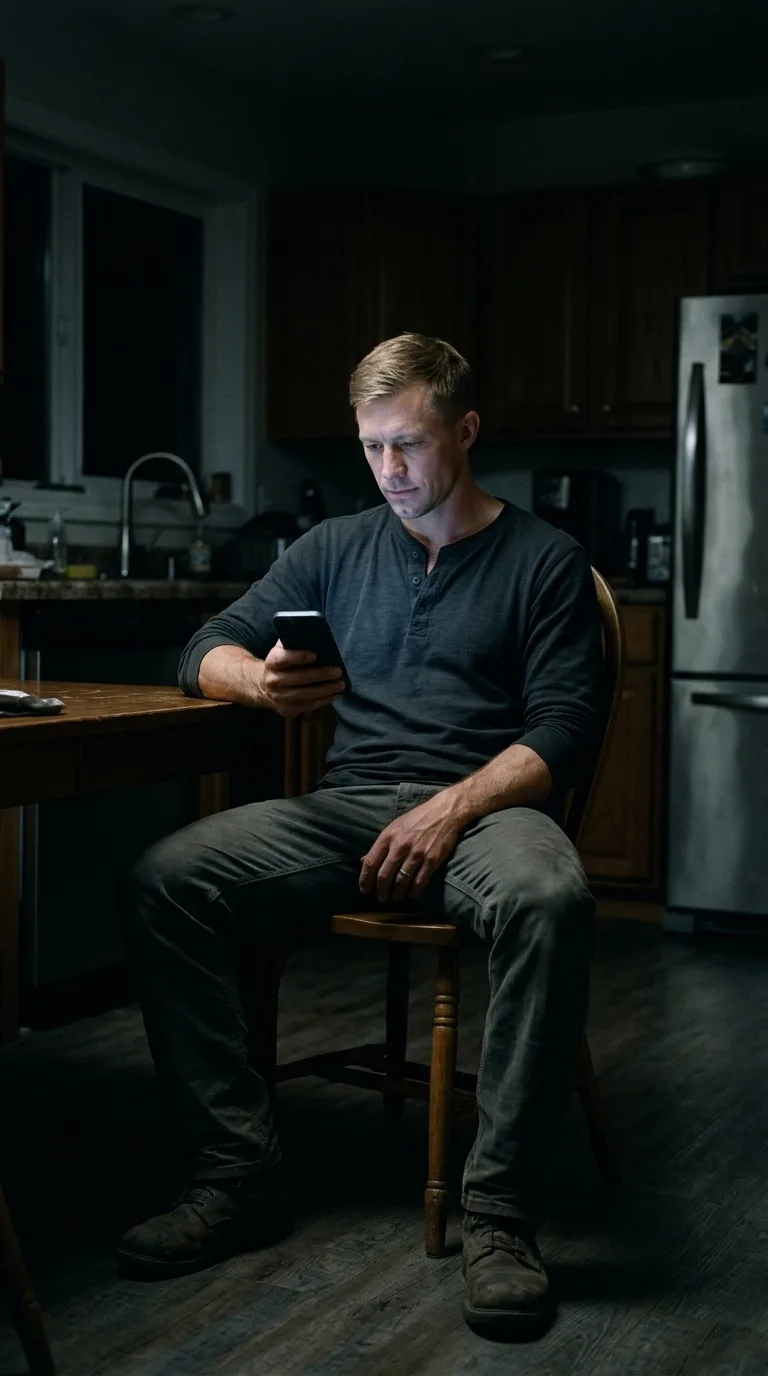
Rarest thing about him: Scrolling a shop he cannot afford — common, 1 in 54
Face-off rating 1501 · not ranked yet
Season 1seed 375347704 · engine v11
Character card
lineage A8GP7H
His body-swap story
@caleb.dean.whitfield, wearing Rigoberto Salcido, rolled the wheel on and woke up as Travis Wade Thibodeau, spent 2 minutes in him, then spun the wheel and woke up as Marcus Leon Whitaker
HIS LAST NAME IS Thibodeau.
HOOK: He scrolls watches he can't afford, and someone else arrives.
Rigoberto's moustache is still on my lip, and the welder's blue eyes are still looking at a screen in a dark Denver kitchen. I have been him for less than a minute. His birthmark itches under my thumb. Nearly midnight, a Thursday, and I already know what sent me back: I went looking for something in his phone and found nothing. His wife's number is saved under her first name only. He had nobody to call for the rest of the night, and I have no one either. So the wheel, again.
Twenty-two minutes ago I was Dennis, the janitor in Maine, with the mop-bucket wrists and the freckles. I knew a son existed in Nashville because a drawer in Dennis's kitchen held his letters. One was never opened. I remember the name on the envelope and the weight of it. That is why I pay, spin, and let the card fall.
The scroll stops on a price. His thumb lifts from the glass and stays lifted.
I am in a chair in a dark kitchen with a phone lit in my left hand. The wooden slats press my spine. My jaw is smooth and my chin has a cleft I can feel with my tongue. A toothpick is crushed flat between my back teeth, and I did not put it there. The refrigerator hums. The house is asleep, and the window is black.
The henley is soft and warm against my arms, and the first thing it gives me is a morning: his hands doing the three buttons, slowly, on a day he meant to call someone and didn't. The sleeves were pushed to the elbow while he sat in a truck at the end of a row, crates stacked behind him, the harvest in his shoulders. The jeans are stiff at the knee. They carry the field, and under it, the court-house hallway, the day he signed. My ring finger has a pale band on it. When my thumb finds the place, I feel her: the ex-wife, laughing in a different kitchen, and a child's weight on his chest, one child, asleep, a small hot head under his chin. His ache comes up whole. It is his, not mine.
The chair holds me. My legs are long and strong, the thighs hard from rows and lifting. My knees ache a little. His liver is tired and his mouth wants a drink; the want is old and polite. I think of church, of a kneeler under his knees, of Dennis in a pew in Maine. Dennis never came to Nashville. Travis never went home. They sent each other nothing, and the silence was a kind of loyalty.
I set the phone face-down on the counter. My hand stays there, flat.
I turn it over. It is a big, scarred, patient hand, and it is mine now. I lift my eyes to the dark window, to the glass that gives me back his face, and I say, quietly, "Hello, Travis."
How long do I get you? The wanting has not come back. It will.