Tom Brennick
Fictional. Generated by AI — not a real person, and no likeness of one is intended.
44, carpenter in San Francisco · rolled by @connor.waskiewicz · card — no film
History
who has worn him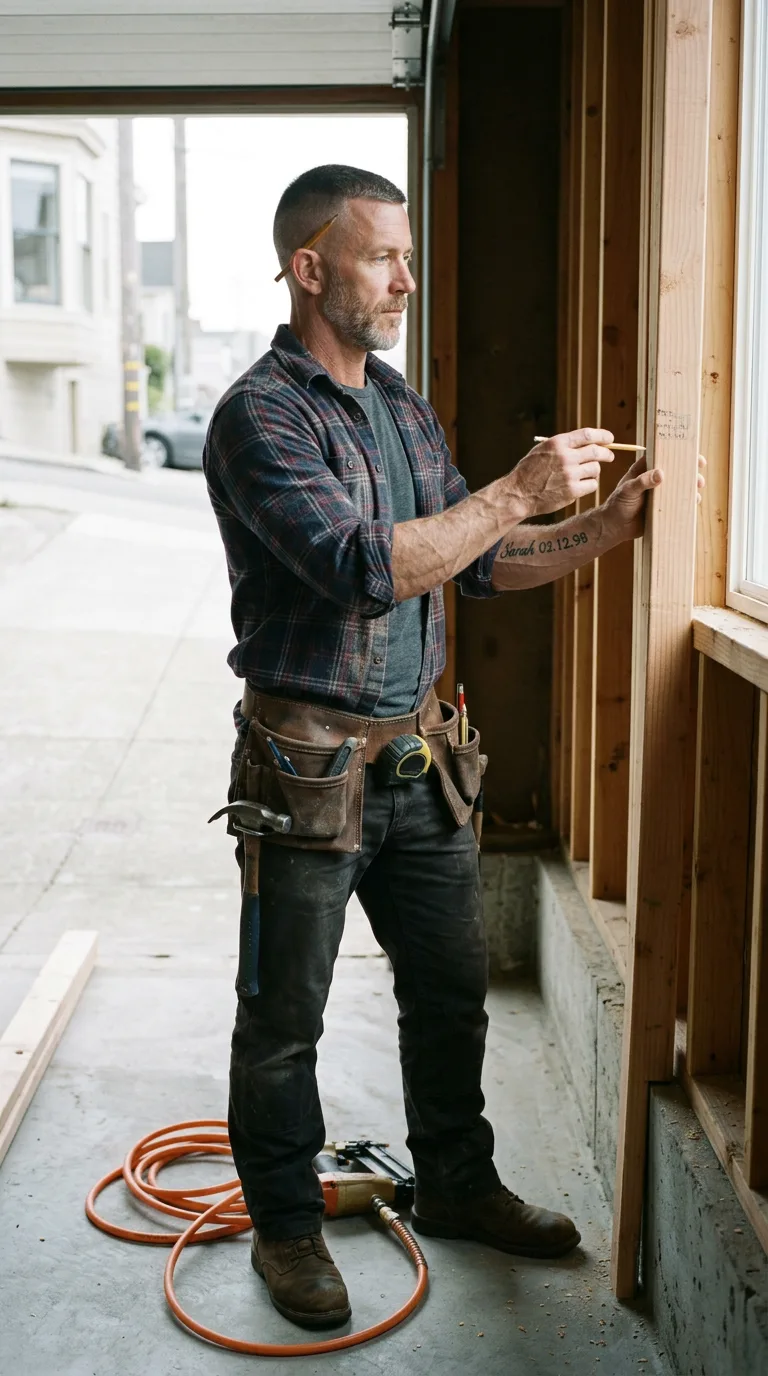
Rarest thing about him: Pulls at his beard — epic, 1 in 365
Season 1seed 1081363305 · engine v11
Character card
lineage 2NZHHJ
His body-swap story
@connor.waskiewicz, wearing Neil Garrity, rolled the wheel on and woke up as Tom Brennick, spent under a minute in him, then spun the wheel and woke up as Chad Boudreaux
Neil Garrity's thumbs are still sore from the phone. Forty-one years old and soft at the middle, he stands in a kitchen in Seattle with a coffee going cold, and he is already wrong for you. Nothing is broken in him. He came with a pleasant face, dimples, one eye brown and one pale, and a sample case by the door. All morning you have been the man who is good at lunch. You sat in a parking lot for twenty minutes before the first call and could not make yourself open the car door, because nothing in him wants anything you want. His wanting is small and warm and it has a dental office in it. So you put the cup down and open the page with the wheel, and it turns, and Neil is a coat you leave on a chair.
Cold white light, and a pencil in your right hand with its point against wood.
You are standing in a garage below a bay window, with the street dropping away steeply outside the open door. The slab is damp under your boots. The air smells of cut fir and old concrete. You had been moving, and your arm finishes the motion without you: a mark on the stud, one stroke, wrong. It lands a quarter inch off the line. The arm stops and does it again, slowly, and it lands true. Then ten more marks, each one checked against the tape before the pencil lifts, as if the arm has only just learned to doubt.
Your other hand is flat on the framing. The grain is rough and warm, and through the palm something comes up that is not yours.
A Saturday, years back. This same hand holding a much smaller one against a stud, a girl's, the pencil wobbling in it, and a pride in him so large it embarrassed him. *Right there, Bean. Now it's a wall.* He had gone inside after and stood at the sink, and been unable to say why.
Your thumb finds the beard and pulls at it. The hair is close and coarse, and the gesture is so old in him that it happens before you know. With it comes the smell of a cigarette he quit nine years ago, and the particular ache of wanting one at the end of a hard cut, still, on some afternoons.
The flannel is stiff with dust across the shoulders. You feel the morning in the sleeves: his arms going in one at a time in a dark bedroom, her breathing beside him, a button done wrong and redone. He rolled the cuffs twice, left then right, and stood a second looking at nothing. The belt is heavy on the hips, and the hammer knocks his thigh when you shift. The leather has been shaped by him. Your knees are forty-four years old and complain on the way down toward the board. Your shoulders are not complaining at all. They are thick and quiet, built by lifting.
You turn your left arm. Inside the forearm, in script, a name and a date. Reading it brings her laugh, a hospital corridor, and a night he drove too carefully home. Under the band on your finger the skin is paler. He drinks a glass or two in the evening, on the back step, and counts nothing.
The hose lies coiled at your foot. The nail gun waits. Somewhere above you, a floor creaks, and it is the house he is working under.
You hold your hand up in the light and turn it over. It is square, scarred nowhere, steady. Then you look out at the street, and say to the empty garage, "Okay. Let's see how long you last."
You don't know whether that is to the wall, or to him, or to yourself.