Thomas Rudnick
Fictional. Generated by AI — not a real person, and no likeness of one is intended.
61, accountant in Chicago · rolled by @connor.waskiewicz · card — no film
History
who has worn him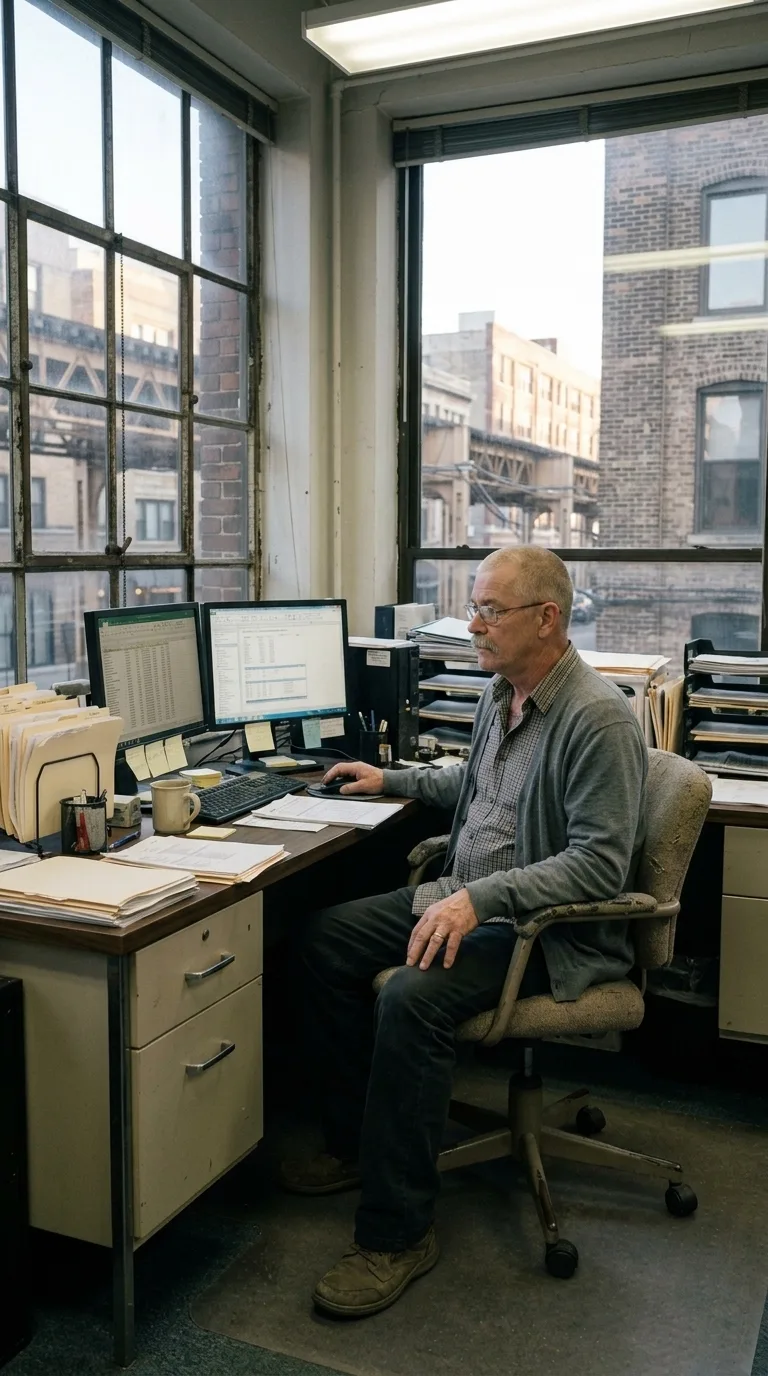
Rarest thing about him: Back piece — common, 1 in 80
Season 1seed 1974684628 · engine v11
Character card
lineage 2NZHHJ
His body-swap story
@connor.waskiewicz, wearing Isaiah Fontenot, rolled the wheel on and woke up as Thomas Rudnick, spent under a minute in him, then spun the wheel and woke up as Marco Delgado
You are Isaiah Fontenot for seven more seconds, standing in a dark kitchen in High-desert Nevada with a bricklayer's forearms braced on the counter. Seven minutes you've worn him. The scar through his eyebrow itches. His hands are good, and strong, and when you flex them the knuckles answer like well-oiled hinges. There is nothing wrong with him.
That's the trouble. You went to the sink for water and found you didn't want it. The mortar dust sits in the creases of his palms, and you stood looking at them thinking: I know exactly what these do. Nothing in here can surprise me. The cold of the tile came up through his bare feet and was only cold. So the phone is in his hand, the page with the wheel is open, and your thumb, his thumb, is already moving.
The wheel ticks past. It slows.
Fluorescent hum. You are sitting, and your right hand is on a mouse, moving, a task done ten thousand times. The cursor jumps a cell the wrong way. You stop it. You go back and do it again slowly, correctly. Then ten more, each one checked, though this sheet hasn't needed checking in years. Behind the glass the L tracks run gray along brick, and the morning hasn't started yet.
Your chair creaks. The cardigan sleeve is rough wool against your wrist, and when you shift, the plaid shirt pulls across a back that is not bare: something is written there, and the shirt knows it.
The mouse is warm and worn smooth at the left button, and it gives you him. He buttoned this shirt in the dark in a quiet house, left to right, fingers slow because the top button always fights him. His wife's breathing in the next room. He stood a moment in the hall by the closed door of a child's old bedroom, and something in his chest turned over, fond and sore.
The mug by the keyboard has a chip at the handle. Your thumb finds it, and you get years of coffee, and a night shift in tax season, and the dull pride of numbers that balance. You get a drink or two in the evening, rye, the glass set on the same ring in the wood. You get a church, cold stone, the smell of wax, his knee complaining as it meets the kneeler.
Your left hand has gone into the cardigan pocket and closed on something small and metal. A lighter. Your thumb flips the lid, snaps it, flips it. He never smoked. He carries it anyway, and the click arrives with a girl's laugh, long ago, a porch, a summer, a woman he didn't marry and still thinks of some Tuesdays. His feeling, not yours: ache, without regret.
Under the shirt the date and name on his back press as the chair does, and you don't need to read them. You know them the way you know your own, by weight, a grief he chose to carry in ink. The tongue finds a gap between the front teeth. His knees are sixty-one years old. His shoulders are stiff, but the eyes behind the glasses are tired and sharp, and the breath comes slow and easy.
You lift your right hand off the mouse and turn it over. A plain gold band on the left. Wide knuckles, gray hairs, a pen callus. Not a bricklayer's hand. Not yours. Not anybody's yet.
You look up at the window, at the tracks, at the dull light.
"Well," you say, in a voice that is rougher and kinder than you expected. "Hello, Tom."
The lighter clicks shut in your pocket. How long, you wonder. Until the wanting wakes. You listen for it, and for now it is quiet.