Terrence Whitfield
Fictional. Generated by AI — not a real person, and no likeness of one is intended.
47, delivery driver in Small-town Ohio · rolled by @connor.waskiewicz · card — no film
History
who has worn him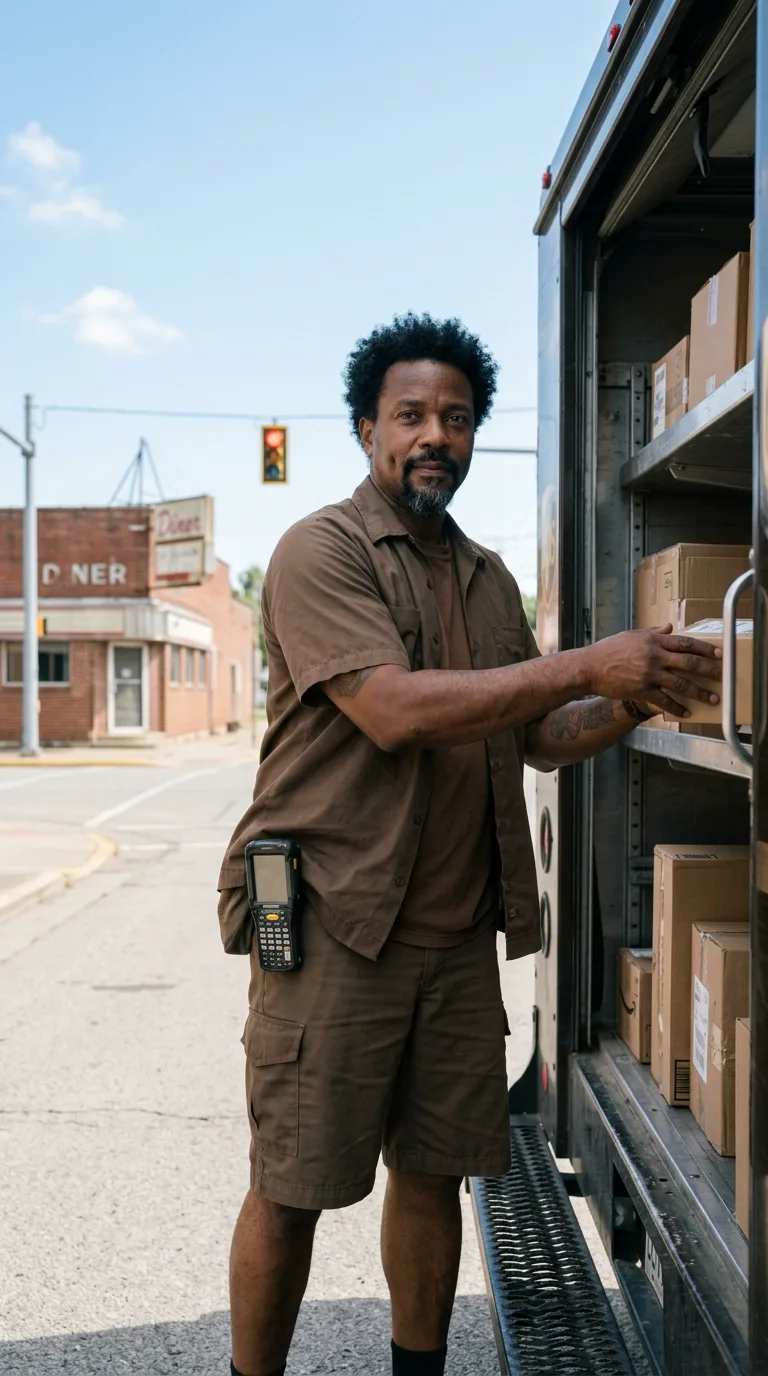
Rarest thing about him: Goatee — common, 1 in 13
Season 1seed 920878866 · engine v11
Character card
lineage 2NZHHJ
His body-swap story
@connor.waskiewicz, wearing Evan Kozlowski, rolled the wheel on and woke up as Terrence Whitfield, spent under a minute in him, then spun the wheel and woke up as Glenn Sorensen
Eleven minutes in Evan Kozlowski, and he is already too light. Twenty-six years old, six feet of skinny, and the freckled forearms keep surprising you by how little they weigh. The listing on the screen says nothing, and the screen is a client's kitchen in Shadyside, and he has been standing at that counter nodding at a woman about granite. His stomach is a clean, empty bell. His knees do not hurt. That is the trouble. Nothing hurts and nothing in him is a question, and the thing that sent you back to the wheel is not the granite. It is the quiet. You would not say it out loud. You step into the pantry as though for a glass, the phone already open in the hand that is not yours, and the wheel turns its colors over, and you press.
The brother. You know the name when it lands, before anything else does: Whitfield, Marcus's, the one you wore five spins ago in Atlanta, for less than a minute. You do not know this one. You only know the one he shares a surname with.
Then you are standing in sun.
Your right arm is out, flat against a cardboard side, the palm pressing. The weight arrives all at once: five foot eight of a forty-seven-year-old man settled low in the hips, a dull coin of ache under the left shoulder blade, the back of the knees warm. Air smells of hot rubber and tar and cut grass. A steel step is under the soles of heavy shoes. Across the street a brick building says DINER over a door that has not opened in a long time, and the one traffic light hangs red over an empty road.
Your hand did something wrong a half-second ago. You felt it: the box was set crooked, the label turned inward. You take it out and do it again, slowly. Label out. Edge square. Then ten more, each one touched twice, checked, on a shelf that has not needed checking in years.
The shirt starts first. Brown cotton, soft with washing, stuck at the shoulder blades with sweat. A flash comes up through the fabric, his and not yours: a bedroom, gray at the window, his thumbs working buttons from the bottom because the top one always sticks, the left cuff rolled twice, always twice, and a quiet in the house that he has stopped noticing. The shorts are stiff along the seams. Cargo pocket, the flap's Velcro rasping, and with it a drawer of identical pairs, a man who never has to decide anything in the morning and likes it. The scanner at the hip knocks against the bone, and under your fingers its rubber grip hands you a thousand porches: dogs, screen doors, an old woman who gives him a peach every August and watches him eat it. He says her name aloud on the porch in his memory. You cannot catch it.
You touch the shelf rail. Cold steel, a grit of dust, and he is nineteen, loading his first truck, frightened of being slow. Then the money: a savings account, a number he checks on his phone and never says to anyone, enough to feel like a door, not enough to walk through. No wife in any of it. No one at the end of the hall. Only Marcus, a voice on a phone on Sundays, easy and far, and Terrence laughing at something Marcus said, the dimples cutting both cheeks. You can feel them now, deep, resting there even while you are not smiling. Your calves ache in a way that is honest. Your hips are used. He has never had a drink, and his mouth is clean and dry and tastes of the mint from lunch.
You lift your hand off the box and look at it. Broad, dark, creased across the knuckles, the pad of the thumb hard as a boot sole. Not Evan's. Not the one you wore in Atlanta either, and you know that one. You turn it over. A pale line of cardboard dust runs through the palm.
You look up at the empty street, at the red light that has not changed.
"Well," you say, in his low, easy voice. "That's one more."
The light stays red. Somewhere under your ribs, small and patient, the wanting is already turning over. You do not know how long you have him.