Suresh Venkataraman
Fictional. Generated by AI — not a real person, and no likeness of one is intended.
65, accountant in Small-town Ohio · rolled by @connor.waskiewicz · card — no film
History
who has worn him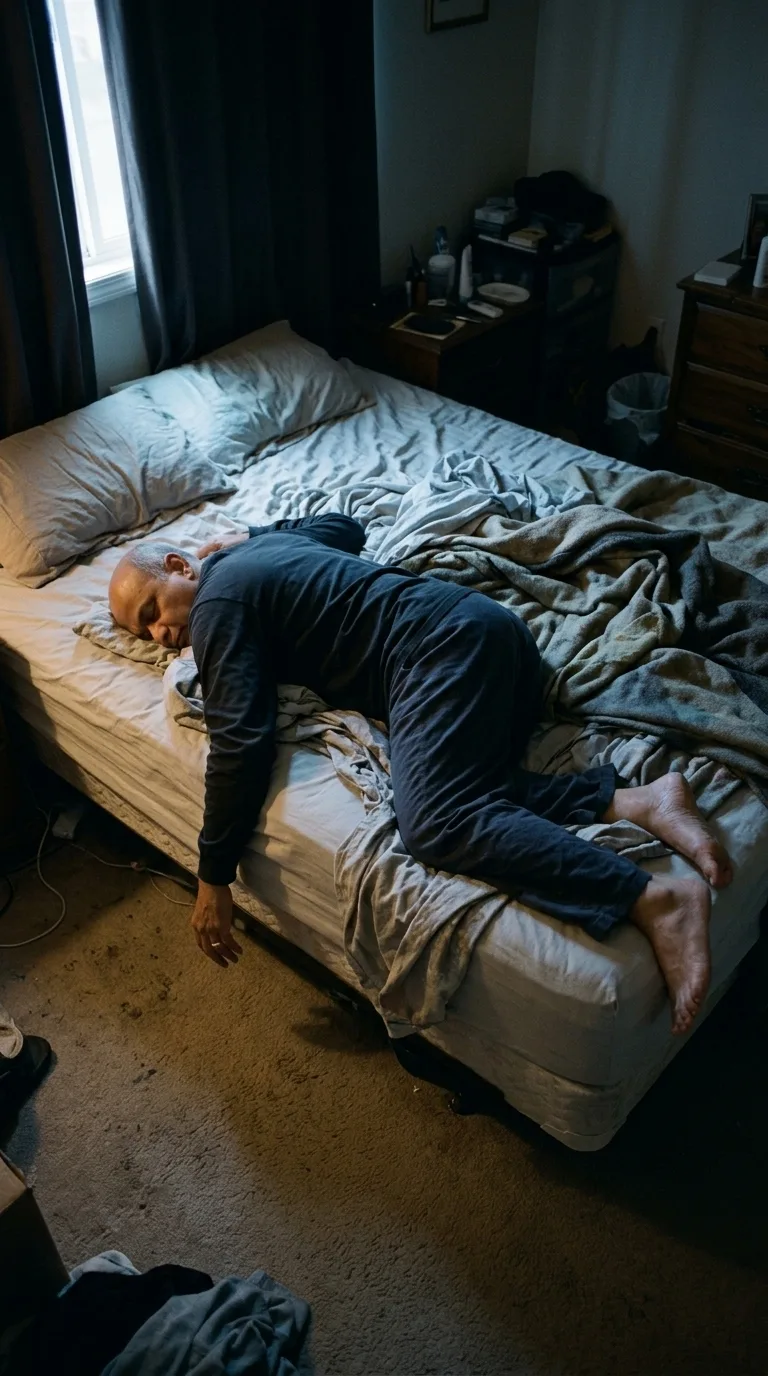
Rarest thing about him: Hindu — common, 1 in 82
Season 1seed 1754781059 · engine v11
Character card
lineage 2NZHHJ
His body-swap story
@connor.waskiewicz, wearing Harlan Gaines, rolled the wheel on and woke up as Suresh Venkataraman, spent under a minute in him, then spun the wheel and woke up as Daniel Wong
You are standing in Harlan Gaines's kitchen, in a house in Eastern Kentucky where everyone is asleep, and the man you are wearing has a glass of water going warm in his hand.
He is heavy and sixty and his knees have opinions about the linoleum. Down the hall a woman he aided for six years has been dead for eleven days, and her son's voicemail is still on his phone, asking whether he could come Thursday and help box the closets. You listened to it twice. That was the whole reason. Nothing was wrong with the body. It lifted, it carried, it was patient with the dying. It was just that on the second listening you felt the weight of being needed settle on you like a wet coat, and you wanted, badly, to be a man nobody was waiting on.
So you set the glass down on the counter, thumb the phone awake, and press the wheel.
The arrival is a floor dropping out in the wrong direction. The kitchen is gone and you are lying on your stomach in cotton, one arm hanging into cool air, a streetlight laying a thin stripe through the curtains. Your breath is ragged and then, in one pull, it is even. Your arm draws itself up. You roll onto your back and your hands fold on your chest, and you lie there in the shape of a man laid out, which he has never once slept in.
The sheets come first. Cotton, worn soft, a little damp at the collar. You are touching them and something rises that is not yours: his wife, Padma, turning toward the wall on her side of this bed, thirty-four years of a particular back, and him learning not to put a hand on it when she is angry. A fight about the roof. Not about the roof.
The pajama sleeve against your wrist: navy, a gift from the eldest, a daughter, who bought it in Columbus and called it "dad-proof." He laughed and wore it the same night, and the laugh is in your chest now, small and dry.
Your hands, folded. They tremble, fine and constant, like a wire in wind, and the trembling has a feeling he has trained himself not to look at. Under the right thumb is the band on the left hand, plain gold, and when you turn it a flash opens: a woman on a porch in Chennai, long before Ohio, laughing with her hand over her mouth, the one who got away. He has not said her name aloud in forty years. He says it now in the back of his throat, and it tastes like the cigarettes he gave up, the last of which he smoked standing in a parking lot behind the firm the day his third child was born.
The mattress under your shoulder blades sags exactly where he sags. The ceiling holds a stain shaped like Ohio, which he has pointed out to no one. Down the hall the furnace ticks. His heart is slow and a little tired, and it is rich in a quiet way: two monitors, a spreadsheet of other people's fears, tax season in the neck, a closed diner on a street with one light that he keeps meaning to mourn.
Then you lift your hands into the stripe of streetlight. You turn them over, and the trembling does not stop.
"All right," you say, in a voice that is higher and softer than the one you left. "All right, Suresh."
Somewhere under it the wheel is already warm, and you cannot tell whether you will hold this man until morning or until you next close your eyes.