Suresh Venkataraman
Fictional. Generated by AI — not a real person, and no likeness of one is intended.
50, engineering manager in Denver · rolled by @owen.prescott · card — no film
History
who has worn him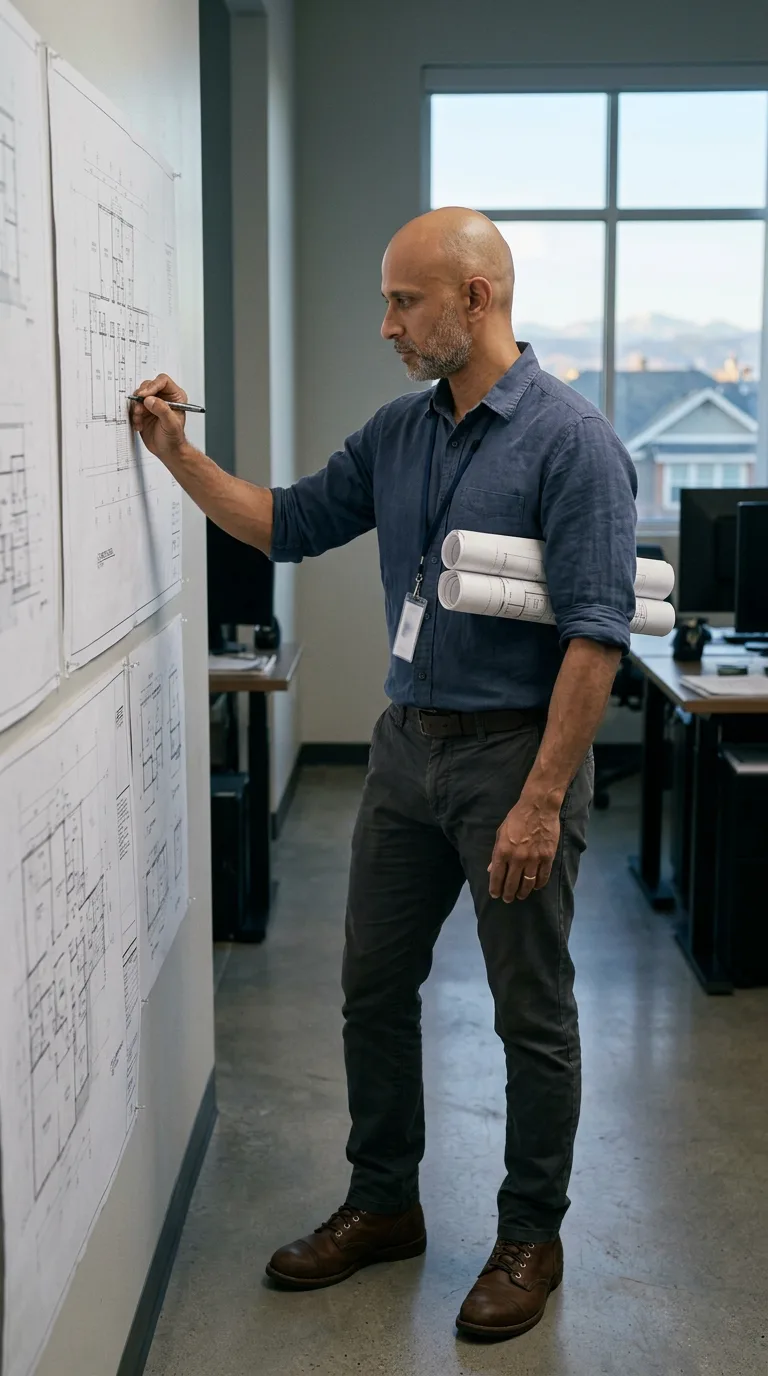
Rarest thing about him: Quitting right now — uncommon, 1 in 103
Season 1seed 1231834610 · engine v11
Character card
lineage 5OR92V
His body-swap story
@owen.prescott, wearing Martin Joseph Keegan, rolled the wheel on and woke up as Suresh Venkataraman, spent under a minute in him, then spun the wheel and woke up as Omar Haddad
You are leaving Martin Keegan because of the buzzer.
Not the buzzer itself. Under it, the thing the buzzer announces. It is early, the house in Seattle still dark, and you stand at his kitchen counter in his heavy body, his knees complaining on the cold tile. The phone on the counter shows a text from the district. Another parent meeting. Another Tuesday that will go exactly as Tuesdays go. Somewhere in his chest is a flat, patient sadness that belongs to him, and you have worn it for less than a minute and already cannot bear its weight. Under your thumbs the skin of his hands is pale and patched, and you keep looking at it, because it is the only interesting thing he has. You think: he is not wrong, he is not bad. He is simply finished being new. You open the page. The wheel is already turning under your finger.
Pen on paper. A line drawn along a wall plan, a motion done ten thousand times.
Then you are in it. The pen is in your right hand, mid-stroke, the tip touching the print. A roll of drawings is clamped under your left arm. Your weight is on the balls of your feet. Light comes from a big window on your right, cold and bright. You draw the line wrong. It wanders. You stop, and you draw it again slowly, correctly, and then ten more, each one checked, because you do not trust this hand yet and it does not need your trust.
The lanyard swings against your chest. The shirt is linen, soft with washing, and when your arm lifts, the cuff rolled to the forearm slides against skin and the memory comes up through it. His hands, early, in a hallway with a mirror. He rolls the left cuff first, always, two folds, the way his father did. His wife is in the next room saying something about the car. He is smiling at nothing, and the feeling is plain and warm: ordinary luck.
The roll under your arm presses a paper edge into the bare skin. The paper smells of toner. You remember a night before a launch, a team asleep on the floor and him walking between them with coffee, proud and terrified. Then the pen: a cheap one, a click-top, and his thumb already wants it. The knuckles of your left hand want something too. You curl the fingers and press, and they crack, one after another, and a whole life of that sound comes with it, in a classroom, in a car, at his daughter's recital, his wife laughing and swatting his arm.
The belt, brown and stiff at the buckle, brings the cigarette. A porch. Mountains standing behind the rooflines in the evening. He holds an unlit one between two fingers and does not light it, day nine, ten, the craving sitting in his jaw. Now it sits in yours. A small hunger. You know hunger.
The boots are heavy and good. Under the soles the concrete is cold, and the memory is of buying them, resoling them, and a woman long before his wife, a letter, a city he left. He does not think of her often. He thinks of her now, a little, in the back of your head, and then not.
His body is fifty and compact and strong. The shoulders are hard from years of something, the back faintly sore, a bruise of tiredness behind the eyes. The breath goes deep and easy. The ring on your left hand is a thin plain weight.
You lower the pen. You look at the hand, turn it over. A mole you can feel but not see sits high on your cheek. Brown fingers, short nails, the ring. Nobody is watching. You lift your eyes to the window, to the mountains, and you say, quietly, "Well. Hello."
How long, you wonder. The wanting always comes back. You flex the hand and wait to find out.