Suresh Bhatt
Fictional. Generated by AI — not a real person, and no likeness of one is intended.
52, water treatment operator in Western Kansas · rolled by @colin.hasbrook · card — no film
History
who has worn him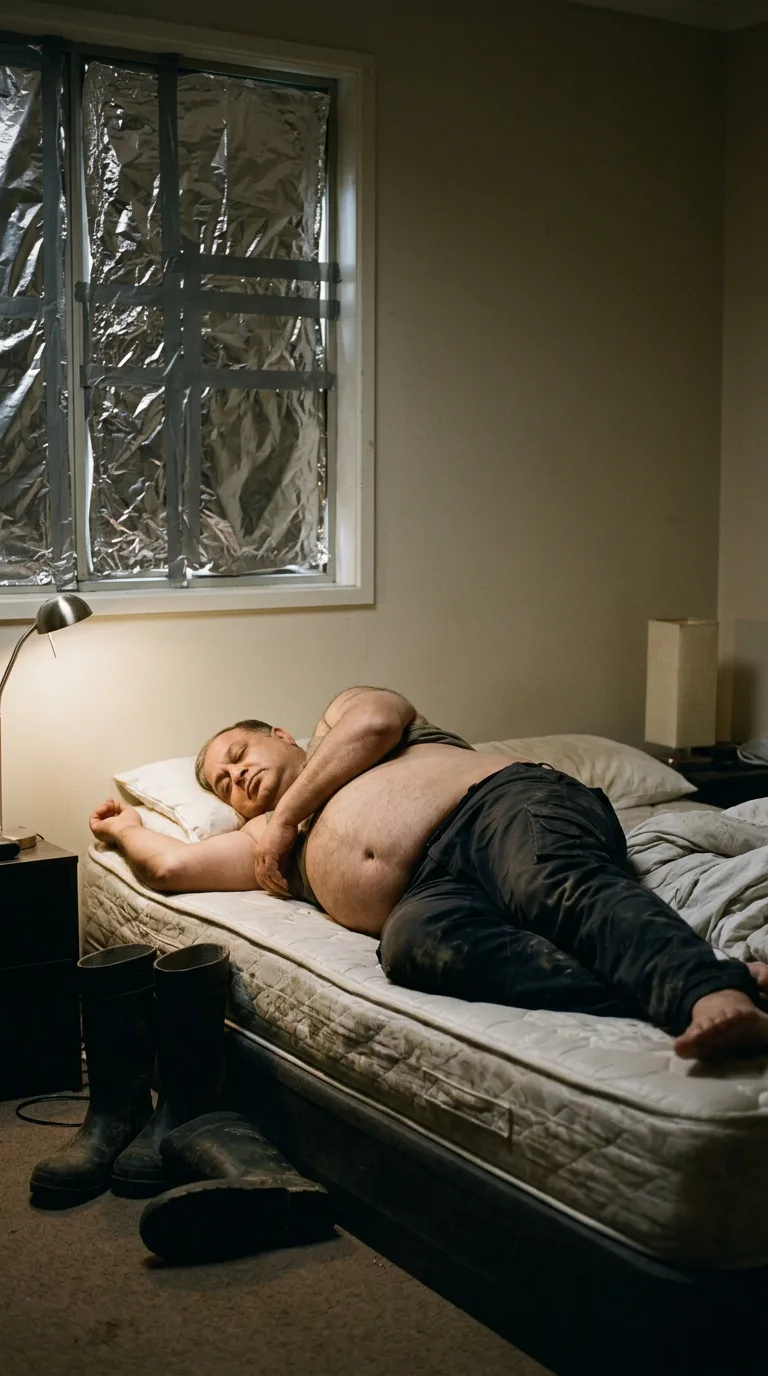
Rarest thing about him: South Asian — rare, 1 in 26
Season 0seed 1837870826 · engine v10
Character card
lineage 2NZHHJ
His body-swap story
@colin.hasbrook, wearing Owen Rhoades, rolled the wheel on and woke up as Suresh Bhatt, spent under a minute in him, then spun the wheel and woke up as Kyle Ferrante
The rig is idling in the gravel lot outside a Sonic in Amarillo, and the cab smells like burnt coffee and the red hair on your borrowed head is damp against the seat. You have been this man for less than a minute, the trucker with the blue eyes and the bad knees from thirty years of a clutch pedal, and already the boredom has set back in like weather. It is not even his boredom. It is yours, worn into him the second you arrived, because you have learned by now that no life fits for more than a few breaths before the seams show. He was going to drive to Lubbock. You do not want to drive to Lubbock. You have the phone out — his phone, thick-cased, a crack across the corner — and the page loads the way it always loads, patient, gray, a wheel drawn plain as a raffle at a church fair. You do not think about him, the man you are about to leave folded into a gas station parking lot with a headache he'll blame on the coffee. You never do. You pay. You spin.
The room arrives before you do — a foil-taped window, a bar lamp still burning gold in daylight, the particular gray hush of a house where the day is being kept out on purpose. Weight comes next, more of it than you have carried in ninety spins, settling into a body already lying down, already turned away from a seam of light that has found the gap in the foil and laid itself flat across a sleeping face. The face turns from it. Then, helplessly, back into it. Eyes open into the glare and hold there, unblinking, the way a man's eyes will when they are not entirely his anymore.
You are on your back on a bare mattress, one arm dead-numb under your own head, work trousers still buttoned and filthy at the knee, boots standing at attention on the carpet like they're waiting to be told something. Your belly rises and falls under a undershirt gone thin at the collar. Your lower back is a low, dull complaint that has clearly been going on for years, and your knees agree with it. It is the middle of the day. He should not be asleep. But the trousers say night shift, and the foil over the glass says a man who has taped his own daylight shut so many times it stopped feeling strange.
The mattress gives him to you first — no sheets, just the bare ticking, and under your palm a memory surfaces of him hauling it down into this room himself, alone, because Priya was at her sister's with the kids that week and there was no one to take the other end. Then the boots by the floor, and a whole cold morning comes with them: frost on the walkway rail over the aeration basin, the water underneath churning white in the dark like something boiling that isn't, the earmuffs cold against his neck before the blowers make it worth wearing them. Thirty-one years he has stood on that walkway. He likes the smell least in August and does not mind it the rest of the year, which he has never told anyone because it sounds like something a strange man would say.
The trousers against your legs give you the drive home, headlights catching cut wheat stubble stretching gray to the horizon, a thunderhead stacked up black in the mirror with the light underneath it gone the color of a bruise, and him thinking, the way he thinks most drives home, about his oldest, who won't return calls, and his youngest, who calls too much, and the middle one who is fine, who is always fine, who he worries about hardest for that reason. The undershirt against your ribs gives you Priya's voice through the bedroom door an hour ago, telling him to eat something before he lies down, and him too tired to answer, and her not minding, because eleven years in she has stopped needing the answer.
Somewhere under all of it, older, is a marriage that ended without much noise — a wife, a house, a set of years he does not regret and does not revisit, and three kids split across both halves of his life who he loves with an intensity that never once made him articulate about it. He has more money than any of them know what to do with, invested quietly, spoken of never, and he still buys his shirts three for twenty dollars because some men who don't need to worry about money keep worrying anyway, out of habit, out of a superstition he'd never call by that name. He does not go to temple. He talks to something, some mornings, on the walkway, before the plant crew arrives, and does not call it prayer and does not call it nothing either.
The back pain is old and permanent and yours now, a low ache riding along the base of the spine that has outlasted two mattresses and one ex-wife. The weight is his too, settled and solid, a body that has done the same forty steps between basin and control room for three decades and knows exactly how much give the walkway grating has left in it. Nothing about any of this hurts in a way he hasn't made peace with. It is just Tuesday in his bones, except it's Monday, and he does not know that either, yet.
You bring both hands up in front of your face, into the bar of light still lying across the bed, and turn them over — thick fingers, a callus ridged hard along the base of the right thumb from a valve wrench that has fought him for years, a half-moon of grease worked so far into one knuckle it will never wholly wash out. Not the hands you had this morning. Not the hands you'll have tomorrow, maybe, though you don't know that yet either.
"Okay," you say to the taped-up window, to no one, in a voice that isn't the trucker's and isn't quite this man's either yet — somewhere between, the way it always is at first. "Okay."