Silas Renfrow
Fictional. Generated by AI — not a real person, and no likeness of one is intended.
33, bartender in San Francisco · rolled by @grant.delahoyde · card — no film
History
who has worn him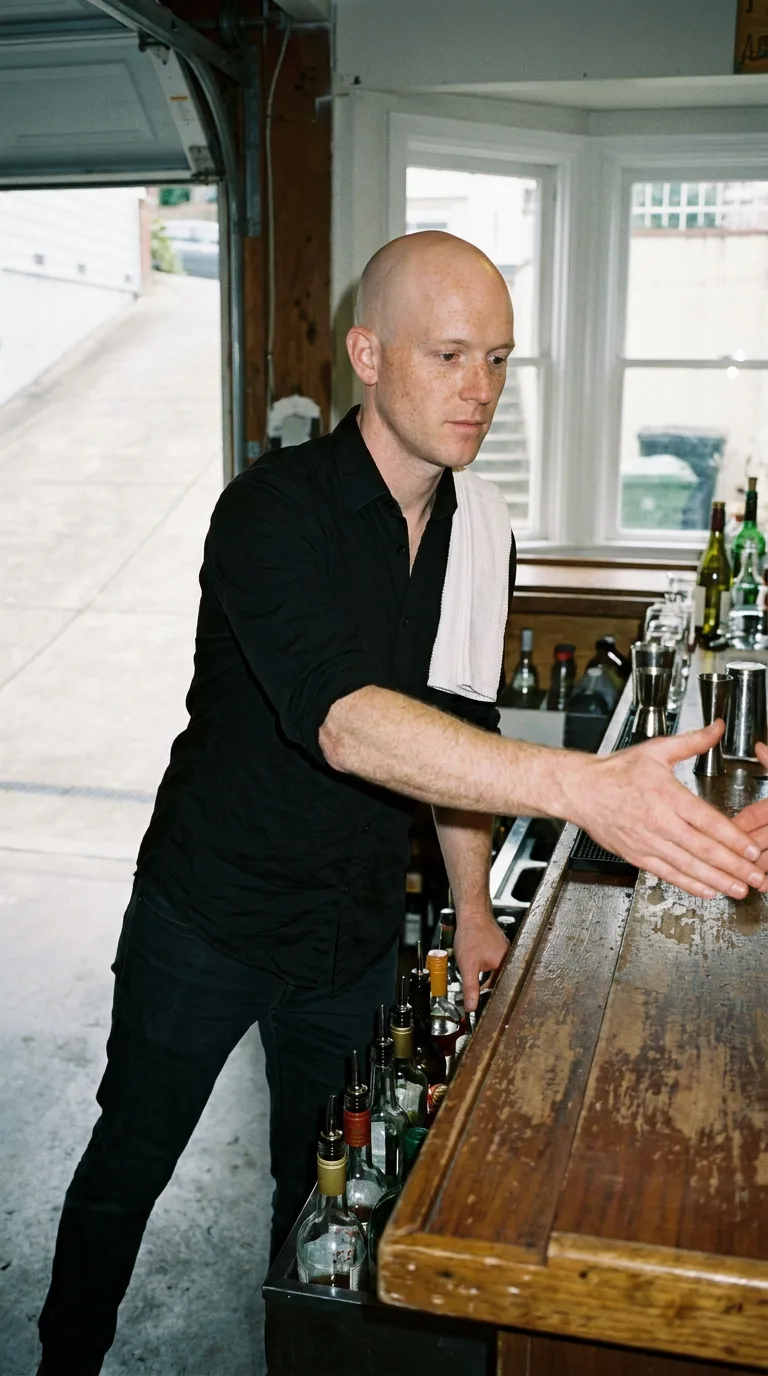
Rarest thing about him: Migraines — rare, 1 in 34
Legacyseed 1294097404 · engine v8
Character card
His body-swap story
---
You know his hands better than you know your own.
Twenty-two years of them. The garage on Alemany where his uncle kept the bar he never opened, the two of you at eleven pulling nails out of that oak top with a claw hammer, and you cut your palm and he wrapped it in a dish towel and prayed over it, out loud, at eleven years old, unembarrassed. That's Silas. He prays like other men clear their throat.
Now it's 6:40 in the morning and the garage door is up on the steep cut of the driveway and the light coming off the concrete is that cold San Francisco white that has no warmth in it anywhere, no color, like the inside of a refrigerator. He's got the bay window behind him, sash rattling in its frame. The well bottles standing in the crate at his knee — vodka, rye, the cheap gin nobody orders, all of it for a bar that will never have a license and never open, because there is nothing to his name, not four thousand dollars, not a lease, not a plan. Just his uncle's bar top and a towel over his shoulder and a shift at four across town at somebody else's place, pouring for people who'll never know he doesn't drink. Thirty-three and he has never once had a drink. He'll pour you a Manhattan you'd cross the city for and he has no idea what it tastes like. He asks you. He believes you.
He is wiping the bar with his forearm out flat because his right hand is busy on a bottle in the crate below, and I know what you notice, because I notice it every time — the freckles. Across the nose and up over the cheekbones, spilled there, the same as when he was nine and would come up out of the ocean at Fort Funston with them lit right up. Nothing on him has changed but the hair, and he shaved that off himself at twenty-six with clippers in this garage while you held the mirror.
You are dying. That is the part he doesn't know. You've had six weeks of knowing and you have not said it, and the not-saying has become the whole shape of your friendship, a room you sit in with him where you have moved all the furniture to one side.
He gets migraines. Bad ones, since he was a kid — he'll go still mid-sentence and put two fingers against his temple and say *hold on* and stand there in the dark of the garage with his eyes shut for a minute and a half, and then come back and finish the sentence at the exact word. You have watched him leave and come back a thousand times. Maybe that's where you got the idea. Maybe you've been sitting on it since the second week.
You could take anyone. You have thought about the man with the boat. You have thought about strangers with money and time and clean scans and no one waiting on them. And you are here at 6:40 in the morning in a garage with a bad slope and a bad view and a man with nothing, because a stranger's life is just a longer wait, and *this* — this is the only life you ever actually wanted to be inside. His hands. His freckles. This ridiculous unopenable bar. Him.
You say his name. He straightens up.
"Hey," he says. "You're early. You want to hold the crate?"
And then, because he doesn't know how to end a conversation any other way, because his father shook hands with everybody at the church door and Silas learned it there and never stopped — because he shakes your hand hello and shakes it goodbye and shook it at the hospital door in June and said *whatever it is, we go through it* — he puts his right hand out across the bar top into the light.
Your hand goes into the frame and takes it.
One beat. Then a second beat, and it should have ended on the first, and he feels that, you feel him feel it — his brow gathering, a small polite confusion, the beginning of *you okay?* on his mouth.
Then the other hand withdraws, and it is empty.
And you — the you that is now the one with freckles, the one with the towel warm on the shoulder, the one whose skull holds a low pressure behind the left eye like weather coming in off the Pacific — you close your fingers around what was left in your palm. Nothing there. Air, cooling.
The body is a shock. Not the change: there is no change, nothing melts, nothing turns. It's just that one second you are looking at him and the next second you are looking *out*, and the seam is that thin. The garage is louder from in here. The floor is cold up through the boot soles. The bar top under your left hand has a raised grain you never felt from the other side, a place where the two of you sanded and didn't finish sanding in 2004, and you know exactly which day that was, and now the hand that stopped sanding is yours.
Your right hand is still out over the wood, half-closed, holding the shape of a handshake that has ended.
You turn it over. Callus at the base of every finger from bottle necks and shaker tins. A nick on the thumb pad, working nick, nothing anybody would call a mark. Small hand. Five foot eight of him and you always forget he's shorter than you were.
You had a speech ready. Something about how nobody's using it now, how it was going to be nothing, how he'd have wanted — no. He would not have. He'd have said no. He'd have said the body isn't the man and the man belongs to God and *what did you do*, and he'd have said it kindly, which is worse, and then he'd have prayed over it out loud, unembarrassed, and you'd have let him.
The behind-the-eye pressure ticks up a notch. His migraine, arriving on schedule, and there is no way back and no term on it: this is the head you get now, this is the weather you live in. Somewhere in the city a shift starts at four and the person expected there is you.
You lift your eyes off the hand.
The light out the open garage door is white and flat and it does not care. And there is nothing in the frame to speak to. So you speak into it anyway, because he shook your hand in June and said *we go through it*, and because he was right, and because he could not have known that we would be one man.