Sawyer Ketchum
Fictional. Generated by AI — not a real person, and no likeness of one is intended.
18, tailor in High-desert Nevada · rolled by @grant.delahoyde · card — no film
History
who has worn him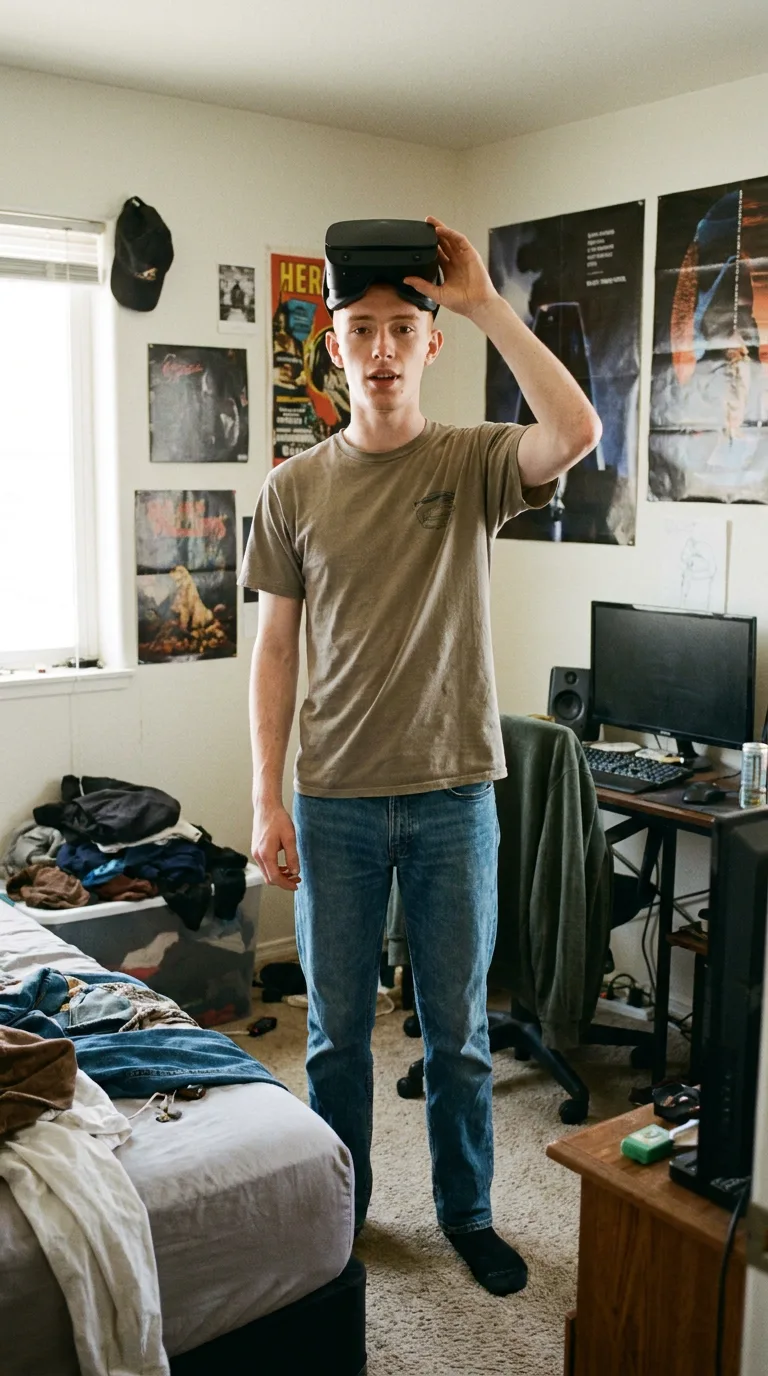
Rarest thing about him: A gold tooth — epic, 1 in 190
Legacyseed 1990021003 · engine v8
Character card
His body-swap story
---
You did not choose him. That is the first thing to say, and you will keep saying it for years, to no one, in his voice.
You were in the test rig in a leased suite off Sunset Road in Henderson, seventeen minutes into a calibration pass, a technician named Marisol reading numbers to you through a wall. The rig was supposed to map intention onto a body double. Instead the handshake went out across whatever the handshake goes out across and found a headset sitting on a boy's face in a single-wide trailer a hundred and eighty miles north, and the disconnect never came. You felt the suite go away like a held breath being let out by somebody else. Then carpet under socks. Then a smell — sagebrush and hot dust and the inside of a warm plastic visor.
Your name is not Sawyer Ketchum. Sawyer Ketchum is eighteen years old and has red hair cut short at the sides with a little length left on top, and he is five foot eight, which is four inches shorter than you were, and you have not gotten used to the way the doorframes sit yet. He has brown eyes. In the mirror over the dresser in that bedroom you saw them looking back and they were a stranger's eyes and they were the only eyes you had.
You lifted the headset off. You blinked at the real room — the posters taped crooked, the laundry tub, the desk chair with a jacket thrown over it, the window with the blinds half up and that hard blue high-desert shadow cut across the carpet. Your hands came up in front of your face on their own, and you turned them over and back, over and back, like a man reading an assignment sheet. Long fingers. Calluses on the pad of the right index finger and along the outside of the right thumb, the pressing-and-pinning calluses. Nicks healing on the left knuckles. A body that already knew a trade you'd never learned.
Here is what you found out in the first week, because a life comes at you like mail.
He is a tailor. Not a hobby — a job, at Vasquez & Son Cleaners and Alterations on the main drag, a cutting table set right in the light of the shop window, a half-made jacket on the dummy beside it with pins bristling out of the lapel roll. The first morning you stood in front of that table and your hands picked up the shears before you decided anything. That is the part nobody warned you about: the wanting stays yours, the memory stays yours, but the body keeps its own small fluencies. You watched him hem a trouser leg with hands you were only renting. You cried in the back room with the steamer hissing and you had to look up how to turn it off.
He has a daughter. Fourteen months. Her name is Junie and she lives with her mother, Kayleigh, who is his girlfriend and now yours, in an apartment behind the Family Dollar, and the second night she said *you're being weird* and you said *long day* and she believed it because eighteen-year-old fathers are allowed to be tired. The baby knew before Kayleigh did. Babies always do. She looked at your face and looked and looked and would not come to you, and then a week later she did, and you held her and that was the day you understood there was no way back and no term on it. You are going to raise this child. You are going to be at the recital. You are going to be a man named Sawyer Ketchum for the rest of a life you did not apply for.
He has debts. There's a truck with a note on it, upside down by four thousand, and a card and a medical bill and a machine loan for the shop, and you added it up on the kitchenette counter of the trailer with a pencil and a receipt and got to a number that made you laugh out loud in his voice, the gold canine flashing at the window. Twenty-something thousand in the hole and eight hundred a month coming in from hemming Levi's for ranch hands. That was the first thing you ever did *for* him rather than to him: you renegotiated the machine loan. You know how. You used to know things like that.
The gold canine. You'd notice it on anyone. It shows every time you talk, a warm little glint low on the left, and for the first month you talked less because you kept seeing it in reflections and it kept reminding you that the mouth was borrowed. Kayleigh asked once why you'd stopped smiling with your teeth. Now you talk plenty. Now it's your tooth.
His hands will not hold still. Not nerves exactly — just a body with the engine idling high. On the tailgate, in the waiting room, at the table: tapping, folding a receipt into eighths, spinning the pencil, thumbing the seam of his jeans, working a nicotine pouch out of the tin and up under his lip. You tried to still them, early on, out of some idea of dignity, and it was like holding a bird. So you let them run. They fold. They pin. They do something with a scrap of thread the whole time you're on the phone with the credit union. It turns out he was good at his job partly because of this. It turns out the anxiety and the trade were the same muscle.
There's medication for it, in the cabinet over the trailer's little sink, and you keep taking it, and it makes the mornings a flat grey road you can actually drive on. That's a thing you decided in week two, standing there with the bottle: that whatever else you'd stolen, you would not let his body come off its meds because the man inside it was too proud or too rattled to fill a prescription in his own name. It was the closest thing to a prayer you had. You are spiritual and not religious, both of you, as it happens — the sky out there does that to people. You sit on the block steps at dusk with the sagebrush coming up to your feet and you say something in the direction of whatever took you, and it never answers, and you keep saying it.
Marisol filed a missing-person report on a man in Henderson. You read about it once on the shop computer, then never again.
The worst hour is not the mirror and not the baby. It's Sunday afternoons at the cutting table, alone, the window light going long and gold across the fabric, when his hands do something you didn't ask them to — a certain flick to seat a seam — and you understand you are the only place he still exists. Nobody else on earth is going to remember that a boy named Sawyer Ketchum did that with his wrist. So you keep doing it. You keep doing it on purpose. You learn the trade for real so the trade doesn't die. You marry Kayleigh in four years in a room with folding chairs and you cry and everyone assumes they know why.
And when Junie is six she will say *Daddy, why is your tooth gold*, and you will say what he must have said, because it's the only answer the body has: *because I paid for it, kid.* And she'll laugh. And you will feel a stranger's dead boy's tooth catch the light in a mouth you have finally stopped calling borrowed.