Saul Reznick
Fictional. Generated by AI — not a real person, and no likeness of one is intended.
48, house painter in Philadelphia · rolled by @saul.reznick · card — no film
History
who has worn him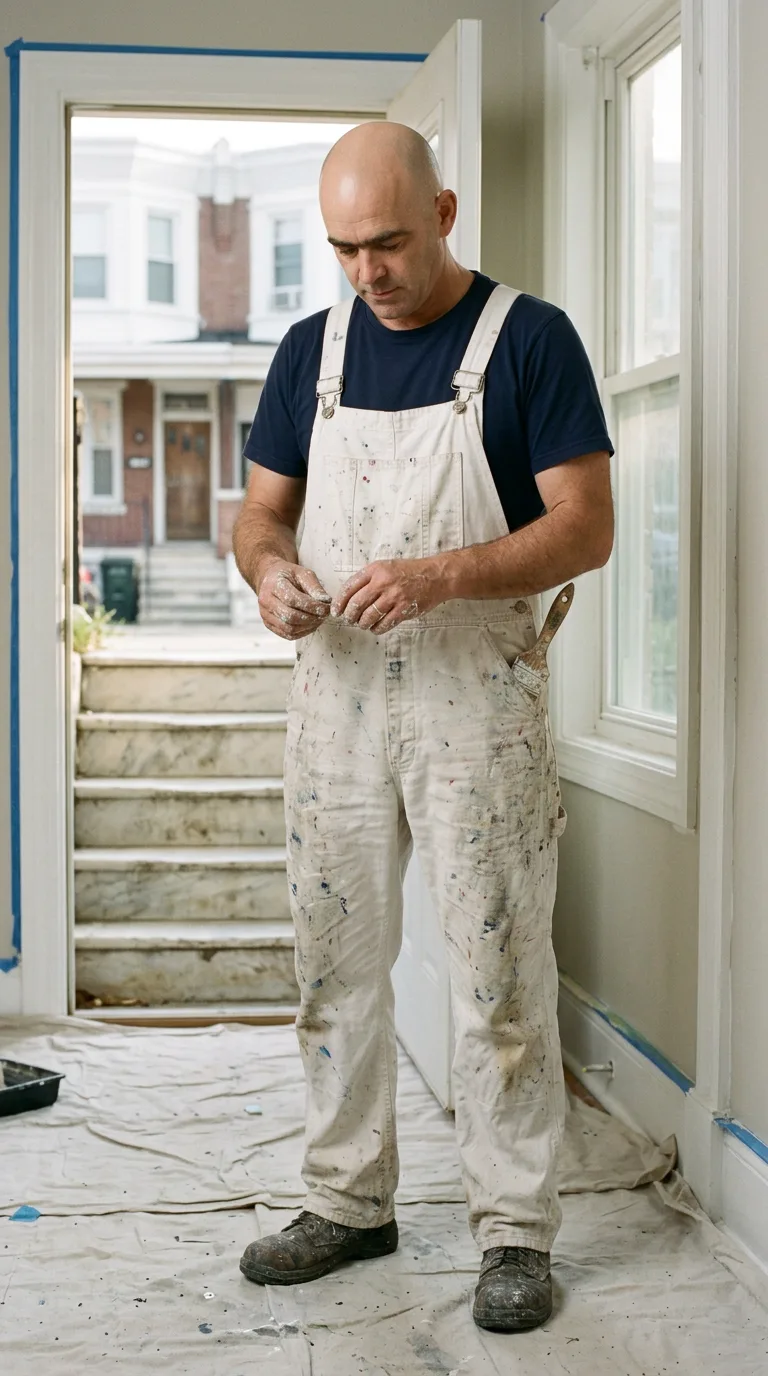
Rarest thing about him: A unibrow — rare, 1 in 49
Season 0seed 1185699843 · engine v10
Character card
lineage 1VLCH7
His body-swap story
@saul.reznick rolled the wheel on and woke up as Saul Reznick — their first
The page loads slow on a dead Monday afternoon, the kind with nothing in it, and you have been circling this exact idea for years the way other people circle a used car they can't yet afford — the threads at 2 a.m., the stories, the question of what it would actually feel like to be someone else, entirely, from the inside. You always assumed the answer was never. Then a friend of a friend of a friend mentioned a site with a wheel on it, half-joking, and you did not laugh. vessel.cards. You pay what it asks. You spin because you have always wanted to, and because today, for the first time in your life, it turns out you can.
The wheel does not ask what you want. It gives you a man mid-stroke, a brush loaded and dragging along a strip of blue tape, in a room that smells like fresh cut-in paint and old plaster dust. His weight settles into you all at once — shorter than you expected to feel, compact, a low ache already sitting in both knees, forearms roped tight from twenty years of the same motion. The brush stutters. One pass goes crooked, a thin gray tongue licking over the tape line. You correct it, slow, deliberate, the next ten strokes checked like a man doing this for the first time instead of the ten-thousandth. Outside the window the light is early-evening gold, sliding long down a row of white marble steps. Nobody in the room notices anything. There is nobody else in the room.
The clothes bring him first. The overalls are stiff in places with dried paint, soft in others from a hundred washes, and touching the bib strap gives you a flash — his own hands doing this same clasp seven hours ago, in a bathroom with a cracked mirror, his wife Devora's hairdryer still warm on the counter, the smell of her shampoo. Saul Reznick, forty-eight, up before six because the job in Fairmount starts early and the parking is worse if you're late. He'd pulled the navy t-shirt over his head first — worn thin at the collar, softer than it has any right to be — and felt, for half a second, the version of himself at twenty-six who used to iron his shirts before he owned a single tool. That man is gone. This one bites his nails down to nothing when a job's behind schedule, and the job today is behind schedule.
The brush handle in your palm — his palm — is worn to the shape of a grip held ten thousand times, and it opens wider: a whole afternoon three years back, teaching his oldest, Miriam, how to cut a clean line around a switch plate, her tongue between her teeth in concentration exactly like his. The paint tray at your feet, half-crusted at the rim, gives you a colder memory — a fight with Devora two winters ago about money, about the slow months, about whether this was really what he wanted at forty-six with three kids and a fourth almost certainly coming, said in the kitchen with his coat still on. And under that, older and warmer, an ex-girlfriend's name — Rachel — surfacing without invitation from nowhere in particular, from nothing he's touching, just there the way old names are, filed but never quite closed.
The unibrow you can't see but can feel, somehow, in the small habitual gesture of rubbing at it with a knuckle when he's thinking hard, which he is not doing now, because he isn't doing anything now. The wedding band on the left hand is warm from his own skin, plain gold, and it carries the smallest thing of all: a Tuesday, ordinary, Devora sliding it onto his finger under a chuppah nineteen years ago, her hands shaking worse than his.
Your knees ache in a way that isn't yours. Your shoulders know how to hold a five-gallon bucket without thinking. Your feet, in boots gone stiff with old paint, feel every seam in the drop cloth underneath them, and none of it is asked for — it simply arrives, the way his whole ordinary unremarkable evening arrives, second by second, into hands that are, right now, entirely someone else's.
You look down at them. Nail-bitten, paint-flecked, a stranger's wedding band catching the last of the window light. You turn the brush once between your fingers like you're checking it's real.
"Okay," you say, out loud, to the empty room, in his voice. "Okay."
Nobody answers. The tape line is still crooked. You don't know yet how long you'll be the one deciding whether to fix it.