Sammy Haddad
Fictional. Generated by AI — not a real person, and no likeness of one is intended.
31, waiter in Atlanta · rolled by @sammy.haddad · card — no film
History
who has worn him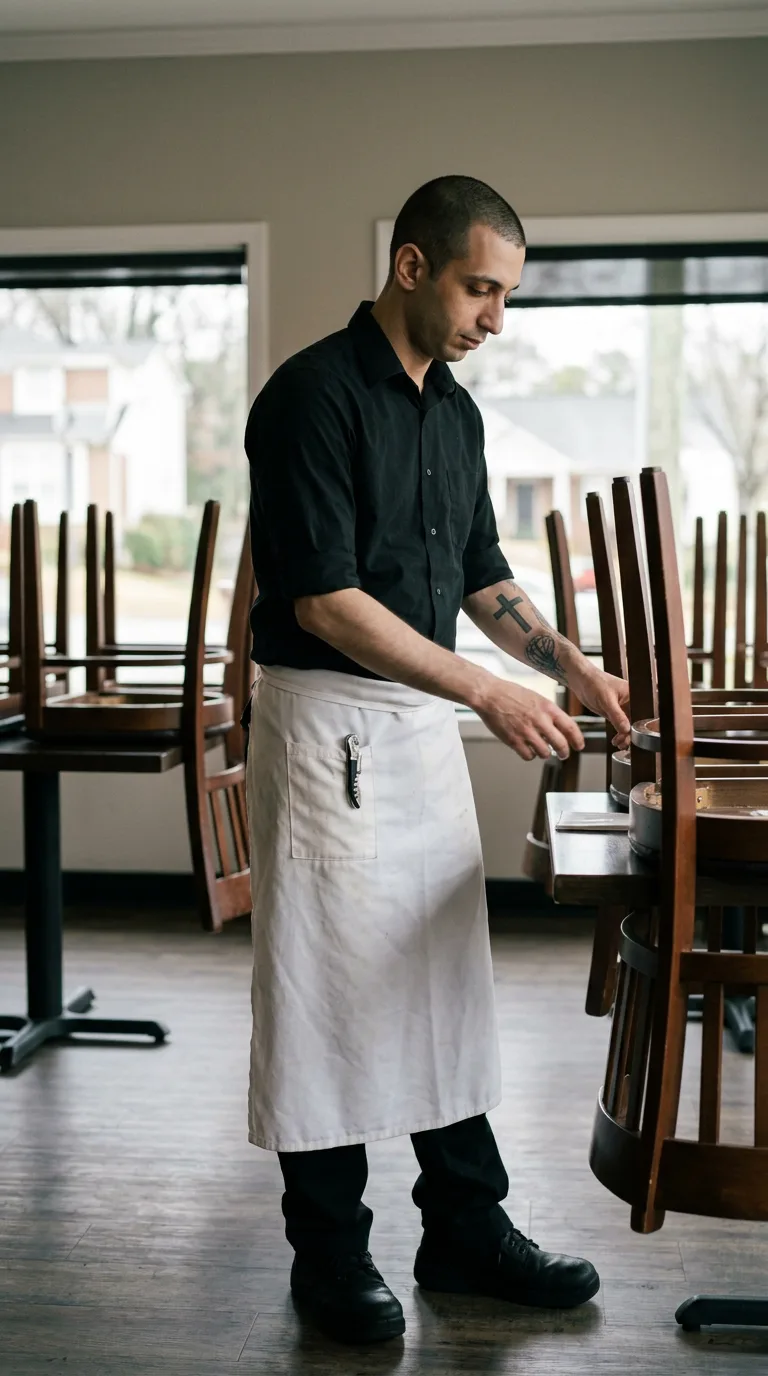
Rarest thing about him: Half sleeve — epic, 1 in 37
Season 0seed 1854265700 · engine v10
Character card
lineage RUB2E9
His body-swap story
@sammy.haddad rolled the wheel on and woke up as Sammy Haddad — their first
The site loads slow, the way cheap sites do, a wheel rendered a little too smooth against a background the color of nothing. You have read every thread about this for years — the two-in-the-morning forums, the stories people swore were real, the films you watched alone because nobody else wanted to talk about it after. It was never for sale before. Now there's a price and a button and it is the middle of the night where you are, everyone else asleep, a Thursday going nowhere, and there is nothing on, and there has never once been a night you didn't think about this when there was nothing on. You pay. You spin. The wheel does what wheels do, and then it isn't a wheel anymore.
You are bent at the waist, weight forward on your left foot, and your hand — his hand — is on the leg of a chair that is already upside down on a table, mid-lift, and the light through the window is flat gray afternoon and somewhere behind you a walk-in compressor kicks on with a sound your body knows before you do. The motion breaks. The chair leg goes up crooked, catches wrong on the tabletop, and you set it down and pick it up again, slow, correct, watching your own hand do it like it belongs to someone else giving a lesson. It does. It doesn't. Ten more chairs come off ten more tables and every single one of them you check, the way you'd check a knife you didn't trust, on a job that has not needed checking by him in six years.
The apron string is tied at your back and the knot gives you a Tuesday — no, a hundred Tuesdays, tying it one-handed behind himself in the narrow hallway by the walk-in, cursing when the string frays and someone always says get a new one, Sammy, and he always says next week. The toothpick is in his shirt pocket, not his mouth, and touching the little paper sleeve gives you the taste of it, cheap mint, the particular unthinking work of his jaw when a table is slow to order and his hands have nothing else to do. He quit cigarettes four years ago on a Tuesday too, cold, because Layla asked him to before they moved in together, and the toothpick took the cigarette's job and never let it go.
The shirt is the big one. Black, rolled to the elbow, buttoned by hands that did it in the dark this morning — his morning, a Wednesday that started at eleven a.m. because the dinner shift runs him into midnight most nights and this one runs later, a private party, extra hours he said yes to before he'd finished being awake. Layla was still in bed. He remembers the specific weight of not waking her, the care of it, cuff over the ink on his right forearm — cross, praying hands, done nine years ago in a shop in Decatur the week after his son was born, when he'd wanted something on him that meant *thank you* and didn't have better words for it. He isn't devout. Hasn't been to a service in years. But something in him still reaches upward on bad nights, unbothered by not knowing exactly where it's reaching, and the tattoo is the only proof he ever bothered to leave of that on the outside of himself.
The floor under your feet — his shoes, flat-soled, scuffed at the toe from seven years of this exact walk between kitchen and dining room — gives you the whole shape of the restaurant without needing to look: the two-top by the window that always wobbles, the ficus nobody waters right, the manager who calls him *chief* like it costs nothing. And under that, quieter, is the divorce — Rania, three years married, done for reasons that were nobody's fault and everybody's, mostly just two people who stopped reaching for the same things at the same time. It didn't burn. It just ended, the way some things do, and they still talk, mostly about their daughter, mostly fine. The custody schedule lives in his phone in his back pocket, which you can feel there, a small hard rectangle against skin that already knows this Wednesday is not one of his daughter's days.
His body is thirty-one and carries itself like it's tired of being looked at — soft through the middle in the way of a man who's on his feet all shift and sits for none of it, arms wiry underneath, more strength in them than the shape lets on. Nothing hurts exactly. Everything is a low hum of use: the arches of both feet, a left shoulder that clicks when it's cold, the particular ache behind the eyes that means he hasn't had water since the lunch rush. His hands know sixty things without asking him — how a chair balances, how a wine key opens without looking, how to carry four plates up one arm — and none of that knowledge is yours, only borrowed, sitting in muscle that will do it whether you mean to or not.
You straighten up. You look at your hand — his hand — still curled around the chair leg, and you turn it over slowly in the gray afternoon light, and it is not a gesture he would make, and somewhere in the kitchen someone calls out a name that isn't yours yet either.
"Sammy?" the voice says again, closer, and you hear yourself answer before you decide to.
"Yeah — I'm good," you say, to no one, to the empty dining room, to whatever comes next. "Just lost my place for a second."