Samir Khoury
Fictional. Generated by AI — not a real person, and no likeness of one is intended.
61, machine operator in Pittsburgh · rolled by @connor.waskiewicz · card — no film
History
who has worn him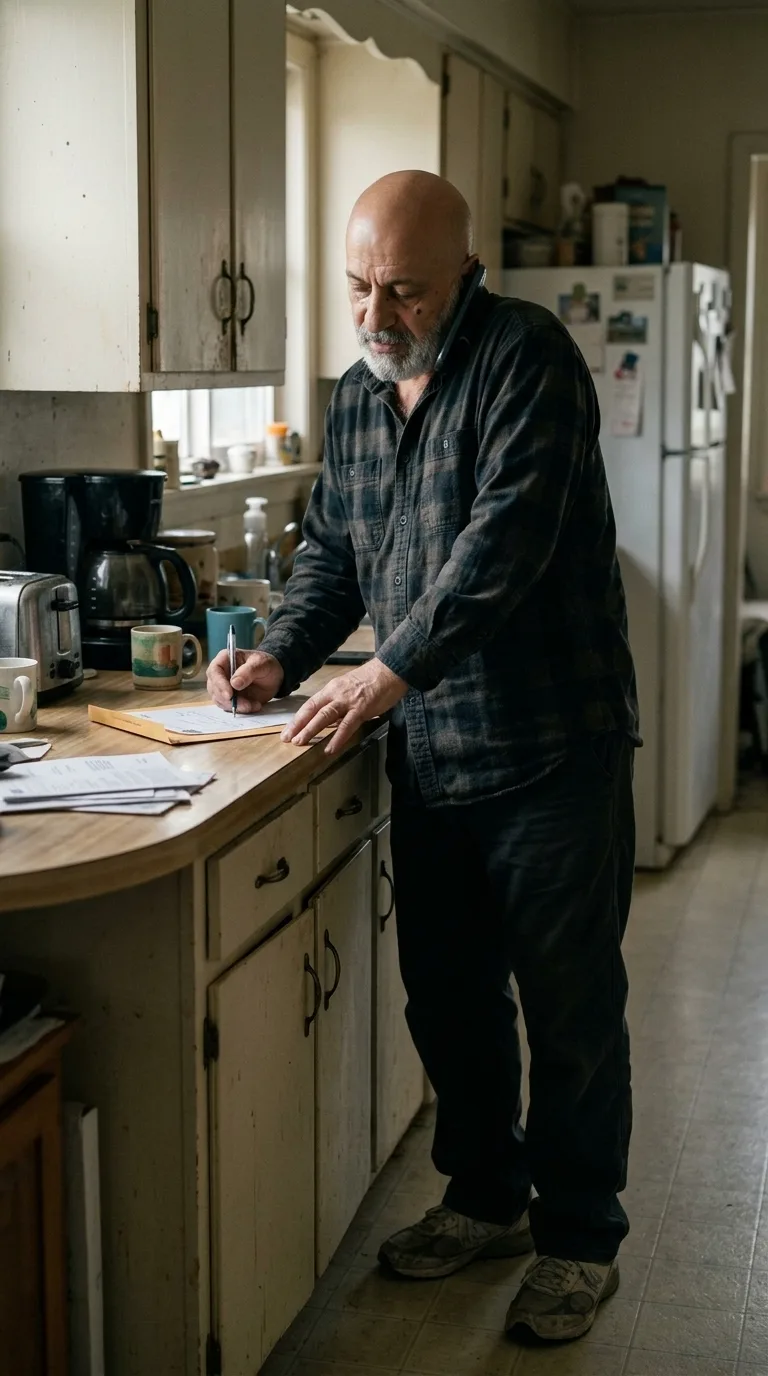
Rarest thing about him: On hold with someone — common, 1 in 70
Season 1seed 1970268575 · engine v11
Character card
lineage 2NZHHJ
His body-swap story
@connor.waskiewicz, wearing Mark Hollenbeck, rolled the wheel on and woke up as Samir Khoury, spent under a minute in him, then spun the wheel and woke up as Isaiah Fontenot
Mark Hollenbeck's body is good, and that is the trouble with it. I stand in his dark kitchen in Ohio with his forearms on the counter, forearms that have pulled wire through a hundred attics. Everything works. His knees don't ask for anything. I have been him for less than a minute and I already know the whole of him: the green eyes in the dark window, the thick hands, the ease. Nothing in him is hard, and nothing is mine. Somewhere in the house a furnace ticks. I think of a number, 1492, and then I open the page with the wheel on it, and my thumb, his thumb, does not shake.
The wheel turns, and I am standing.
Pittsburgh is a kitchen, early, before anyone is up. A phone is wedged against my shoulder and the hold music loops back to its first bar. The shoulder drops, and the phone falls into my hand mid-loop. In the other hand a pen has stopped on the second digit of a number circled on an envelope, and it does not start again. The air is cold and smells of old coffee and a toaster.
The flannel arrives first, against my back. It is soft and thin at the elbows, and a button hangs by one thread. Then he comes, in his feeling and not mine. He put it on in the dark, left sleeve first because of the shoulder, and rolled the cuffs twice. His wife bought it a long time ago, before she was an ex-wife. He kept it because it was warm, and for no other reason he would admit.
The pen is a cheap one, chewed at the end. Through it comes the line at the plant: plastic spooling out of the die, warm and endless, and his gloved hand learning its sound over thirty years. The earplugs on their blue cord hang in his shirt pocket at the plant. Here they are only a memory of pressure in the ear.
My thumb finds the bare place on my ring finger. A pale band, smooth, and a grief with no sharpness left in it. I get the day she gave the ring back, the table, the two children still in the next room pretending not to listen. I get his daughter's laugh on a stair, the public stairs behind the house, wet leaves on the concrete and late light. I feel how he taught her to go down them without holding the rail. I feel how proud he was, and that he never said it.
The envelope is a bill. The number is a claim, and he has been on hold nineteen minutes, which for him is almost kind. His feet ache in his sneakers. His lower back has a hot coin of pain in it, and his bald scalp is cold. I touch my beard and find it coarse and two inches long, and my cheek, high up, where a mole sits that he stopped noticing decades ago.
He prayed in a plain church, mainline, hymns he knew without trying. He gave up cigarettes and still reaches for his pocket when afraid. He is afraid now, a little, of the bill, of the money, of being sixty-one with almost nothing. He kept going anyway. That is the whole of him, I think, and it is more than Mark ever asked of his body.
I turn my hand over. It is brown, scarred across the knuckles, the pen still in it. It is not mine, and it is heavy with someone's work.
I look up and say, in a voice that is rough and accented and kind, "Hello?" The music loops again.
How long will this one last, and when will the wanting come back?