Samir Haddad
Fictional. Generated by AI — not a real person, and no likeness of one is intended.
61, bouncer in Nashville · rolled by @colton.vandermark · card — no film
History
who has worn him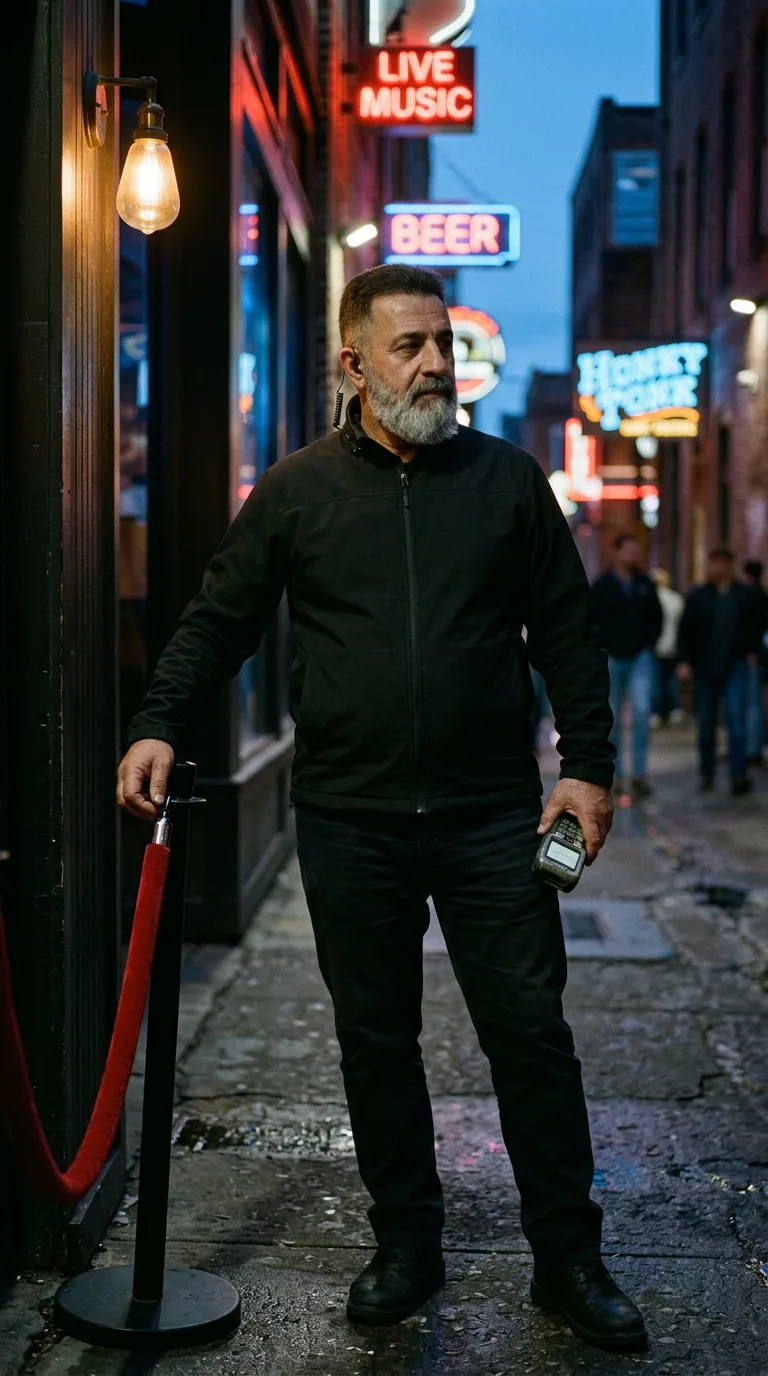
Rarest thing about him: Bouncer — uncommon, 1 in 2,187
Season 1seed 1230672997 · engine v11
Character card
lineage PYNCV3
His body-swap story
@colton.vandermark (admin), wearing Terrence Dewayne Boyd, rolled the wheel on and woke up as Samir Haddad, spent 15 minutes in him, then spun the wheel and woke up as Liam Brandt Kessler
You are Terrence Dewayne Boyd for less than a minute, and that is already too long. Twenty-seven, tall, skinny, a freight handler's back. You are standing in a dock office with a dead phone and a sandwich you cannot make yourself finish. The thing that sent you back is small. Terrence's stomach growls at the exact moment you want quiet, his knees are loud on the stairs, and you wanted a man who could carry a silence. You wanted weight and a body that has already stopped asking for things. So you open the wheel again.
It turns. It gives you a man at a rope.
The arrival has no seam. The rope's brass clasp is cold in your right hand, and you have just clipped it to the post. You did it wrong, and then you do it again slowly, and it takes. Something in this man's hand is surprised at you. A radio sits in your left palm, small and warm from being held. The air smells of fryer oil, spilled beer and wet pavement, with a thread of cigarette smoke from somewhere you can't see. The neon turns the puddles red and then blue.
You are short. The street comes at you from a lower angle than you are used to. Your belly rests over your belt like a held breath. Your feet ache in a way that has history, flat and settled in the arches, and your lower back is a hot, dull rope.
The jacket first. The collar rubs your beard, and the zipper is cold under your chin. You pull it, and he comes: a morning in a narrow kitchen, this same jacket coming off a hook, his arm finding the sleeve without looking, a child's voice somewhere behind him saying *Baba, your coffee*. The cuffs are tight and elastic on his wrists. He tugs them down one at a time, left and then right, and has done it every working night for years. That is the ritual. It is not for warmth. It is so that nothing will be loose.
The rope's brass is under your thumb, and it opens a Saturday. A man swung at him, drunk and young and sure of himself. He did not hit back. He took the wrist and turned it, and then he stood there afterward holding a stranger's shame until the boy cried. He remembers being tired in a way that was almost tender.
The radio buzzes in your palm. The plastic is worn smooth at the corners, and under it comes a phone call he did not finish, a woman's voice saying *I can't keep waiting for you to be home*. The ache of that comes up through his chest, not yours. She was the last good thing, recent enough that the bed still has her side. He still sleeps on his own half.
Your thumb goes to your mouth. You taste the edge of a nail before you realize it, ragged and bitten down to the pink, and the habit arrives with a whole childhood of worry. Beneath it is the old craving for cigarettes, quit and still there. His mouth wants smoke. His mouth also wants to pray, and a Sunday folds open: folding chairs, a hymn, his daughter's hand in his, too small to hold a hymnal. He is not rich. The rent is a number he knows like a pulse. The tips are thin, the nights are long, and the money goes to two kids. You can feel that in his shoulders, a weight he never put down.
The boots are heavy and cracked at the toe, and the concrete under them is damp. Somebody laughs down the alley. Someone in a hat comes toward the rope, and he knows without being told to look at the shoes, not the face, and to keep his own voice low.
You look at your hands. They are broad and brown, with thick fingers and a thumbnail chewed ragged. They are steady, and they are not yours.
You look up into the neon and say, quietly, "Evening. Come on in."
Under the words the other question is already there, patient as a rope across a door: how long before you want to turn again.