Sami Haddad
Fictional. Generated by AI — not a real person, and no likeness of one is intended.
28, teacher in Boston · rolled by @colby.marchetti · card — no film
History
who has worn him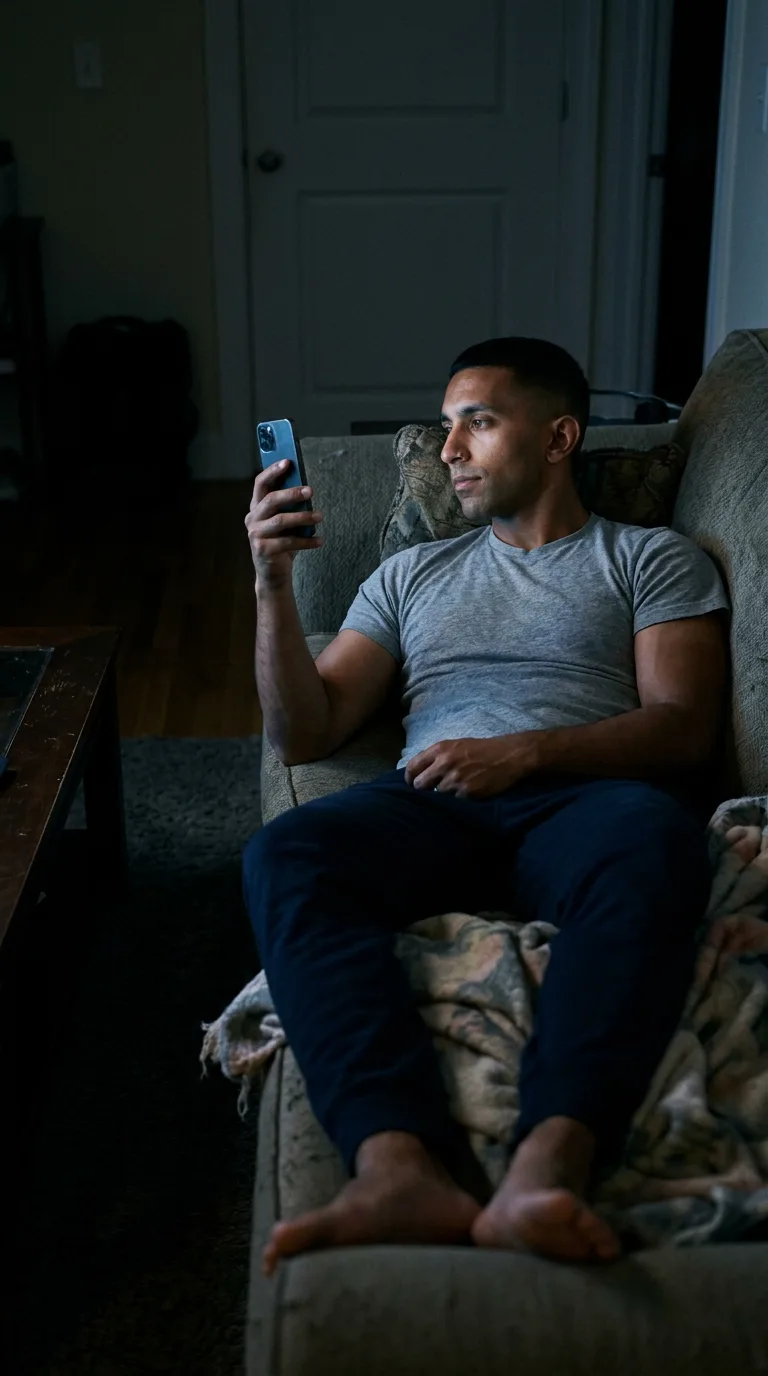
Rarest thing about him: Nose — epic, 1 in 46
Season 0seed 781956474 · engine v10
Character card
lineage OZ80W3
His body-swap story
@colby.marchetti, wearing Aaron Dietz, rolled the wheel on and woke up as Sami Haddad
Aaron Dietz's beauty mark is on the wrong side of his mouth. You noticed it again tonight, the thirty-first or fortieth time, standing in his bathroom in High-desert Nevada at an hour that belongs to nobody, running his blunt manager's thumb along his jaw in the mirror like the answer might be under the skin. He is fine. He is a fine body — six feet, good shoulders, a job that pays and asks nothing hard of him — and that is exactly the problem you've been circling for eleven days now: fine is a floor, not a ceiling, and you have thirty men behind you and every one of them was fine for a while. The house is dark. His wife — his, not yours, never yours — is asleep down the hall with a rhythm to her breathing you've learned like weather. You are not tired of him. You are tired of knowing exactly what tomorrow in him will feel like before it happens. So you take his phone into the bathroom, thumb the screen the way you've thumbed a hundred, and there's the wheel, patient, lit, waiting for you the way it always waits, and you spin it not because Aaron did anything wrong but because there is a version of tonight where you don't, and you have never once chosen that version.
The wheel spins and lands and you are sitting down already, weight distributed wrong for a second, a phone six inches from a face that isn't Aaron's — younger, close-cropped black hair, a thin ring of metal in the nose you can feel now like a second nostril's worth of cold. It's morning here, gray through a window you haven't looked at yet, and the thumb under your thumb is already moving again, flicking up through a feed too fast to read, because whatever he was looking at, you have no interest in it. The couch under you is a specific give, broken-in on one side more than the other. Bare feet on a rug that's seen a lot of years. You have not blinked in longer than a person should not blink, and you feel that late, the way you always feel the seams of a new man late.
The T-shirt is what opens first — soft gray cotton, worn thin at the collar, and there's a whole Tuesday folded into it, him pulling it over his head after a shower with his hair still wet, late August, the AC in the school building broken again and the room smelling like chalk dust and twenty-six kids' worth of humidity, him standing at the whiteboard in this same shirt under a blazer, sweat at the small of his back, and a girl in the third row asking if fractions were invented by someone who hated children, and him laughing before he could stop himself. That laugh is still in the muscle of the jaw somehow. You feel it try to happen again now, unbidden, and let it.
The nose ring gives you nothing dramatic — just a mirror, nineteen years old, his mother's face doing something complicated when she saw it, not anger exactly, something more like recalibration, like she was updating a file. He kept it anyway. Twenty-eight now and it's just a fact of his face, cold under your fingers when you touch it without meaning to.
The sweatpants — navy, soft, the drawstring gone slack years ago — bring back a different morning than this one: him pulling them on in a bedroom that isn't this one, an apartment he doesn't live in anymore, a woman's voice from the bathroom saying something about her sister's wedding, the two of them still gentle with each other in the mornings even after they'd stopped being gentle with each other at night. That's Layla. That's over, mostly, except for the sweatpants apparently, which he never gave back and she never asked for. There's an ache in that that isn't yours and you let it sit in the chest for a second like weather passing through.
Under your other hand, against your hip, the couch cushion is doing something else — a Saturday, not long ago, two small weights on this same cushion, one on each knee, a boy narrating a cartoon he'd already seen and a girl mostly interested in the zipper of his hoodie. His kids. Half his week now, since the split, every other weekend and Wednesdays, and the ache from Layla folds into a different ache that has his daughter's laugh in it and no bitterness at all. The body under you is twenty-eight and carries that split as a low, permanent hum, nothing loud, the kind of thing you learn to teach math around.
His hands know the phone before you do — steady, competent, the click-scroll of a man who spends his days holding a marker and clicking a pen and doesn't notice either. There's a partner now too, somewhere in this apartment, asleep probably, a woman whose name arrives soft and recent, still new enough to feel like luck rather than routine — Dana, the smell of her shampoo threaded faintly into the couch fabric under your palm. He quit drinking two years ago without much ceremony, quit smoking before that, and both absences sit in the body like negative space, a mouth that still sometimes wants something to do.
You look down. The hand on the phone is brown, blunt-nailed, a thin white watch strap-tan line where a strap isn't right now, and it is not Aaron Dietz's hand, and for one full second that is the only fact in the world.
You lift your eyes to the black rectangle of the phone's dead camera like it's a mirror that could still show you something, and you say, out loud, to the empty room and the two people asleep down its hallways:
"Okay. Let's see what you've got."