Sabir Oberoi
Fictional. Generated by AI — not a real person, and no likeness of one is intended.
37, boxing trainer in Atlanta · rolled by @colin.tarwater · card — no film
History
who has worn him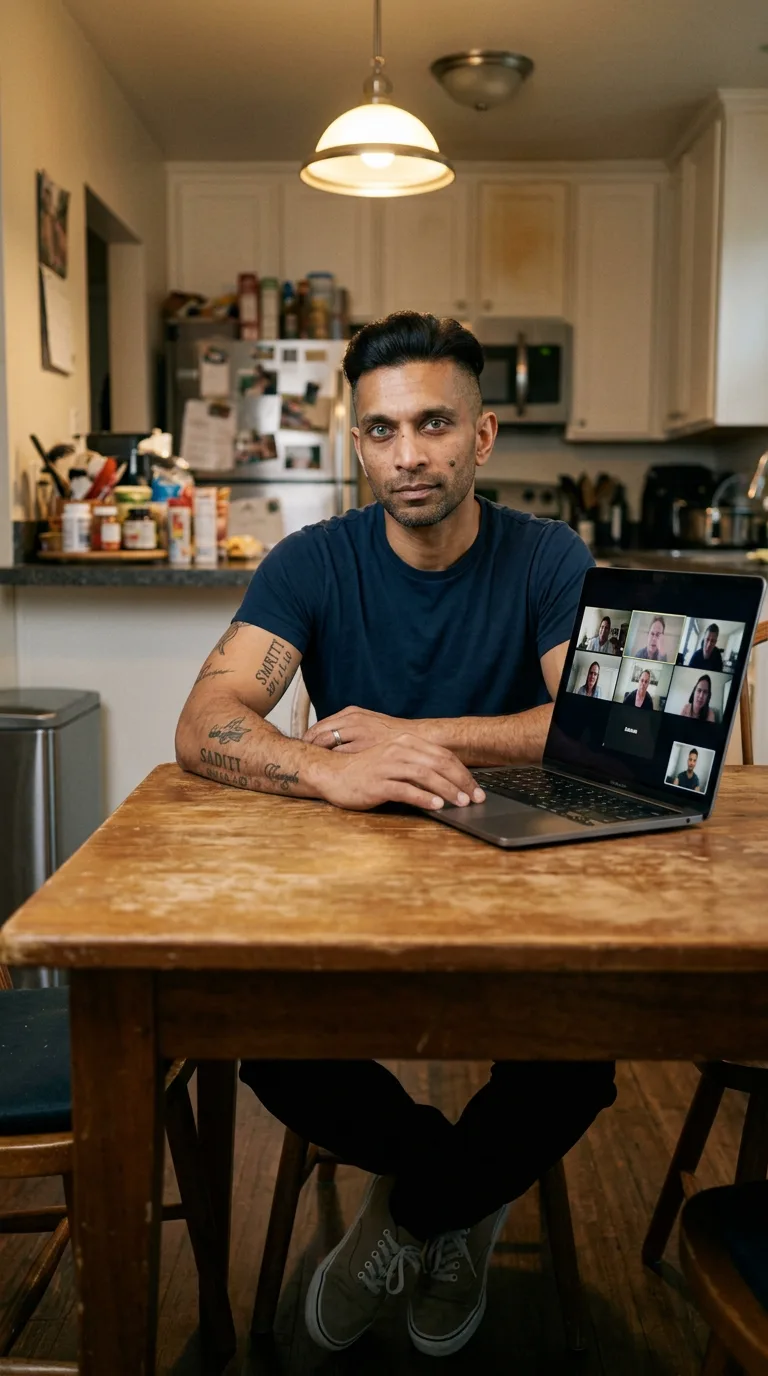
Rarest thing about him: Heterochromia — legendary, 1 in 200
Season 0seed 1640056910 · engine v10
Character card
lineage COEU7T
His body-swap story
@colin.tarwater, wearing Roland Iwata, rolled the wheel on and woke up as Sabir Oberoi, spent 6 minutes in him, then spun the wheel and woke up as Danny Pruitt
The picker gun is heavy in Roland Iwata's hand, and the cold in the warehouse has settled into a place behind his knees that never quite leaves anymore. Fifty-seven times you have stood in someone else's weight and felt it start to fit, and fifty-seven times you have decided it fits badly. Roland has been you for less than a minute. That is enough. There is a Saturday morning smell of cardboard and someone else's cigarette break drifting in from the dock doors, and you set the gun down mid-scan, walk to the break room, take out the phone this body owns, and open the page with the wheel on it, because boredom in a body is the purest kind there is — it has no memory to argue with it.
You spin.
You are sitting. There is wood under your forearms, old and scarred smooth, and a warm rectangle of light thrown down from somewhere above your head, and in front of you a small bright window full of frozen faces, one of them yours, small, waiting. Your own mouth is already open. Weight settles into you all at once — shorter than Roland, tighter, warm through the shoulders in a way that says exercise done recently and often — and you hear a voice come up out of your own chest before you've decided to use it, testing itself, too loud in the quiet kitchen. "Hello? Hey — can you guys hear me?" The face on the screen across from you stays frozen mid-blink. Nobody answers. You are already sitting up straighter, dead centre in the little lens, before you understand that this is wrong, that this stillness is not a bad connection.
The wood under your arms is the first thing that talks. It is a kitchen table, somebody's grandmother's maybe, and the memory that comes up through your forearms is of refinishing it one August with the windows open and the radio on, Sabir's hands raw with the smell of tung oil, his wife laughing at him from the doorway for taking three coats when the internet said two. Under your right hand, the aluminum edge of the laptop gives you the rest of that morning in a rush — coffee, the low murmur of the six a.m. news, the particular ache low in his back from yesterday's session at the gym, three hours holding pads for a middleweight who hits harder than he thinks he does.
The t-shirt against your back gives you the way he dressed this morning without looking, the way you dress when your body has been the same shape for twenty years: reaching for the navy shirt because it was on top, not because he chose it, sliding his left arm through first out of some old habit from splinting a broken wrist in his twenties, the wedding band catching for half a second on the cotton the way it always does and needing to be tugged free. Under the fabric, the tattoos come up warm, private, specific — his daughter's name in his wife's handwriting run through a date on his left forearm, RESILIENCE lettered plain on the right where the sleeve used to sit before he started cutting the sleeves off everything because the gym runs hot and he stopped caring what it looked like. Smriti. Sadit. Names he loves saying inside his own head even when nobody's listening.
The chair under you gives up the ordinary five years of Saturdays like this one — a call with people from church, a men's group thing his wife signed him up for that he grumbles about and never misses, sitting here in the smell of his own kitchen with the fridge humming and the light too warm for the hour, because whoever built this house put the good bulb in the wrong fixture and nobody's ever fixed it. There's a low, steady hum underneath all of it that isn't a memory so much as a fact of the body: a tightness behind the sternum that isn't fear, a thirst that never quite goes away, insulin somewhere in a drawer he's careful never to mention to the fighters he trains, because a man who tells you how to survive twelve rounds should look like he could survive anything.
There's a jaw doing something on its own — clenching, unclenching, an old tell from a hundred corners between rounds, shouting instructions nobody in the ring could hear over the crowd — and under that, further down, something that isn't in the shirt or the table: her. Not the wife. The other one. A porch somewhere in another decade, a screen door, a version of his life he didn't take, surfacing for one full unbidden second with a taste like unfinished business, gone again before you can hold it. He married the right woman. He still keeps the other one somewhere he doesn't visit on purpose.
The screen in front of you unfreezes on its own timer, faces resolving into people laughing at a joke you missed, and one of them says his name — Sabir? — like they've been calling it for a while.
You look down at your hand on the table before you answer. Tattooed, ringed, a mole riding high on the cheek you can't see but can feel like a coin under your own touch. You turn the hand over once, like it might explain itself, then lift your eyes to the little glass circle at the top of the screen instead — the only lens available to look into — and say, easy, testing the new weight of your own voice:
"Sorry — lost you for a second there."