Russell Kopecky
Fictional. Generated by AI — not a real person, and no likeness of one is intended.
40, machinist in Phoenix · rolled by @colin.hasbrook · card — no film
History
who has worn him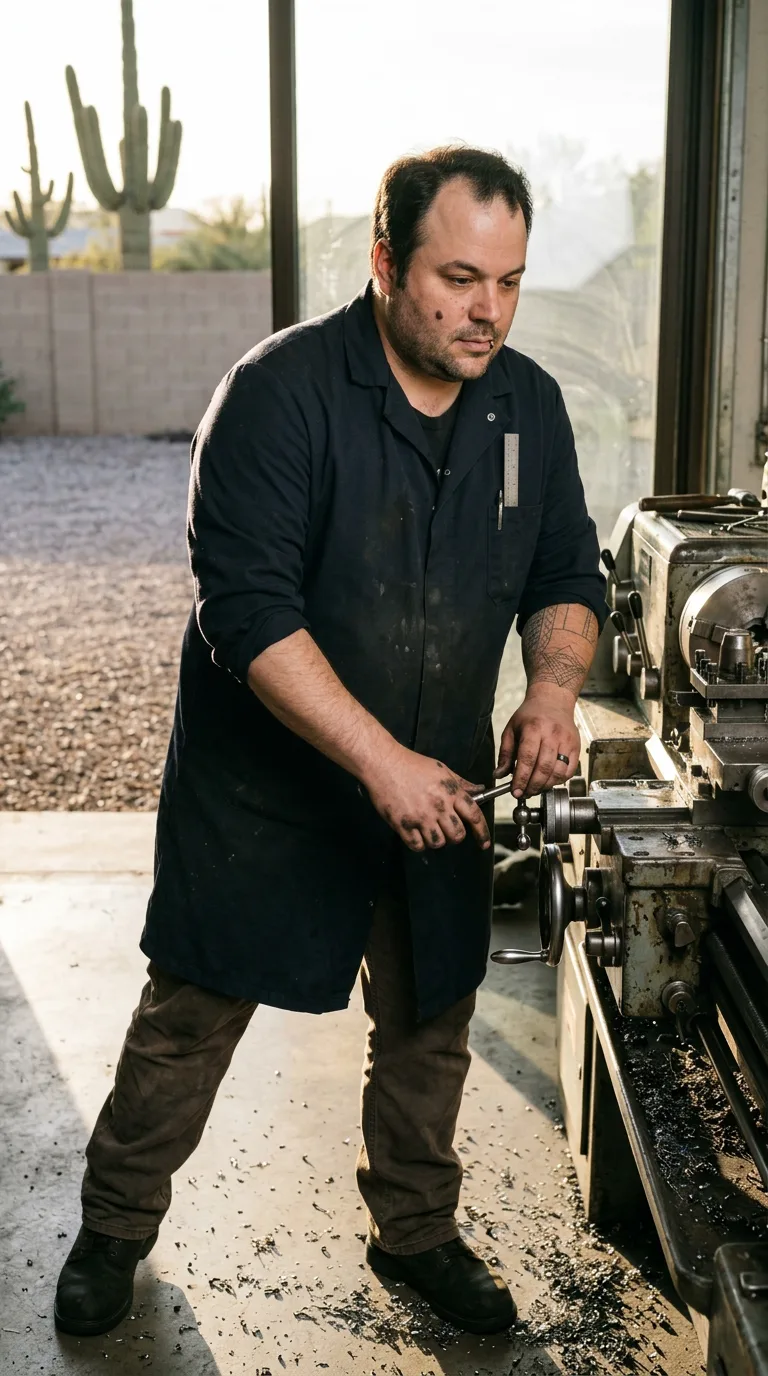
Rarest thing about him: Lip — rare, 1 in 212
Season 1seed 149969280 · engine v11
Character card
lineage 2NZHHJ
His body-swap story
@colin.hasbrook, wearing Casey Vellum, rolled the wheel on and woke up as Russell Kopecky, spent under a minute in him, then spun the wheel and woke up as Gary Ostrowski
You are standing in a kitchen that smells like somebody else's dinner, wearing hands that are not calloused enough. Three minutes ago you were nothing — a coin drop, a spinning wheel — and now you are Casey Vellum, 24, average in every direction, a wrench heavier in your borrowed grip than it should be. Detroit is going amber outside a window that isn't yours to remember. You flex fingers that feel new and thin and wrong. Three minutes is not enough time to want anything from a body. That's the problem. There's no ache in it yet, no traction, nothing to lose. You paid for Casey and Casey gave you nothing back but the smell of pipe dope and a mild headache behind eyes that are, technically, on loan. You open the site again on a phone that lights up blue in a hand you don't trust yet. You spin.
Half a world of clock away, in a yard the color of a struck match, a lathe is turning and a man's hands are not on it, exactly — they're on it the way ten thousand nights make a hand move without a mind attached. Steel curls off the bit in a bright ribbon. The motion breaks. One pass comes out wrong — a half-thou too deep, felt before it's seen — and then, slow and correct, it comes out right, and the ten after it come out right too, each one checked like the machine has never been trusted before in its life. Nothing about the arm changes. Everything about who is running it does.
The shirt is what starts it — not a shirt, a coat, canvas gone stiff with old oil, buttoned wrong at the collar from a hand in a hurry. It comes back through the shoulders first: a Thursday, early, cold enough in the yard to need it, a wife's voice from somewhere inside the house asking if he's taking Mateo to the dentist Friday or if that's her, and him saying he doesn't know, ask him again when he's not elbow-deep in a headstock. The coat remembers being put on. Left arm first, always, because the sleeve catches on the ink there — the fine geometric lines wound around the right forearm, six sessions over two winters, a shop three miles from here, a guy named Ruiz who talked the whole time about his kid's soccer and never once looked up from the needle. That arm still tightens with the memory of sitting still through it.
The lip ring is a smaller thing, metal warm from his own mouth, and it brings back nothing dramatic — just a version of himself ten years younger, a version his wife likes to say she fell for before he "got sensible," a joke they've had so many times it isn't a joke anymore, it's just a thing she says while she is putting dishes away and he is taking his boots off by the door. The wedding band is heavier. It always surprises him, still, twelve years in, the weight of it — cheap and plain and bought in a hurry because neither of them had money then, and neither one of them has ever wanted to replace it with something better, because better isn't the point.
The floor under his boots is concrete he poured himself two summers ago, extending the slab so the machine would have somewhere dry to live besides the garage, and the memory of that comes up through his soles — the ache in his lower back that lived there for a week after, his son sitting on an overturned bucket handing him tools he didn't ask for, four years old and useless and wonderful about it. The gravel yard past the open bay, the saguaros standing around like they're bored of the view, the light coming in low and orange and relentless the way it does every single afternoon here, indifferent to the fact that a man's whole life is stacked up in a garage full of dirty rags and one very old lathe he bought off a guy retiring out of Tucson.
His body carries what forty years of standing at a machine does to a person — the heaviness through the middle that he stopped fighting around thirty-five, the low complaint in both knees by four o'clock, the strength still living stubbornly in the forearms and the grip, hands that know a micrometer the way another man's hands know a steering wheel, without looking, without deciding to. The stubble itches faintly along the jaw where he didn't shave this morning, didn't shave yesterday morning either, wife teasing him about it over coffee, said she liked it, said it some other way too that made him grin into his mug. There's a mole high on his cheek he has stopped seeing in mirrors decades ago, the way you stop seeing anything that's always been there.
Nobody taught him to run a hand over his scalp when he's thinking. It just started somewhere in his thirties, when the hair up top thickened with worry about the hair at the temples going, an M cut into it now that no barber's trick disguises, and the habit outlived the vanity — now it's just what the hand does, unbidden, between passes on a job, a small private punctuation mark nobody else ever notices.
You look down. The hand on the lathe's handwheel is thick-fingered, ink-stained at the nail beds, a wedding band catching the light, and it does not startle you the way three minutes in a stranger's kitchen did — it settles, heavy and known, like sitting down after a long walk. You lift it off the wheel and turn it over once, palm up, watching steel dust shift in the crease of it.
"Okay," you say, to no one, to the cactus outside, to the wife you have not met yet who is somewhere in the house behind you not knowing anything has changed. "Okay."