Russell Dahlgren
Fictional. Generated by AI — not a real person, and no likeness of one is intended.
48, construction foreman in Los Angeles · rolled by @owen.prescott · card — no film
History
who has worn him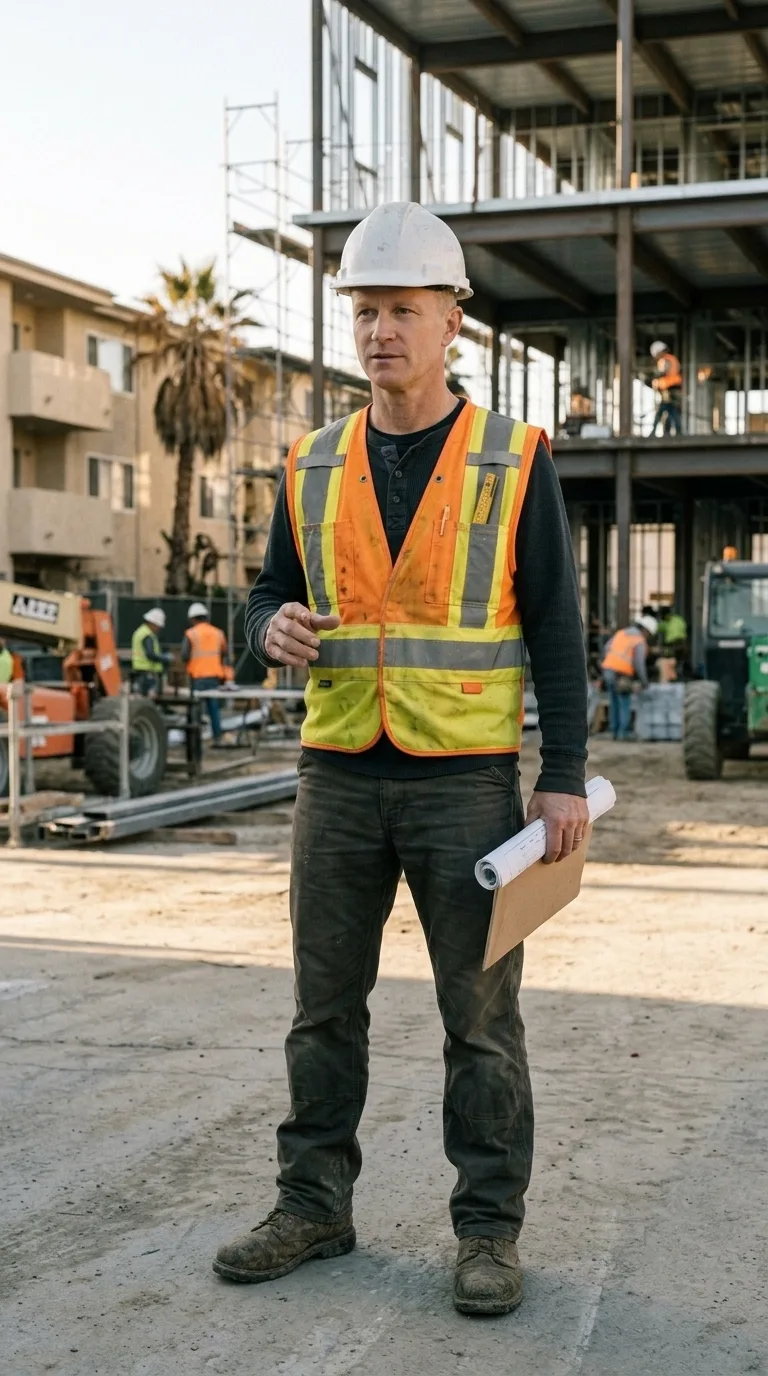
Rarest thing about him: Construction foreman — common, 1 in 125
Season 1seed 496809955 · engine v11
Character card
lineage 5OR92V
His body-swap story
@owen.prescott, wearing Lamont Whitfield, rolled the wheel on and woke up as Russell Dahlgren, spent under a minute in him, then spun the wheel and woke up as Travis Whitecloud
You are standing in Lamont Whitfield's kitchen in Chicago, mid-morning, and the bag by the door still has someone's lunch order in it, cooling. His knees ache from the stairs. His shoulders are wide and strong and carry nothing you want. You have been him for less than a minute, and already you are looking past him.
It is not that he fails you. It is that Emilio's hands were in your head all morning, the thin wrists, the ledger-cramp in the right thumb, the way the boy laughed with his whole goatee. You wore him fourteen minutes. You left him at a desk in New York, and Lamont's big body feels like a coat cut for a stranger, and the phone is already in your hand, and the page is already open, and you are not going to say why.
You press the wheel. It turns.
Early light, wet cold dust, a steel frame ringing somewhere above. You are mid-stride with a roll of drawings under your left arm and your right hand in the air, making the small flat gesture of a man telling someone to hold. Your hand does something wrong, a half-second slip in a motion it has made ten thousand times, and you stop it, and you do it again slowly, correctly. Then ten more, each one checked, a hand learning that you are in it.
The body is short and tight and solid. Forty-eight years sit in the lower back, a low steady hum, and in the right knee. Your scalp is cool where the hair has thinned at the crown. Your jaw is smooth, freshly shaved, and it smells of soap under the dust.
You touch the vest, and the zipper-sound of Velcro opens a morning. A kitchen, dark still, a woman's back at the counter pouring coffee into a thermos, not turning around. His hands, not yours, threading the left sleeve of the black henley, then the right, pushing the cuffs to the forearm. A small voice from down the hall, their kid, asking if it is a school day. He says yes, buddy, and feels the tenderness all the way down like a plumb line.
The pencil in the vest pocket. You close your fingers on it and a job comes back: a crane that nearly swung wrong in the wind, nine years ago, his own voice going very calm. He has not raised it since. The tape on the vest gives you a crew, a laugh, a man named Ortiz he trusts with the heavy things.
The ring is warm on your left hand. You turn it with your thumb and a church comes, folding chairs, a hymn, his wife's shoulder against his. A little saved, careful money, which he thinks about more than he says. And Emilio. He knows Emilio, the kid he talks into steadiness on the phone, and you know the other side of that, from inside Emilio's chest.
You look at your hand. It is square, scarred by nothing, the band plain on it. You turn it over.
Then you look up and say, quietly, "Okay, Russ. Show me what you do."
Under it is the question that never leaves: how long. An hour, a year. Whether the wanting is already stirring in his chest.