Ruben Solorio
Fictional. Generated by AI — not a real person, and no likeness of one is intended.
28, sales rep in San Francisco · rolled by @toby.lankford · card — no film
History
who has worn him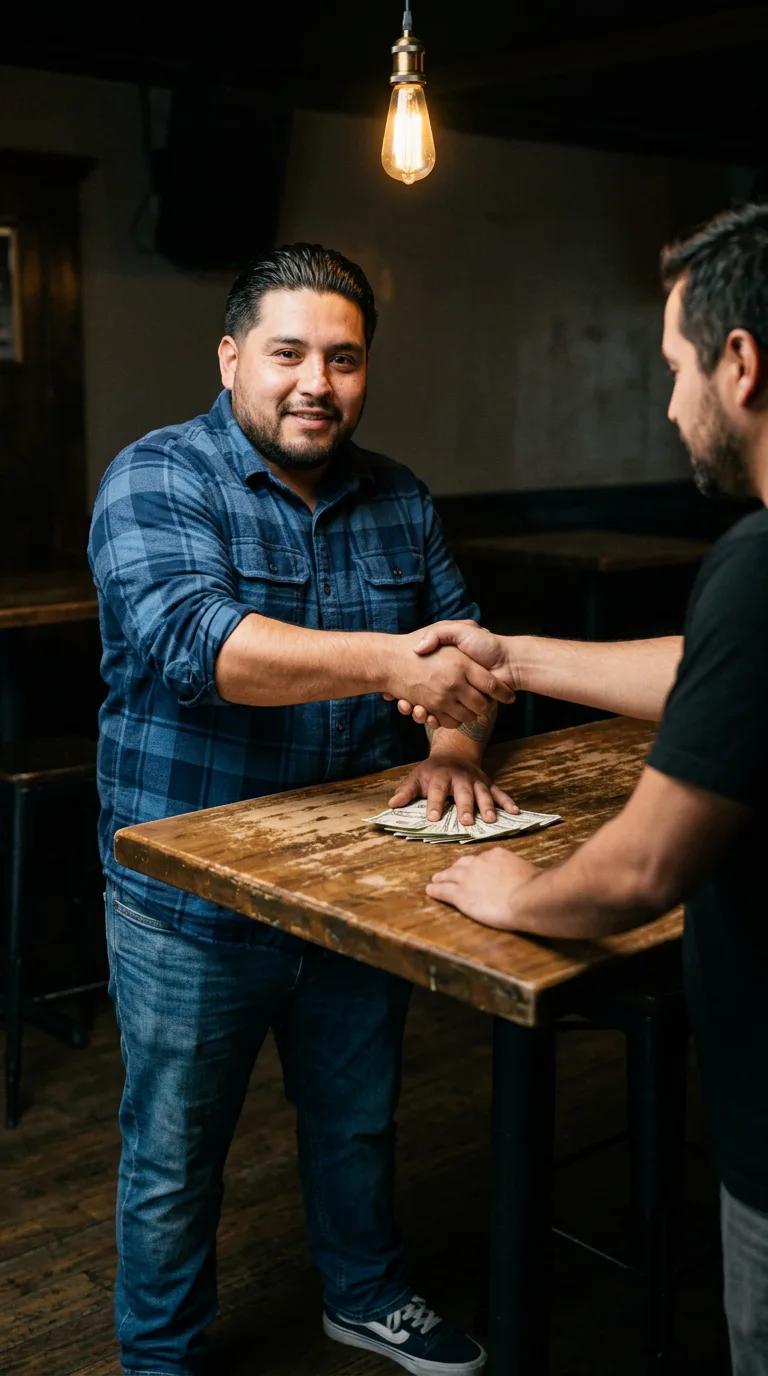
Rarest thing about him: A tremor in the hands — epic, 1 in 504
Legacyseed 2127119758 · engine v8
Character card
His body-swap story
---
You have watched him for eleven days and you still do not know him. That is the whole point. A stranger is cleaner. A stranger has no one in him who will look at you across a kitchen table and say *you're not you.*
You found him the way you find all of them — by listening at the seams. Ruben Solorio has seams. He is a man who has been folded and unfolded too many times and the creases have gone soft. Twenty-eight years old, five foot eleven, built heavy in the way of men who were once built solid and then stopped moving. Black hair combed straight back and kept long on top, short at the sides, the kind of cut a man gets when he wants to look like he has a plan. Brown eyes. And freckles — that is the thing, that is what you noticed first and cannot stop noticing, a scatter of them across the bridge of his nose and up onto his cheeks, boyish, absurd on a man that size, the one part of him that never learned to be tired.
You watched him in a hotel lobby off Mission, lanyard around his neck, badge turned backwards, waiting out forty minutes between one meeting and another. He sat in an armchair with his phone face-down on his knee and did not look at it. His right hand rested on the arm of the chair and shook. Not badly. A fine steady buzz in the fingers, the kind that would spill a full cup, the kind that has been there long enough that he no longer notices he keeps his coffee half-poured. Sleeve pushed up, and there on the inner forearm the unit insignia, greened out a little, the ink of a nineteen-year-old who wanted it permanent. He had gone to war and come back with a tremor and a prescription and no story he would tell at a table.
You followed him down the hill to the house on the street too steep for the driveway they cut anyway, and the under-house garage below the bay window where he sleeps because the room is fifty dollars less than the room upstairs. Cold white light in there. A shop light on a chain, no shade. He does not decorate. There is a folding table, and on the folding table there is a small stack of things his grandmother left him and a saucer with water in it he changes every few days, and a candle he lights and does not always explain to the girlfriend, who is patient about it in a way that costs her something. He prays to people who are dead. He does it awkwardly, half-remembering, and he does it anyway. That is the part of him you almost respected enough to walk away from.
He has been sober four years. Not a program, not a sponsor — a decision, made once, held onto with both hands like a rail on a boat. No cigarettes, never wanted them. In the bars he drinks club soda and gets there early so nobody watches him order it.
Eight thousand dollars in the world, give or take, most of it money he has not spent yet on the thing he is saving for.
And a woman he does not talk about. You learned about her the way you learn everything, by watching what a man's face does when nothing is happening. There is a name in his phone with no photograph and no messages since a Tuesday two years ago, and once, in the lobby, his thumb hovered over it for the length of a slow breath before he turned the screen face-down on his knee again. That is the one who got away. The girlfriend is real and good and does not know she is in second place, and Ruben would sooner die than tell her, and that too is a kind of loyalty.
So. A stranger. Clean. Freckled. Shaking.
But you cannot simply take. That is the rule, and it has never once been bent for you. There has to be a door and he has to open it. He has to *deal.*
So you got a body to wear for one night — a borrowed thing, a man in a black t-shirt with a jaw and a grey wash in his hair — and you sat down across a high wooden table in a bar on Folsom where the pendant bulb hangs low and yellow and the tabletop is scarred like it has been sanded by every hand that ever leaned on it.
You talked about nothing for an hour. You bought him club soda and did not comment on it. You got him to laugh twice. And then you got to the thing you had come for, which was a bet, because a bet is the only contract a man like Ruben will sign without reading.
You said: *I don't think you can keep a secret.*
He said: *Try me.*
You said: *No — I mean a real one. Something that would cost you. You'd tell somebody. Everyone does.*
And you watched the freckles go still on his face, because you had just walked, in the dark, straight into the room he keeps locked. He has one. He has kept it for four years and two years and nine years depending on which one you mean. He has kept it through therapy and through Sunday dinners and through a woman crying in a parked car asking him to just *say* something. Keeping it is the only thing he has ever been unquestionably good at.
*Name it,* he said. *Name the stake.*
You put down a stack of bills. Not much — a few hundred, enough to matter to a man with eight thousand dollars, small enough not to smell like a trap. *This,* you said, *against whatever you've got on you. You keep one thing to yourself for the rest of your life and I never find out what it is. If I ever learn it, I win.*
He grinned. God, he grinned. Because it was free money. Because he had already won it years ago, on a night he does not talk about, and every day since had been the collecting.
*Deal,* he said.
And his hand came across the table and clamped down on yours over the bills, warm and heavy and shaking, and you felt it — the door, opening — and you thought, with something almost like tenderness: *no term on it, Ruben. For good.*
The hands part. The bills slide toward the edge of the table and start to go over.
And there he is, sitting back, easing his weight onto his heels, wearing the grin of the man who won.
You come up behind the grin like water filling a boot.
For one second the light is in him — that white cold light, the shop-light-on-a-chain light, coming out of him instead of falling on him — and then it snuffs, and the grin drops off his face like something unhooked, and he is loose, standing there, breathing, empty.
Then you take the breath. It is a bigger chest than you expected. There is a knee that does not like being stood on. There is a low hum of medication somewhere behind the eyes, and under it, banked and quiet, a grief with a woman's name on it that you can now read like a page. There is the tremor — you lift the hand and it is still shaking, and you understand suddenly that it will keep shaking, that it was never his nerves, it is just the wiring, it comes with the body, it comes with you now.
You turn the hand over. Palm, then back. The freckles keep going right up over the knuckles; nobody ever told you that. On the inner forearm, the insignia of a unit you were never in, a promise made by a boy who no longer exists.
You paid nothing for it. That is what a bet is.
You look up, off the hand, into the room — and the room is a bar with a yellow bulb and a man in a black t-shirt slumped forward over the table like he has had a long night, and the bills are on the floor now, fanned out where nobody has noticed them yet.
*Deal,* you say, in his voice, to no one.
You keep the secret. You have to. It was the terms.