Rubén Salinas Cantú
Fictional. Generated by AI — not a real person, and no likeness of one is intended.
60, hotel housekeeper in Rural Texas · rolled by @declan.michael.farrow · card — no film
History
who has worn him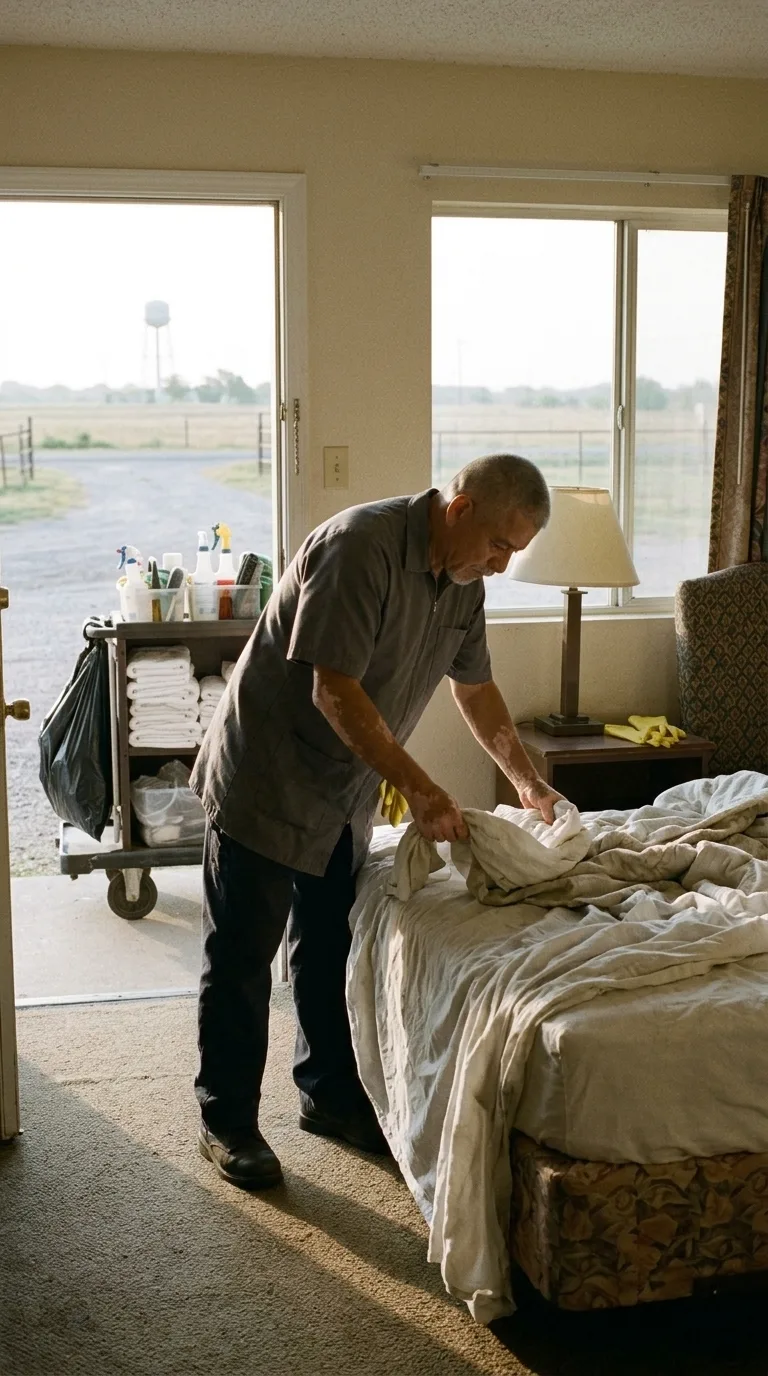
Rarest thing about him: Vitiligo — uncommon, 1 in 123
Season 1seed 1817183455 · engine v11
Character card
lineage 5OR92V
His body-swap story
@declan.michael.farrow, wearing Nathan Cole Verhoeven, rolled the wheel on and woke up as Rubén Salinas Cantú, spent under a minute in him, then spun the wheel and woke up as Cody Wayne Pritchard
You are standing in Nathan Verhoeven's kitchen with a mug going cold, and the thing that sent you back is the quiet of it. Thirty-four years of him, and he is soft where you wanted strength, short of breath on the stairs. This morning the stairs were the whole argument. Somewhere in him a child had been sick in the night, and a message from a parent was waiting on his phone. It was a stranger's worry, and it sat in your chest as if it were yours. You did not want to carry it. Nobody warned you that wearing a man means also wearing his Wednesdays. The chinstrap itches, and the page is already open. The wheel turns the way it always does, and Nathan is gone before the mug touches the counter.
The sheet is in your fists. That's the first thing: cotton, damp with a stranger's night, pulled taut off the corner of a mattress. There is light low through the glass door, gray going gold. Your back bends over the bed and something in it objects. Your hands were mid-motion and they finish it, a flick and a tuck, and it comes out wrong. Half a second of wrong. Then again, slowly, correct. Then the next one, checked, and the next. You check each one, because you don't trust a body you have owned for a heartbeat.
The sheet gives you the first memory. It is the smell of bleach and old sleep, and under it, his morning. A kitchen with the light off so as not to wake her. Beans warming. The shirt coming off its hanger, gray, the zipper cold under his thumb, the left sleeve first because his shoulder likes it that way. He zips it to the breastbone, never higher. He thinks of the Lord in the same breath as the zipper, the way he always does, a short thank-you before the boots. The boots are wet at the toe from the gravel. The laces know themselves.
The ring turns on your finger as you grip. Gold worn thin. That is Marisol, thirty-some years back, a church basement, a borrowed suit that pinched. His feeling is plain and enormous and has no words in it. Then the money: a number he carries like a stone, the house worth less than he owes on it, a figure he does not say aloud even to her. Two children, grown and far away, and the phone calls that come on Sundays. You feel how much he waits for them.
The yellow glove is on the nightstand. You pick it up, and the rubber gives you cigarettes. Twenty years ago, behind a dumpster, shaking, a quit that took three tries and one prayer he is still faintly embarrassed to have meant. Your thumb goes looking for the pack that isn't there. Then your knuckles crack, both hands, without you asking. That is his. It's a habit older than the faith.
Your knees ache, sixty years' worth, and the arches of your feet burn. The forearms are strong, a rope of use. In the window, past the cart, the water tower stands over the fence line and the flat, wire-stitched fields. He has looked at that tower ten thousand mornings and never once wondered at it. You wonder at it for him.
Then you look at your hands. Pale patches map the backs of them, white islands on brown, and the ring sits in the middle like a small flat sun. You turn them over. You lift your eyes to the glass, to the face half-pale in it, and you say, in a voice that has never sounded like yours, "Buenos días." It comes out gentle. It comes out like his.
You don't know how long you get. The wanting is quiet now, but it's there, like the tower on the horizon. You flex the fingers. You wait to learn what this one will let you keep.