Ruben Castellanos
Fictional. Generated by AI — not a real person, and no likeness of one is intended.
40, machinist in Seattle · rolled by @colin.hasbrook · card — no film
History
who has worn him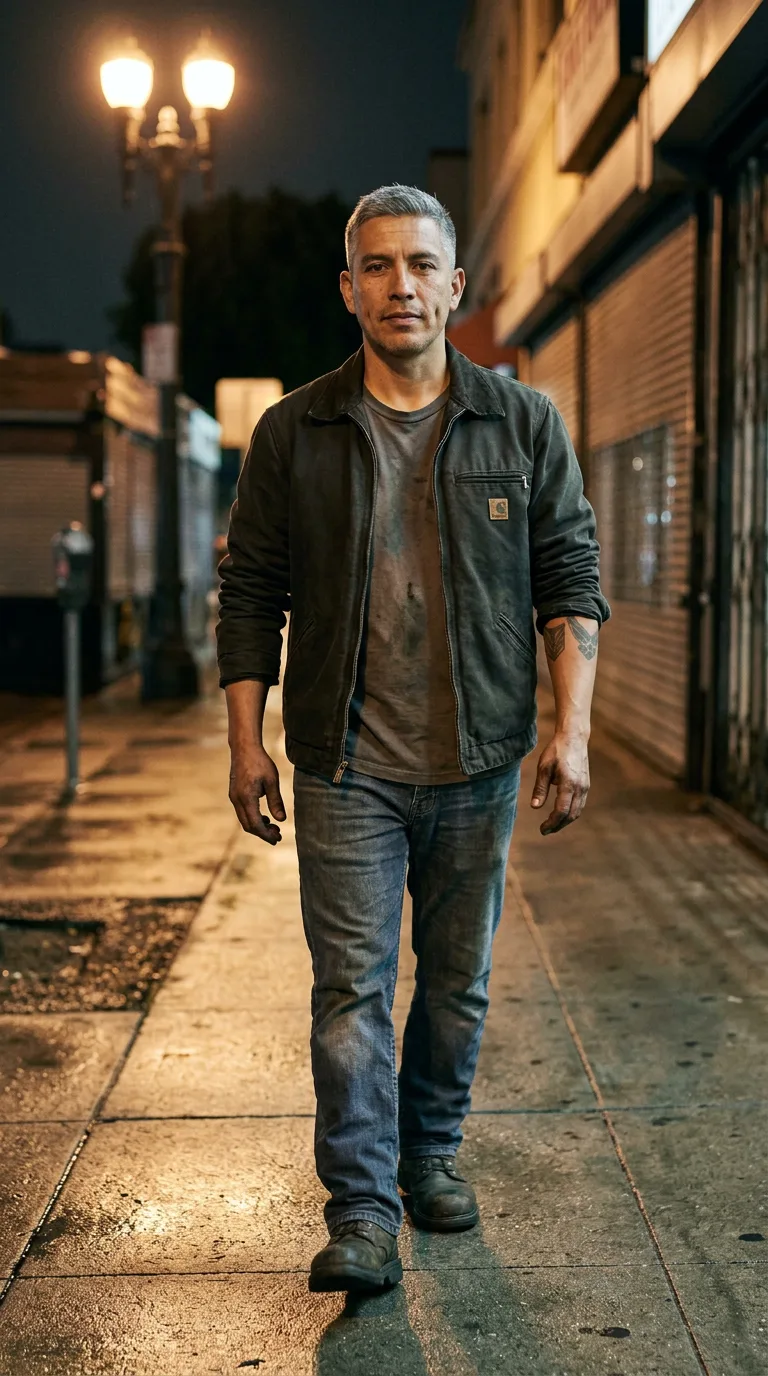
Rarest thing about him: Pulls at his beard — epic, 1 in 203
Season 0seed 1873815677 · engine v10
Character card
lineage 2NZHHJ
His body-swap story
@colin.hasbrook, wearing Danny Iwasaki, rolled the wheel on and woke up as Ruben Castellanos, spent under a minute in him, then spun the wheel and woke up as an unnamed body
The lazy eye is the tell. Danny Iwasaki's own mother used to joke he was always looking somewhere past you, and standing in his kitchen at eleven in the morning, in his dad-bod, in his flannel that smells like bar soap and pine sap, you catch your reflection in the microwave door and it's still doing that — drifting off, off, off — and you are so tired of it. Nine days, or is it eleven, in this logger's body in Western Kansas, a landlocked man in a landlocked state, and the eye never once pointed where you wanted it to. You have chainsaw scars up both forearms that aren't even yours to be proud of. You loved the size of him for about four days. Today you don't. That's reason enough. You open the laptop on his kitchen table, the one with the sticker half-peeled off the lid, and you go to vessel.cards, and you spin.
He stumbles off the curb.
The rain has made a mirror out of the street and his shoe catches the lip of it wrong, and for half a second there is a stranger's whole body doing the falling — short, compact, thick through the shoulders in a way Danny never was — and then a parked Honda's front fender is under your palm and you are standing again, upright, in him, and the falling was his, but the catching was already yours. His heart is going in that after-drink way, too fast for how slow his feet are moving. Behind you a streetlamp throws your own shadow out long and orange on the wet sidewalk. Two in the morning. His jacket is open to the rain.
The forty steps that follow are the quietest thing you've ever done in a stolen body — no scuff, no stumble, heel-toe, heel-toe — and it isn't you doing that, not exactly, it's something in his legs that knows this street even drunk, even now, muscle laid down over twenty years of walking somewhere. You turn left at the corner. It is not the way home. You don't know that yet. He wouldn't have known it either, but for a different reason.
The jacket is what opens first — canvas gone soft at the elbows, a Carhartt patch worn to a ghost of itself — and through it comes a Tuesday, cold, him getting laid off from the boat-canvas shop for the second time in six years and standing in a parking lot in this exact jacket not calling anyone, because who do you call at forty when the last person you'd have called moved out four months ago and took the good coffee maker.
The tattoo on his arm burns under the wet sleeve like it's asking to be read: an eagle, wings cocked, over a shield — and it comes with heat and dust and a barracks in a country he doesn't say the name of even to himself anymore, twenty-two years old and certain of something he can't get back to certain about now. Four years of that. He doesn't talk about it. Nobody at the shop asks anymore, not since the third time he changed the subject with his jaw instead of his mouth.
The dimples are the strange one — they're in his face right now, at rest, doing nothing, and somehow that's the memory: her, the ex, the one who still matters, telling him on a good morning that she fell for the dimples first and the rest of him second, and how much that used to make him laugh, low, from somewhere real. There's a kid too — a boy, seven, maybe eight, whose drawing is folded in the wallet against your hip, creased soft as cloth from being carried and never once thrown out.
His shoes on the wet pavement — steel toes, scuffed white at the seams from grinding steel all day — bring back the lathe, the smell of cutting oil, the exact particular satisfaction of a part coming off true to a thousandth, his hands (not yours, not yet, but getting there) knowing the machine the way a tongue knows a missing tooth. He pulls at his beard when he's not thinking, and even now, mid-stride, stolen, half his fingers are already drifting toward his jaw before you catch them.
Under the buzz you can feel the pills doing their quiet work, a low hum instead of the spike, some doctor's careful arithmetic keeping him level enough to function, level enough that most nights he doesn't walk the long way home drunk — but tonight he did. Something in him needed the extra twenty minutes of rain on his face before he had to be alone in that apartment again.
You reach the corner. You stop turning left. You stand under a coffee shop's dead neon, closed for hours, and lift both his hands up in front of his face, turning them — thick fingers, oil worked so far into the creases it will never wash all the way out, a body forty years old and still strong through the forearms in a way that has nothing to do with a gym.
You say, out loud, to the empty street, in his voice and not Danny's lazy-eyed drawl: "There you are."
Somewhere behind you, in Kansas, a chainsaw sits untouched in a shed and a body you no longer want is standing at a kitchen table with a laptop still open.
You don't know yet how long you get to keep the dimples.