Rolando Esteves
Fictional. Generated by AI — not a real person, and no likeness of one is intended.
55, manager (mid-level) in New Orleans · rolled by @rolando.esteves · card — no film
History
who has worn him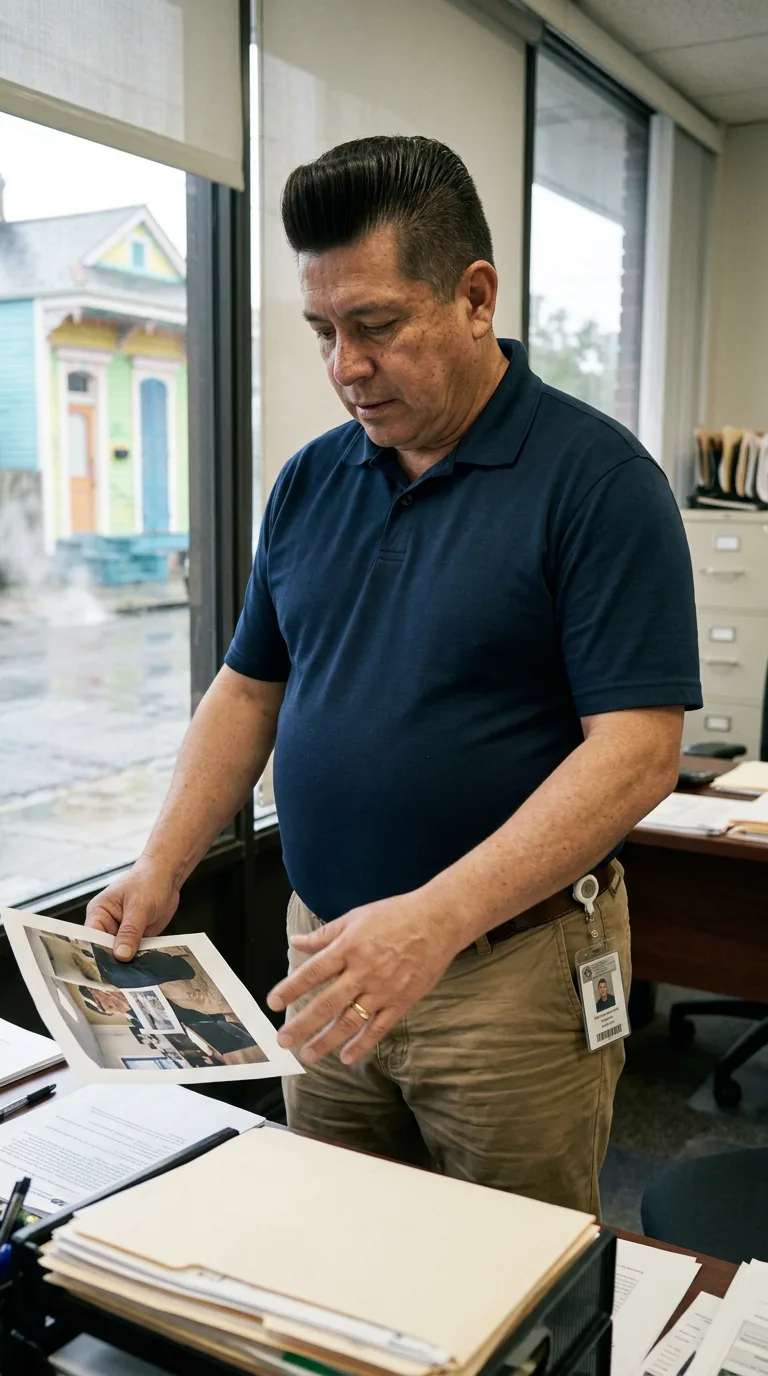
Rarest thing about him: A pompadour — common, 1 in 50
Season 1seed 1137368351 · engine v11
Character card
lineage RHZ4GZ
His body-swap story
@rolando.esteves rolled the wheel on and woke up as Rolando Esteves — their first
It is the middle of the night where you are, and nowhere in particular, and nothing is happening, which is the usual condition. The glow of the screen is the only honest light in the room. You have read about this for years — threads, forums, the half-believed stories of people swearing they'd been someone else for an afternoon — and tonight, for the first time, there is a page instead of a rumor. vessel.cards. A wheel rendered in flat gray, almost bored-looking, like it has done this a thousand times and will do it a thousand more. You pay without letting yourself think about it, because thinking about it is how you talk yourself out of things. You spin.
There is no countdown, no light, no ceremony. There is a man's hand, and then it is yours.
It is early afternoon in New Orleans and the steam is still coming up off the wet street outside a glass-walled office, and you are holding a printed photograph at arm's length, comparing it to something on a desk, and your hand — his hand — does not immediately do what you tell it. The motion comes out wrong, a half-second lurch, your fingers closing on the wrong corner of the page, and then you correct it, slow and deliberate, like a man checking his own work for the first time in a decade. The ten things after that come out checked too. Measured. A job that has not needed measuring in years, suddenly needing it.
You are heavier than you have ever been. That is the first honest fact of him — a gut pressing soft against the waistband, shoulders carrying it like old furniture, a weight that sits low and settled and used to itself. The polo shirt is damp at the back where his skin is damp, and the second your attention goes to the fabric, something arrives that is not a thought so much as a Tuesday: standing in a one-room-wide shotgun house before dawn, buttoning this exact collar in a bathroom mirror with a crack across the corner, the ceiling fan ticking, his wife's voice from the next room asking if he wants coffee in the thermos or if he's stopping on the way. Pack it, he says. Pack it, you hear yourself say, inside a memory that isn't yours, in a voice that is.
The belt against his stomach gives you the weight of the ID badge clipped to it, and the badge gives you the office — glass walls, door always propped open, a habit from a boss he had twenty years ago who said a closed door makes people nervous and he never unlearned it. Freckles prickle faintly under the afternoon light through the window, a thing he has had since he was a boy in Metairie, his mother rubbing lemon on his nose every summer, swearing it would fade them, it never did. You feel the smoothness of his jaw — shaved that morning, a blade pulled careful around a face that has had the same razor habit since nineteen — and under it, old scar tissue of a different kind: the memory of a year he doesn't talk about, a stretch after his second kid was born when the drinking got to be a thing he had to notice, and then a thing he had to stop, quietly, without a program, just a decision made alone in a truck in a parking lot. Nobody at the office knows that. His wife does.
The wedding band on the left hand is warm from his own skin, and it gives you the most of anything — a courthouse afternoon decades back, her laughing at something the clerk said, the two of them too broke for a real reception and not caring, and then years folding forward fast the way memory does when it isn't being careful: two kids, now grown, a house one room wide that they have never left because leaving it never once made sense. He loves her in a way that doesn't need stating to himself, which is its own kind of fact, heavier than the gut, steadier than the badge.
Your feet — his feet — ache in the arches, a manager's ache, built from decades of standing on a sales floor and then decades more standing in an office doing the same thing with better shoes. His hands know spreadsheets and inventory counts and how to calm an employee down without raising his own voice, all of it sitting there ready, untouched by you, waiting for you to reach for it.
You look down at the hand holding the photograph. It is broad, freckled across the back same as the face, the ring catching the window light. You turn it over once, like checking it's real, and it is — heat in it, calluses in it, someone else's whole life folded into the lines of it.
You lift your eyes off it, into the afternoon, into the glass-walled room that smells like rain through an open door.
"Okay," you say, in his voice, to no one. "Okay."
Somewhere behind you, in the dark where you came from, the wheel is still spinning for the next time, whenever that is. For now you stay exactly where he left off.