Roger Estrada
Fictional. Generated by AI — not a real person, and no likeness of one is intended.
51, contractor in El Paso · rolled by @colin.hasbrook · card — no film
History
who has worn him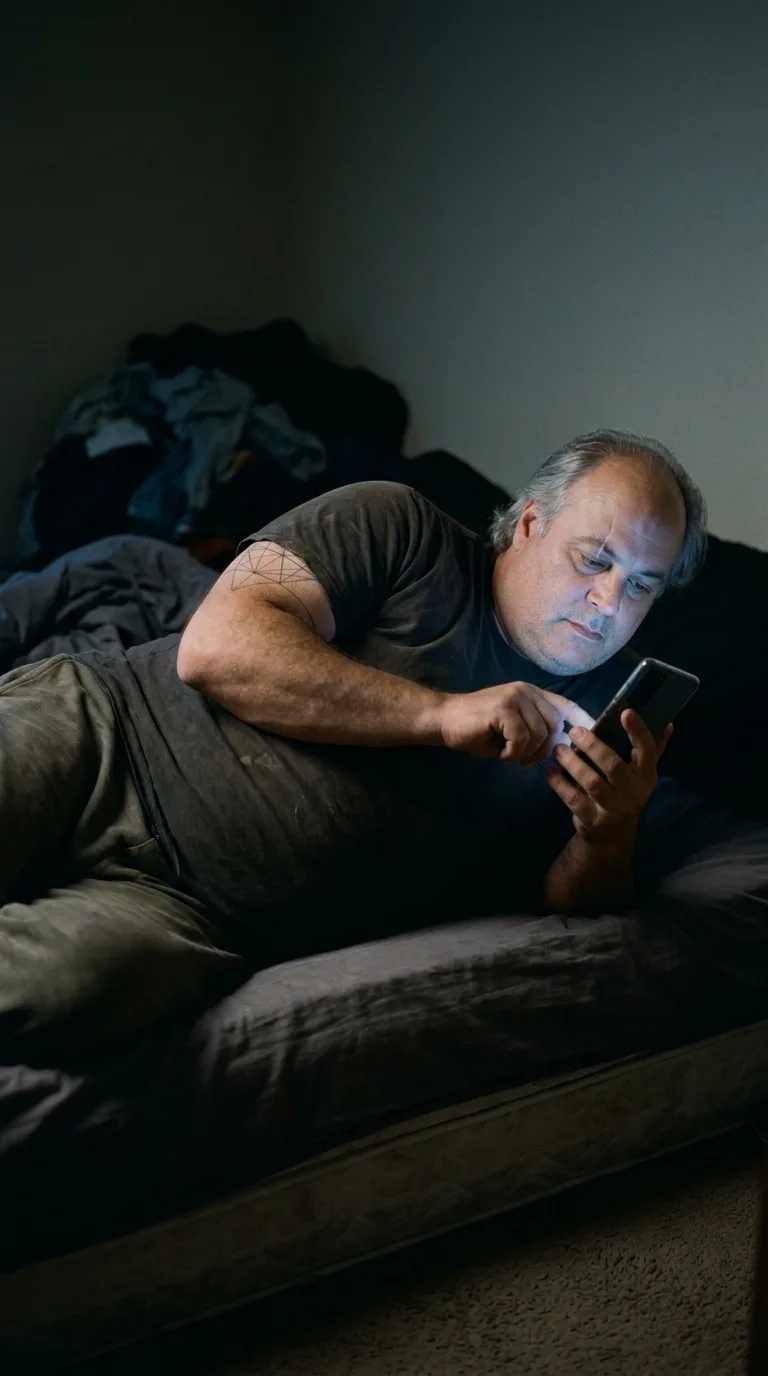
Rarest thing about him: One, upper arm — rare, 1 in 16
Season 0seed 537270015 · engine v10
Character card
lineage 2NZHHJ
His body-swap story
@colin.hasbrook, wearing Gary Petrosky, rolled the wheel on and woke up as Roger Estrada, spent under a minute in him, then spun the wheel and woke up as Yusuf Karam
The bar has been closed for twenty minutes and you are still standing behind it in Marcus's body, wiping down a rail nobody asked you to wipe, because his hands want work when his head doesn't. You've been him nine days. Long enough to know the shape of his boredom — the knee that clicks on the third stair, the ex-wife who calls about nothing, the way strangers flinch a half-second before they remember he's paid to be big and not mean. It was fine for about a week. Tonight some kid at the door called him "sir" and grinned like it was funny, and something in you that isn't Marcus at all just wanted to be somewhere the light was different. That's the whole reason, and it's enough. You lock the register, you go to the office, you pull up the site on his phone with his own thick thumb, and you spin.
The wheel stops and there is no in-between. One second you are behind a bar in Pittsburgh in a body that is starting to feel like clothes worn too many days, and the next you are on your side in the dark, a mattress giving under a heavier hip than the one you had, a phone six inches from a face that isn't yours yet either. The thumb that was already moving keeps moving — flick, flick — faster now, steadier, because you're driving it and Marcus never was. Blue light lies along a cheek gone soft with age. Somewhere behind the eyes you're wearing, a thought that isn't a thought yet is just: heavier. Older. Quiet in a different way.
Then the room comes in through what you're touching, and it comes in pieces, out of order, the way a house gives up its smell before it gives up its rooms.
The phone first — smooth, cheap case, a crack in one corner his thumb keeps finding without meaning to — and with it a flash of a woman's voice down a hallway, not sharp, just tired: *you comin' to bed or what.* Denise. Nine years now. The name arrives whole, the way a name does when you've said it every day.
The mattress under your side — no boxspring, just the frame he keeps saying he'll fix — and with it a whole Saturday: him and his second boy, Danny, wrestling the old one out to the curb, the kid laughing so hard he couldn't lift his end, Marcus laughing too even though his back was already going, even then, at forty-something, the first warning shot of what would live in his lower spine for good.
The shirt is the deep one. It's against your back and it opens like a door. This morning — his morning, ten, eleven hours behind wherever you were standing when you spun — pulling this exact gray T-shirt off the closer chair because the vest goes over it and nobody at a job site cares what's under the vest. Bending for it and the low back complaining the way it complains every morning now, a dull hot wire from hip to shoulder blade that he doesn't mention to anybody because what's the point, and there's ibuprofen in the truck cupholder like always, and there's the toothpick he doesn't even notice going into the corner of his mouth while he's still deciding about the shirt, because his jaw wants something to do and hasn't wanted a cigarette in thirty years, just this. Rolling the sleeve — the tattoo, fine lines, geometric, something he got at twenty-nine for a girl before Denise, before any of it, that he kept because taking it off would've cost more than getting it on. Boots by the door, the left one always looser, the leather gone the color of the dirt he stands in eight hours a day. Framing a wall this afternoon, joists going up clean, the smell of cut pine and the ache settling into his knees on the ladder, and one of the young guys, Ortiz, calling something across the lot that made him laugh loud enough to feel it in his chest — a good day, an ordinary good day, the kind he doesn't know to be grateful for because he's had so many of them.
Under your feet, if you had weight on them, would be the carpet of this rented house with the turquoise front nobody in El Paso comments on anymore. Three kids' voices somewhere in the memory that comes with the walls — the two grown, one still home, a girl, seventeen, who he worries about the exact right amount, which is to say too much, on his knees some nights though he'd never say it that plainly, just: *Lord, watch her.* Church on Sundays when the job doesn't eat it. A beer on Fridays, never more than two, because he watched a man he respected lose everything to more than two. The scar through his eyebrow arrives last and small — a ladder, nineteen years old, a joke he still tells wrong on purpose because the true version isn't funny.
None of it is yours. All of it sits in you anyway, heavy the way his gut sits, the way the pain sits low and constant in a spine that's carried this weight for fifty-one years without once being asked if it wanted to.
The thumb stops. You lift the phone away from the face and look past it, down, at the hand holding it — thick fingers, a white ridge of old callus, a wedding-less hand that has still, somehow, always belonged to somebody. You turn it over once in the dark like you're checking it's real.
"Denise," you say, quiet, toward the shape of her breathing three feet away, in his voice, in his accent, testing how it sits in your mouth. "You up?"
She doesn't answer. Somewhere behind El Paso, evening is ending. Somewhere behind Pittsburgh, a bar sits locked with nobody coming back for it. You don't know which clock you're keeping yet, or for how long you get to keep either.