Robert Ahlgren
Fictional. Generated by AI — not a real person, and no likeness of one is intended.
42, electrician in High-desert Nevada · rolled by @tyler.iverson · card — no film
History
who has worn him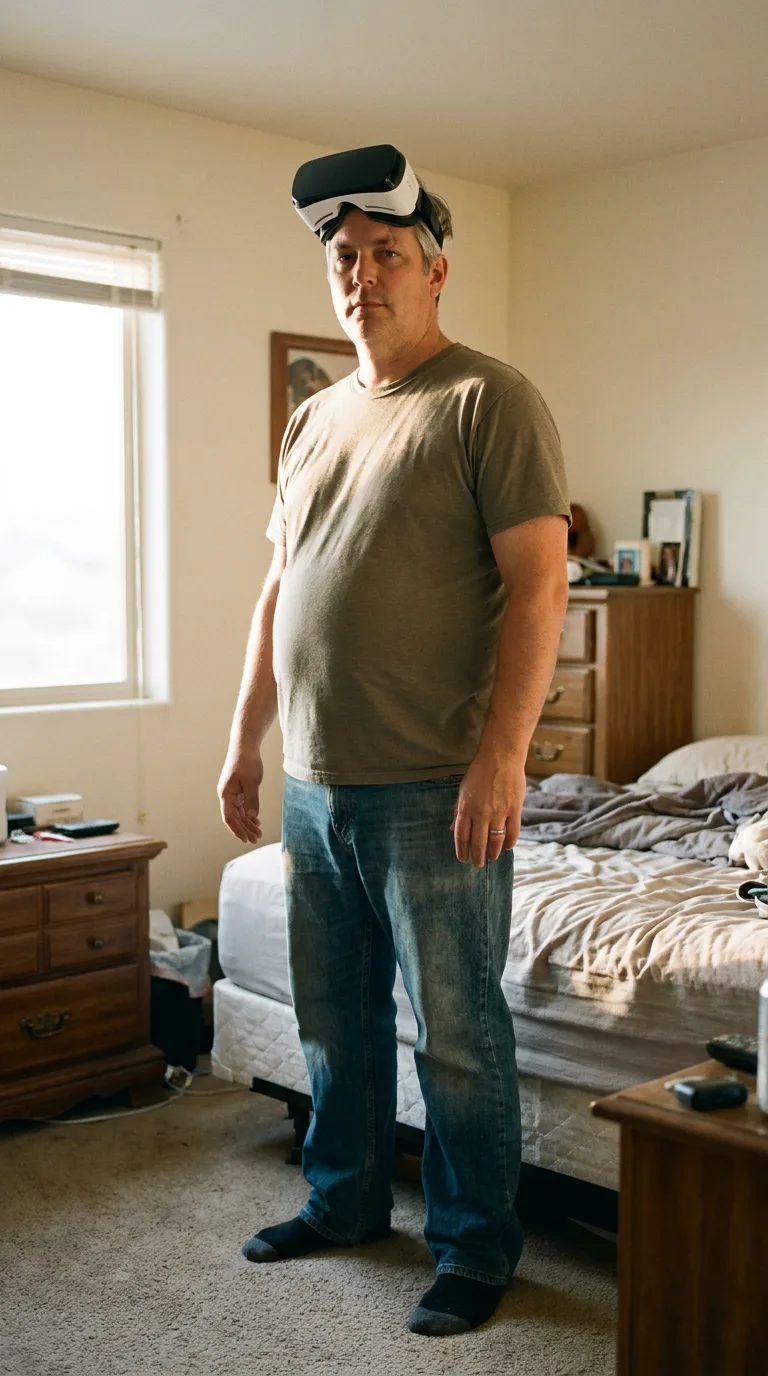
Rarest thing about him: It's a problem and it shows — rare, 1 in 33
Legacyseed 696248372 · engine v8
Character card
His body-swap story
---
You know the scar better than he does. You gave it to him — August, the yard behind the Sparks house, a length of rebar you swung at a paper wasp nest and caught him with on the backswing. He was nine. You were eleven. He didn't cry until Mom came out, and even then it was more about her face than the blood. The eyebrow grew back wrong, a pale interruption in the hair of it, and for thirty-three years it has been the first thing anybody notices about him, and the only thing on him that is yours.
So you know where to look, when you get there. You look for that first.
The lab in Henderson wasn't a lab, it was a suite behind a nail salon, and the trial wasn't a trial, it was four guys with a grant and a headset that mapped what they called sensorimotor identity. You signed up because you were dying and because they paid, and because at forty-four with a liver like a wet paper bag and a sister-in-law who wouldn't take your calls, you had no better use of a Tuesday. They put you under. Something in the handshake protocol didn't hand back. You went out into a field of soft gray light with no body in it, and you stayed there, and you don't know how long — no clocks out there, no hunger, nothing to want except the one thing, which was to be somewhere. To have a hand. Any hand.
And then Bobby bought the headset.
Cheap, secondhand, one of those consumer rigs, because his oldest wanted it for Christmas and he thought he'd check it first — that's him, that's exactly him, the man who tests the outlet before he lets the kids near it. He put it on in the bedroom of a single-wide out past Silver Springs, sagebrush right up to the metal step, hard blue shadows in the afternoon. He stood there swaying a little in his socks with his hands out, laughing at nothing, saying *whoa* the way a man says it when he doesn't want the kids to know he's impressed.
And the gray field had a door in it.
You want to tell it as if you were noble about it. You weren't. You went through the way water goes through a broken pipe — without deciding, without stopping, because that's what water is.
---
Now you're standing in his bedroom with the headset shoved up onto your forehead, the foam still warm, one strap tugging at his hair. Late sun through the blinds laying a white bar across the carpet. Unmade bed. Dresser with the framed picture on it — the three kids on a boat at Lahontan, squinting. There's the nightstand, the remote, the little pile of change.
The room is completely still and you cannot get your breath to be still with it.
Because the body isn't a car. It's a house someone's been living in badly. His lower back is a stone with a wire through it, and standing here is a decision he has to renew every eleven seconds. His mouth tastes like the inside of a bottle cap. His nails are chewed to the quick, all ten of them, ragged little crescents — you feel that before you see it, the tenderness at the fingertips, and it goes through you worse than the back does, because he was a nail-biter at nine and Mom used to slap his wrist for it and he is forty-two years old and still doing it in his sleep somewhere out past Silver Springs. Nobody slapped his wrist. Nobody was there to.
You lift the headset the rest of the way off. Blink at the real room with his eyes, which are brown, like yours were, like Dad's.
And your hands come up in front of your face.
Slow. Turned over, and back. Broad palm, thick knuckles, a scald mark by the thumb, calluses in a pattern you've never had — a lineman's pattern, wire-strippers and conduit. Plain gold band on the left ring finger, worn to a soft shine, dented on the inside curve where twenty years of pliers pressed it against the bone. You turn it into the light. You turn it back.
You had a ring once. You put it in a pawn shop in Fallon for two hundred and ten dollars and drank it in eight days.
He was the one who came and got you, after. He drove three hours, put you in the truck, said nothing about it for the whole trip except *there's water in the cupholder*, and let you sleep on the couch in this trailer for eleven days with his kids stepping over you. He put a Saint Christopher medal on the coffee table by your head and never once said he'd done it. He never once asked you for the two hundred and ten dollars either. He asked you to stop, one time, in the parking lot at Mom's funeral, and you told him to go to hell in front of the cars.
That's who I took. That's who was in here.
The house has a wife in it. She's at her mother's in Fernley with the youngest and she'll be back tomorrow around noon, and she is going to walk in and see this eyebrow and this ring and this bad back and say *hey, hon*, and forty-one hours from now you will have to answer her in his voice. There is no way back. They told you the mapping was one-directional and you didn't listen because you didn't care, you were dying. You are not dying now. You have his blood pressure and his knees and his three kids and his Sunday obligation and his craving, which is in here too, sitting in the hollow of the chest like a dog that hears the leash — and it is the same dog. Yours. His. It doesn't know the difference. Nothing in a body knows the difference.
There is a bottle in the cabinet over the fridge. You know that without going to look, and the knowing came from him, not you, and that is the worst fact in this room.
You lower the hands. The scar sits over the right eye where you put it. You touch it with a chewed-up fingertip, once, the way you'd check a level.
*Bobby.* You say it out loud in his throat, which is the same throat that used to yell your name across a dirt yard until you came out. It comes out wrong. It comes out exactly right.
You're going to keep it good, is the promise you make to the empty room, and you make it because you have nothing to give him back — not the eyebrow, not the ring, not the eleven days. Only this. His youngest is going to grow up thinking her father quit drinking the winter she turned six. She is going to be correct about the drinking and wrong about the father, and that is the arrangement, and it's for good, and nobody is ever going to tell her.
You pick up the headset off the bed. Turn it over in his hands like it's a thing that could still be dangerous.
Then you go find the phone and call the house in Fernley, so she hears his voice before she sees his face, so she has one ordinary thing to hold on to.