Rideshare driver in Eastern Kentucky
Fictional. Generated by AI — not a real person, and no likeness of one is intended.
43, rideshare driver in Eastern Kentucky · rolled by @colin.hasbrook · card — no film
History
who has worn him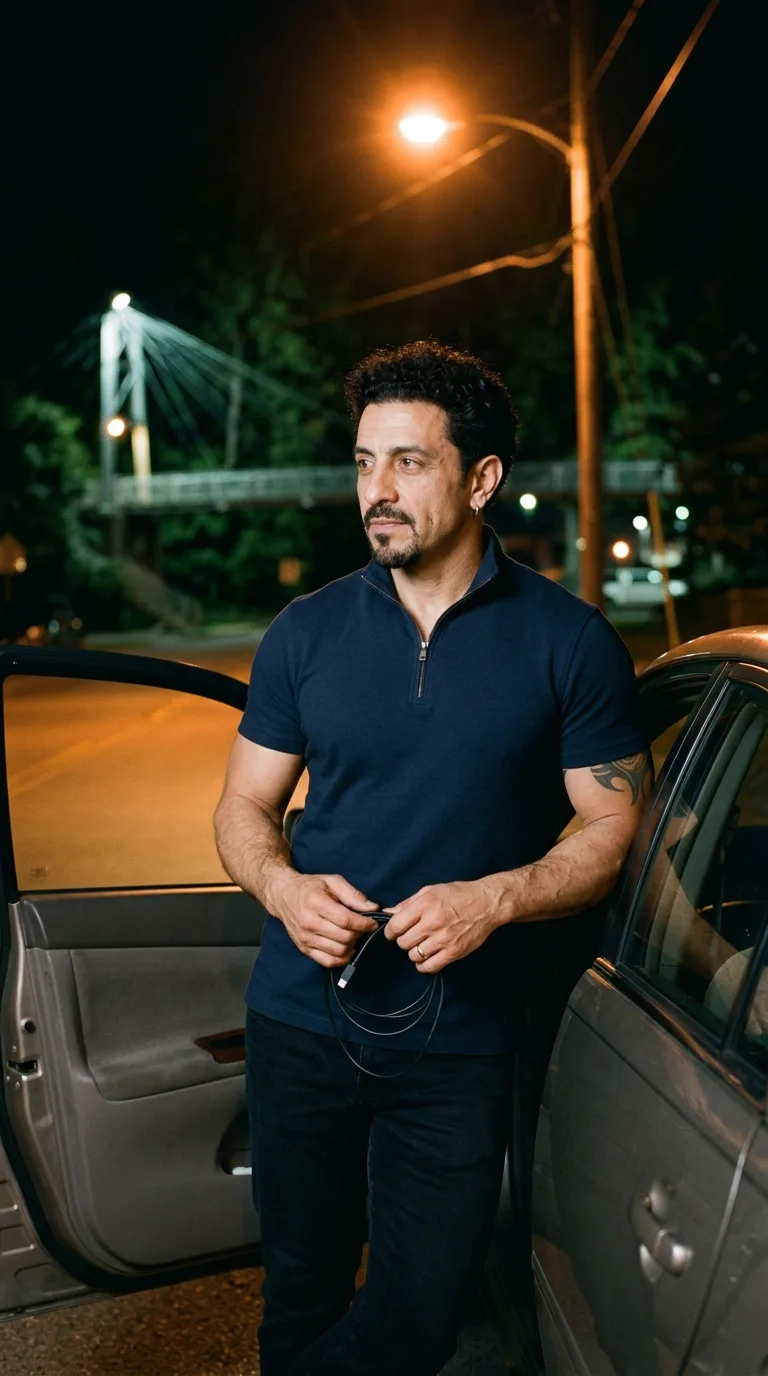
Rarest thing about him: Rideshare driver — common, 1 in 279
Season 1seed 40964039 · engine v11
Character card
lineage 2NZHHJ
His body-swap story
@colin.hasbrook, wearing Ryan Holcombe, rolled the wheel on and woke up as an unnamed body, spent under a minute in him, then spun the wheel and woke up as Danny Choi
---
The forklift's fork clangs down half an inch off true, and you feel it in Ryan Holcombe's shoulders before you feel it anywhere else — a small wrongness, the kind of thing a body knows before its owner does, except the owner isn't home. You've been him less than a minute. Freckled forearms, warehouse light doing that flat sodium thing to everything it touches, and already you're bored in a way that has nothing to do with Ryan and everything to do with you. You did this yesterday. You will do it again in an hour if the mood holds. Coastal Maine at three in the morning, the whole building asleep except the machines and you, and the boredom isn't Ryan's fault — he's fine, he's solid, freckles and all — it's that you know exactly how this shift ends and exactly how the one after that ends too. Seven hundred and twenty-seven men behind you and the only cure you've found for the seven hundred and twenty-eighth is the wheel itself. You set the pallet down. You don't even radio out. You just leave, the way you always leave, mid-motion, and Ryan Holcombe never knows there was a night he almost dropped a pallet for no reason at all.
The site loads the way it always loads: quiet, gray, a wheel that doesn't need decoration because what it promises needs none. You pay. You spin.
—
The cable is cold and coiled in your palm, and the world around it is not warehouse light, it's a streetlamp doing the same flat orange thing but through green leaves instead of steel rafters, and there's a footbridge lit up white in the middle distance over water you can smell before you can see it. Your hand — his hand — is already moving to loop the last foot of charging cable around itself, a motion done ten thousand times, and it comes out wrong, fingers crossing where they should uncross, and you stop, and do it again slow, and it comes out right, and then the next ten loops all come out right too, checked, each one, on a job that stopped needing checking years before you arrived. Nobody sees it. There is nobody on this street to see it. A sedan door stands open at your hip, dome light spilling onto asphalt, and somewhere behind your sternum a man's heart is beating a rate that has nothing to do with what you're feeling, because you're not feeling anything yet. You're just standing in him.
Then the cable finishes coiling and his life comes in through your fingers like current finding ground.
The polo shirt is against your back and it opens first, small and stupid: this morning, thumbs working the zipper up two inches and no further, the collar just brushing his jaw, and a voice from the next room — Danny, that's the name that comes with it, Danny still in bed — calling out is that the good one or the other good one, and Samir laughing at that, alone in the bathroom mirror, because Danny knows there are exactly two good ones and asks every time anyway. Dimples doing what they do in every light, showing even when there's nothing to smile about, and there was something to smile about this morning. You feel that ease sitting in the jaw like it's furniture that's always been there.
The jeans give you less, just denim worn soft at the knee from getting in and out of a driver's seat four hundred times a week, and the boots — brown, laced twice around because the left one's eyelet tore out two winters back and he never replaced them, just adjusted, the way he adjusts everything.
The steering wheel isn't in your hand yet, but the memory of it is stacked under your palm anyway, patient: fourteen years of night shifts because the daytime rate never worked once the kids started school, three of them, and you get a name for only one right now, Mira, seven, who leaves drawings on the dash clipped under the visor so he sees them driving, sees them at every red light in three counties. A tattoo warms under the sleeve — a crest, some team from a city he left when he was younger than any of his kids are now, half-forgotten allegiance kept out of loyalty to a father more than to a game. The wedding band is cool and plain and exact on the left hand, and touching it gives you a wedding ten years back in a backyard in Berea because the church wouldn't, and his mother came anyway, and cried through it, and told him afterward she cried because he looked happy, not because of anything else, and he chose to believe her.
The earring is a small silver hoop and it gives you nothing, just itself, just years of being there.
Underneath all of it: forty-three, six foot, built from a decade of loading and unloading his own trunk in gas station lots at 2 a.m., a lower back that clicks getting out of the car and doesn't hurt exactly, just announces itself. A goatee he trims every third day without a mirror by feel alone. Cigars on the porch on Sundays, never in the car, never around the kids, a rule he's proud of keeping. No drink for six years — didn't decide to quit so much as noticed one day he already had. Mass on the Saturday vigil because Sunday mornings belong to breakfast and the kids' noise. And under his hand right now, without him doing it, without you doing it either, exactly the motion the body wants: fingers drifting up to touch his own jaw, his own cheek, checking the beard's still there, an old tell that isn't a memory so much as a reflex the flesh keeps making on its own whether anyone's driving or not.
You look down. His hand — your hand now, for as long as this lasts — is still curled around the coiled cable, knuckles broad, a callus at the base of the thumb from ten thousand identical grips. You turn it over once in the orange light, watching it not do anything you told it to.
Then you lift your eyes to the bridge, the water, the dark trees, and you say, out loud, to no one standing there to hear it:
"Okay. Who am I tonight."