Raymond Yazzie
Fictional. Generated by AI — not a real person, and no likeness of one is intended.
64, software engineer in Los Angeles · rolled by @connor.waskiewicz · card — no film
History
who has worn him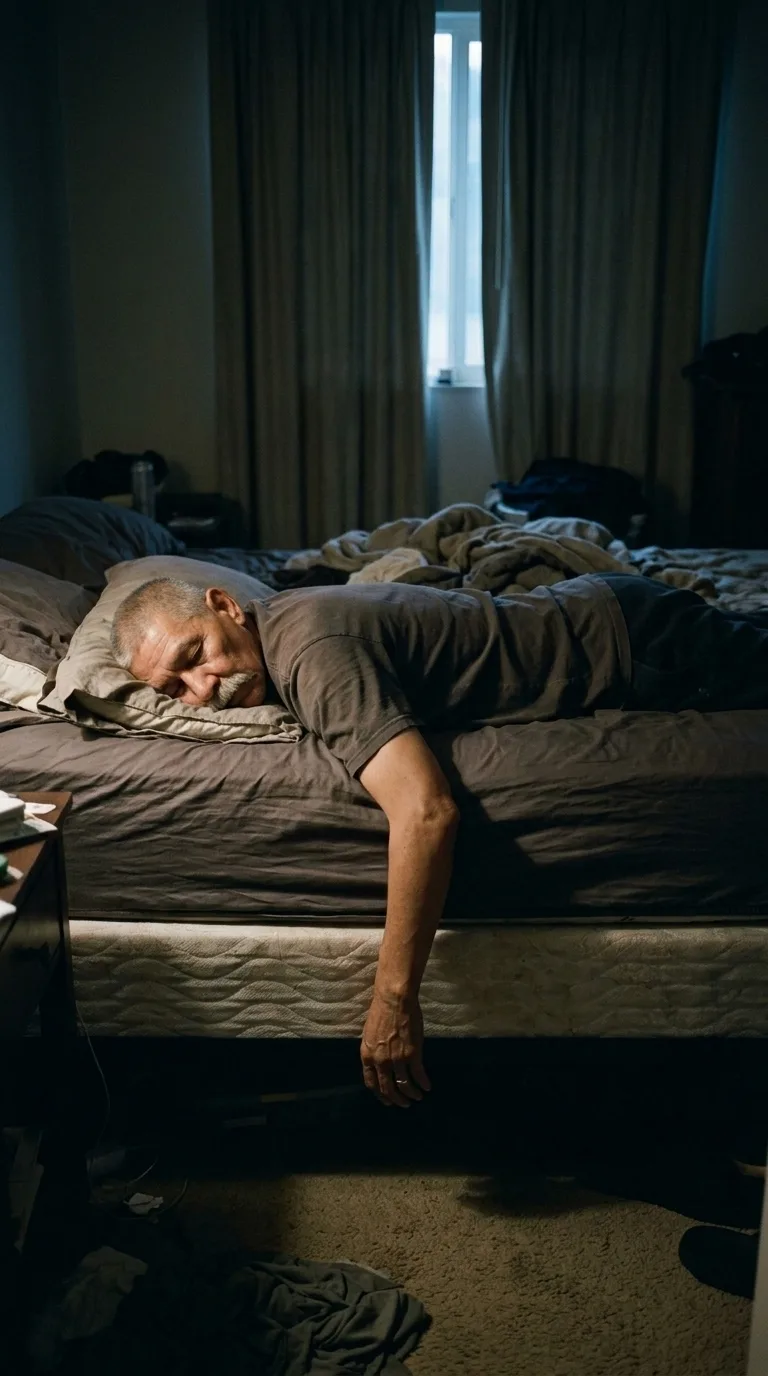
Rarest thing about him: A lazy eye — common, 1 in 66
Season 1seed 289133462 · engine v11
Character card
lineage 2NZHHJ
His body-swap story
@connor.waskiewicz, wearing Arturo Benítez, rolled the wheel on and woke up as Raymond Yazzie, spent under a minute in him, then spun the wheel and woke up as Tomás Reyes Aguilar
You are standing in Arturo Benítez's kitchen, and he has been yours for less than a minute. The linoleum is cold through his socks. Everyone in the house is asleep. His knees hurt in a way you did not choose and cannot argue with. You have his phone in his hand and the page with the wheel open on it. You are not leaving because he is bad. He is a fine, ordinary man between jobs, and the fridge hums for him. But you stood at his window and watched a Thursday-night street do nothing, and you found that you wanted somebody with somewhere to be. Somebody whose life already has a shape. You press the thumb. The wheel goes round.
Then there is a mattress under your whole front, and the sheets are twisted around one leg. Your breath is ragged, caught on something, and then it evens out all at once, as if a hand had smoothed it. A streetlight comes through a gap in the curtains and lies across the pillow. One arm hangs off the edge of the bed, and the blood has pooled in the fingers.
You draw the arm up. You roll onto your back, and the body does it heavily, a big frame with a soft middle. Your hands fold on your chest. You have never slept like this, and neither has he.
The shirt is the first thing that talks. The cotton is worn thin and sits against your ribs. It is a gray T-shirt, and a morning comes up in it: his hands pulling it over his head in a bright kitchen, his wife saying something about the dishwasher, the smell of coffee he let go cold. The sleeve catches on his wristwatch and he swears gently, the way he always does. Later he put the hoodie on over it, because the office air is set for machines and not for people.
The ring is against your own sternum, where your fingers are folded. It is a plain band, a little loose in winter. A flash comes up of a courtyard with dry palms and the late sun on stucco. A woman laughs with her head back. He is twenty-six and thinks he will never be afraid again. Then a hospital corridor, and the first of three small faces folded in a blanket. His whole chest goes wide and frightened, and you feel that fear arrive in a body that is not yours.
Something is in your mouth. It is gum, long dead, tucked in your cheek. Your jaw has been working at it even asleep. Under it is a taste of cigar from some Sunday, and a memory of standing in the yard with his brother-in-law, saying nothing, the smoke going up gray in the evening. He has never had a drink in his life. It is a thing he decided at nineteen, and it is quiet and absolute in him, like a locked door.
Your left eye drifts. You feel it slide outward when you stop paying attention, the old muscle giving up. A boy once called it lazy, and the word still lives in him, small and flat. He taught himself to look people in the face anyway.
The mattress gives under your hip. Beneath it, in the dark, are the code, the standing desk, two screens of green text and the pride of making a thing that works. There is money now, and he does not trust it. And there is an old girlfriend he thinks of sometimes, kindly, like a house he drove past once.
You open your eyes. You lift your hand into the streetlight and turn it over. It is wide, creased, and a little swollen at the knuckle, with the ring on it. The fingers close on nothing, chewing air the way his jaw does.
"All right," you say. His voice is low, and it comes out dry. "Hello, Raymond."
The house breathes around you, his wife somewhere close. You do not know if you have an hour or a year of him, and already something small in you is turning toward the wheel.