Raymond Echevarría
Fictional. Generated by AI — not a real person, and no likeness of one is intended.
58, chief executive in Small-town Ohio · rolled by @connor.waskiewicz · card — no film
History
who has worn him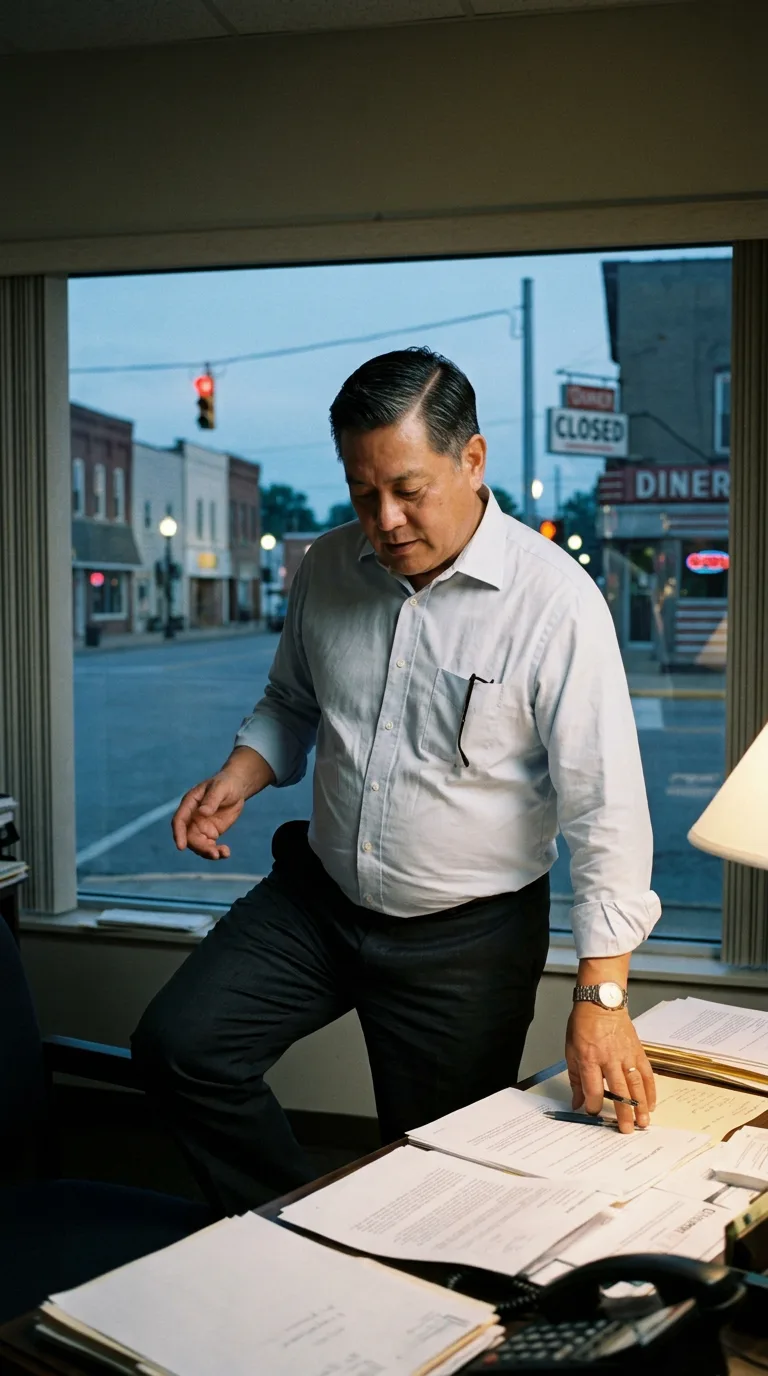
Rarest thing about him: Seriously rich — $3M to $10M — common, 1 in 88
Season 1seed 113600327 · engine v11
Character card
lineage 2NZHHJ
His body-swap story
@connor.waskiewicz, wearing Martin Szymanski, rolled the wheel on and woke up as Raymond Echevarría, spent under a minute in him, then spun the wheel and woke up as Douglas Perrin
You are Martin Szymanski, and you have been him for less than a minute. His thumb is still sore from a catch on the press guard. The shop floor hums in your shins, and the coffee in the break room smells like hot pennies. You asked for none of it. You were handed a good body, and you stood in it and felt the wanting come back anyway, quiet, like a draft under a door. You could not do the thing you wanted in a body that had a bad nose and a shift to finish. So you do what you do. You open the page, you pay, you watch the wheel.
It stops. There is no travel.
You are standing at a desk with one knee against the windowsill, and a pen is under your right hand. Dusk is blue in the glass. A red light hangs over an empty street, and a sign across the way says CLOSED. The papers under your palm are a stack of signatures. Your hand was signing, and then it signed wrong. Something in the loop of a letter slipped. You feel the rhythm break, you feel the half second where nobody is driving, and then you are. You do the signature again, slowly, and it comes out right.
The next ten you check. Each one, you check.
The shirt is the first thing that gives. Pale blue cotton, soft from washing, rolled twice at the cuffs. The fabric across your back brings a morning up: his hands, not yours, working the buttons from the bottom because he always starts at the bottom, a habit from a mother who ironed. The shirt is hanging in a closet that is too big for one man. One side of it is empty and he looks at the empty side and does not say anything. Then the trousers, the belt pulled one notch past where it used to sit. The wide soft weight of his middle sits over it. Fifty-eight years pull in the lower back when you shift your knee off the sill.
The pen clicks. Your thumb does it without you. Click, click. Under the click is a kitchen, a daughter at the table with a worksheet, a son in the doorway, a third child shouting from upstairs, and a woman's voice saying his name, Ray, with the particular tiredness of a thing already decided. The watch on your wrist is heavy and cool. He bought it the year the company turned. The skin at the base of your ring finger is paler than the rest, and when your thumb finds it, it finds the dent where a ring sat for twenty-six years. It aches the way a tooth aches after it has been pulled.
The smooth jaw, the stiff part in the hair. He shaved this morning in the mirror and told his reflection the numbers he would say to the board. The street outside is the street he grew up three blocks from, a town that kept him because he kept it, a payroll for half of it. A hymn is somewhere under all of this, plain and Protestant, a pew with a worn spot. He quit drinking in a church basement and has never told anyone at this desk.
You are rich now. You notice it as weight, not triumph. Signing is a way of carrying people.
You lift your hand off the page and turn it over. The palm is broad, the fingertips ink-stained, the pale band where a ring was. It is steady. It is yours until it isn't.
You look up at the glass, at your own reflection over the red light, and you say, quietly, "All right, Ray. Let's see how long."