Ray Loman
Fictional. Generated by AI — not a real person, and no likeness of one is intended.
36, prison guard in El Paso · rolled by @colby.marsh · card — no film
History
who has worn him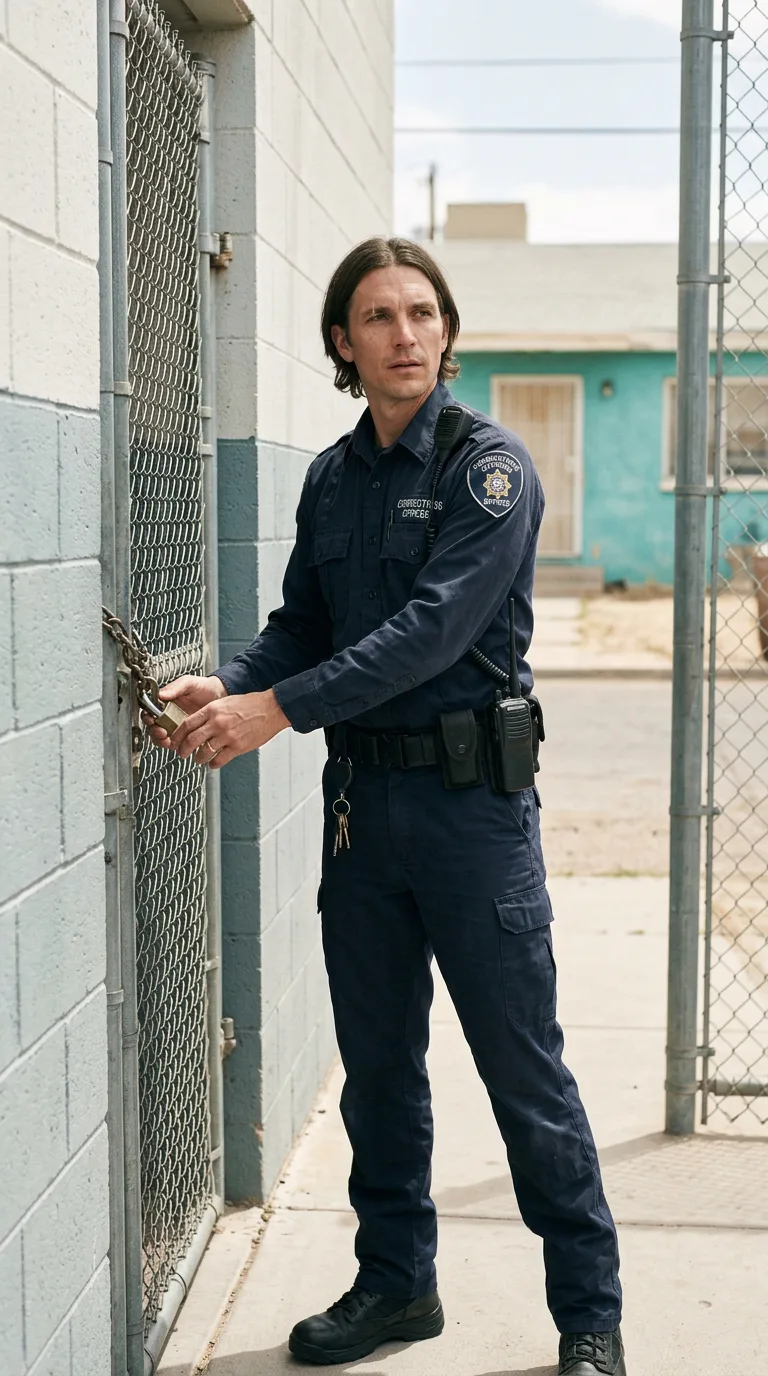
Rarest thing about him: Prison guard — uncommon, 1 in 122
Season 0seed 710602524 · engine v10
Character card
lineage PYNCV3
His body-swap story
@colby.marsh (admin), wearing Michael Summerfield, rolled the wheel on and woke up as Ray Loman, spent 4 minutes in him, then spun the wheel and woke up as Kenny Odom
You are standing in Michael Summerfield's kitchen in Queens, and the coffee has gone cold in his hand because his hand is not moving. It is six minutes since you took him — his shoulders wide, his knuckles thick from twenty years of couches and stairwells, blond hair going gray at the sideburns — and already the apartment feels like a coat that fits someone else. There is a woman's photograph magnetted to the fridge that is not your wife, was never your wife, and a child's drawing under it that makes something in Michael's chest tighten in a way you recognize but did not earn. You did not come here for him. You came here already restless, the way you always get, six minutes in, the furniture-mover's Monday laid out ahead of you — a truck, a dolly, straps that cut into forearms not yours to keep — and the site is right there on his phone, still open in the browser from last night, the wheel sitting mid-spin on the screen like it's waiting on you specifically. You do not think about it as a decision. You think: not this one, not today. You put the mug down on the counter without drinking from it and you tap the wheel with Michael's thick thumb.
Your eyes are closed, and then they open, and they are brown, and the light through them is a hard white desert light, not New York's gray morning.
Your hand is on a padlock. The chain-link fence in front of you is warm already though the sun is barely up over the block wall, and the key is turning — no. It already turned. It is turning again, slower, because something in the wrist decided to check it, the way a man checks a stove he is sure he turned off. Your radio crackles low at your shoulder, a burst of someone else's static, unit numbers, nothing that needs you yet. Behind you a flat-roofed house is painted the blue-green of a swimming pool nobody has filled in years, its dust pale in this early light. Everett Dabney's shift is night shift; the sun coming up now is not dawn breaking on him, it's dawn catching up to him, the tail of a graveyard rotation nobody outside the walls ever adjusts to.
The key. Cool brass, a groove worn into it by his thumb ten thousand times. It gives you the gate first — not this gate, the sally port, steel and cinderblock, the particular clank-and-catch of it that his hand has memorized so completely his mind is free to be elsewhere while his fingers work, is elsewhere right now, has been elsewhere for years on this exact motion. That absence is his signature. You feel how strange it is to suddenly be present in a body that built its whole professional life on not being present.
The uniform. Navy, long-sleeved despite the heat already pressing at the fabric — regulation, no shortcuts, twenty after five this morning in a bedroom with the blinds still down, his wife Denise's breathing behind him slow and even, one of the kids' nightlights bleeding orange under the door down the hall. He buttoned this shirt without looking at it, top to bottom, the way he's buttoned it since he was twenty-eight years old and this was a job he took because it paid and stayed because — the sleeve against your forearm gives you more — because there is a particular quiet in the corridor at 3 a.m. that he has never told anyone he likes. Not the men in the cells. The quiet between them. He clenches his jaw sometimes at nothing, at the wheel of an old radio show playing in his skull, at Denise's face across a table eleven years ago when she was still someone he was choosing rather than someone he'd already chosen — the ring gives you that, plain gold, warm from his own skin, and under it a flicker of someone else, a woman named Priscilla, years back, dark hair, a fight in a parking lot that ended things that should have ended slower. He still thinks of her sometimes on nights like this, walking a corridor that asks nothing of him. He is not proud of that. He does not act on it. It just sits there, a low hum, the way the sleep apnea sits in his chest at night, the machine humming beside the bed that Denise has gotten used to and the kids have never once mentioned, three of them, maybe four, voices from the kitchen this morning already fighting over cereal while he laced his boots in the hallway, unseen, listening, loving them so plainly it embarrassed him a little, alone.
The boots. Steel-toed, broken in exactly to the shape of these feet, this skinny frame that has never filled out no matter how many protein shakes Denise buys him, 5'11" and built like rope, thirty-six years old and starting to feel it in the knees on the concrete. He has not had a drink in nine years — stopped clean, no ceremony, just stopped — and never smoked, watched enough men in this building ruin their lungs on it to never start. He believes in something, vaguely, not a church exactly, more a sense that walks with him down the corridor at night that things balance out somehow, that he is owed nothing and mostly fine with that.
The padlock clicks. It is done correctly. It was done correctly nine times before this one, each one slower and more careful than it needed to be, as if some small persistent doubt has moved into a task that has not needed doubting in years.
You look down. The scar through your eyebrow — you don't remember it happening, but his hand knows the exact numb thread of skin there when you touch it, an accident with a barbell in a garage a decade ago that Denise still teases him about. Your hand. Not yours. His, thin-fingered, the wedding band catching the white light.
You turn it over once, like checking it's real.
"Long night," you say to no one, and it comes out in his voice, low and a little hoarse from twelve hours of not talking much, and you look up into the sun climbing over the block wall like you're waiting to see if it answers.