Ray Domínguez
Fictional. Generated by AI — not a real person, and no likeness of one is intended.
47, cop in Dallas · rolled by @ray.dominguez · card — no film
History
who has worn him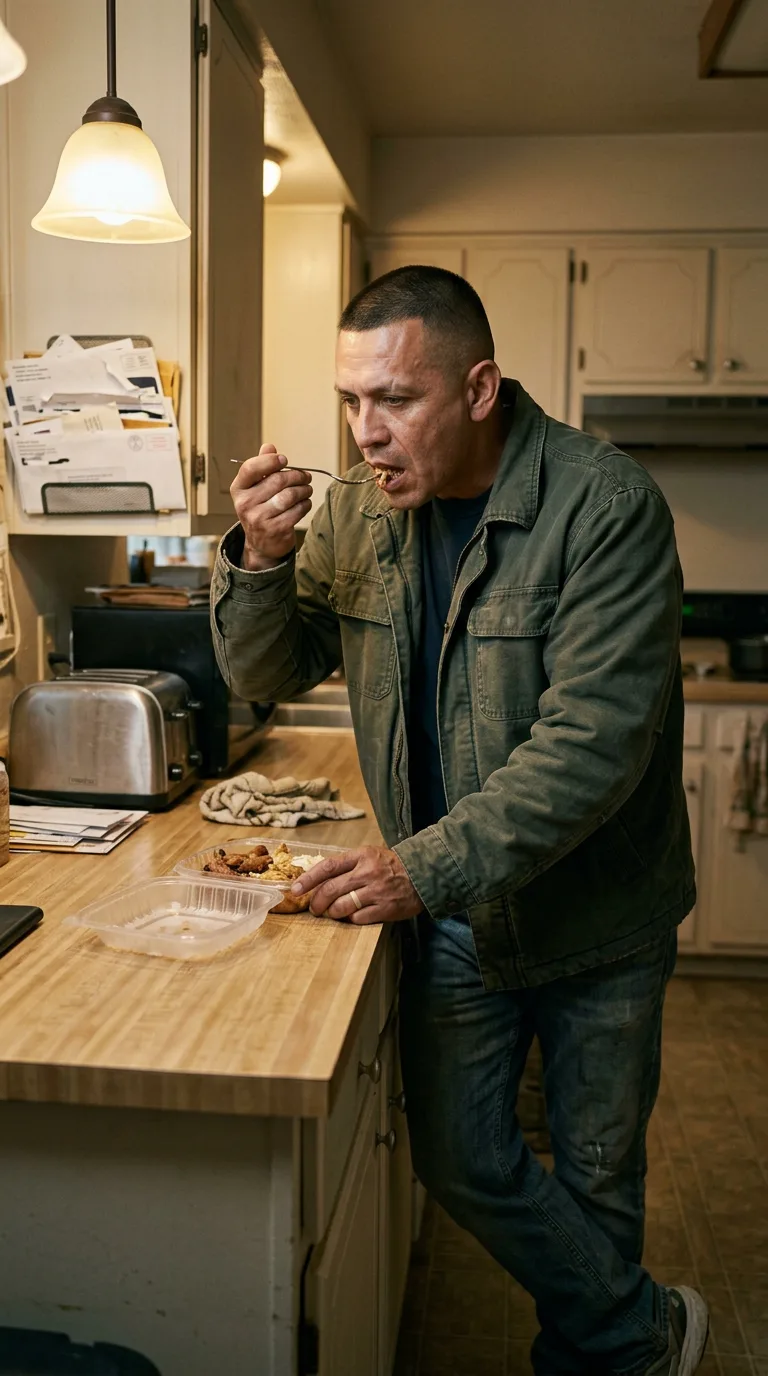
Rarest thing about him: A few, scattered — rare, 1 in 13
Season 0seed 1124940548 · engine v10
Character card
lineage KSU95X
His body-swap story
@ray.dominguez rolled the wheel on and woke up as Ray Domínguez — their first
The page loads slower than it should for something you've thought about your entire life. A wheel, plain as a raffle, spinning under a header font that looks like it was chosen by someone's cousin who does graphic design on the side. You have read every thread about this kind of thing since you were a teenager — the fiction, the forums, the half-serious confessions at two in the morning where someone always says *if this were real I would.* It has never been real. Friday afternoon, nothing on, the particular emptiness of a day that already happened to someone else first. You put in the number. You spin. You do not expect anything, which is the last thought that is only yours for a while.
The fork stops an inch from your mouth.
Not your mouth — his. You feel the weight of it settle into you all at once, like sitting down hard in a chair you didn't know was behind you: shorter than you pictured yourself, dense through the shoulders, a low hum of tired in the lower back that has nothing to do with tonight. The kitchen is dim, one bulb over the counter doing all the work, a window in front of you gone black with evening. The coat is still on. The fork goes down onto the rim of the container with a small plastic click, and your hand — his hand — sets it there like it had already decided to.
The coat comes off first, one shoulder and then the other, and that's the first thing that reaches you: the weight of canvas sliding off, and underneath it a flash — not a memory yet, just a feeling, cold air, a car door, the smell of exhaust and drive-through coffee — gone before you can hold it. You sit. The stool takes your weight the way it's taken it a thousand times, a give in exactly the right place. You pick the fork back up and eat in even mouthfuls, looking at nothing in the window, and every motion of the hand carries something behind it now, faint at first, like a radio finding its station.
The shirt is what opens it wide. Not this shirt — you're not wearing the uniform now, just an old henley gone soft at the collar — but your fingers brush the placket buttons out of habit and it comes anyway, a whole morning arriving sleeve by sleeve: standing in a room with beige walls, a duty belt heavy on a chair, the particular stiffness of a collar starched by a laundromat because nobody starches it for you anymore. Ray Domínguez, forty-seven, buttoning up for a dayshift that will run into dusk, checking his radio, checking the mirror out of habit more than vanity, touching the scar through his eyebrow the way he always does — not out of pain, just checking it's still there, the way you'd check a key in a pocket. He got it off a car door twelve years ago, a domestic call that went sideways in a driveway in Pleasant Grove, and it healed pale and clean and he has stopped explaining it to people who ask.
The fork is next — not this fork, but the memory doesn't care, it comes through the shape of the grip, the exact economical way he holds anything: the toothpick. Thousands of hours of it, chewed down to a splinter and replaced, chewed down again, a tell his sergeant used to read like a gauge — Domínguez working a toothpick means Domínguez is thinking about something he isn't saying. He quit cigarettes nine years ago on a bet with himself the week his youngest was born and never told anyone how close he came to losing it.
The counter under your palms gives you the house — a new-build off a cul-de-sac with a pickup in the drive, bought after the divorce with money he didn't love spending but needed to spend, three bedrooms for three kids who are only there every other weekend and on Wednesdays if their mother's shift allows it. The ring finger has no ring, hasn't in four years, but there's a pale line there still, and touching it — his own hand finding it without meaning to, the way tongues find a missing tooth — brings back a wedding in a backyard in Oak Cliff, salsa on a borrowed speaker, a woman named Consuelo laughing with her head back, and later, much later, the same woman across a kitchen table with a folder of paperwork between them, both of them too tired by then to make it ugly. He loved her the whole time. That part never left, it just stopped being enough on its own.
The badge on the coat, hung now on a hook by the door, gives you fourteen years of it — the good calls and the ones he still sees behind his eyes at red lights, the rookie who used to throw up before every shift and doesn't anymore, the captain who calls him *Dom* like it's a compliment. Sundays, when he makes them, at a church two exits up 35 where his mother still sits in the third pew and prays for his soul out loud at dinner. A big night out once or twice a month with two other officers, whiskey and complaining, nothing more than that, because there are kids who need him sober on Sunday.
None of it is yours. All of it sits in your chest anyway, heavy and warm, like a house you're only borrowing but that still smells like someone's dinner.
You set the fork down in the empty container. Your hand — his hand, tan, tattooed, a scar's-width pale line where a ring used to sit — turns over slowly on the counter, palm up, palm down, like you're checking it came back from somewhere.
You lift your eyes to the black window, and past your own reflection, straight into whatever's watching.
"Didn't feel like anything," you say, in his voice, "and now it's everything."