Rajesh Koirala
Fictional. Generated by AI — not a real person, and no likeness of one is intended.
56, mechanic in New York · rolled by @colin.hasbrook · card — no film
History
who has worn him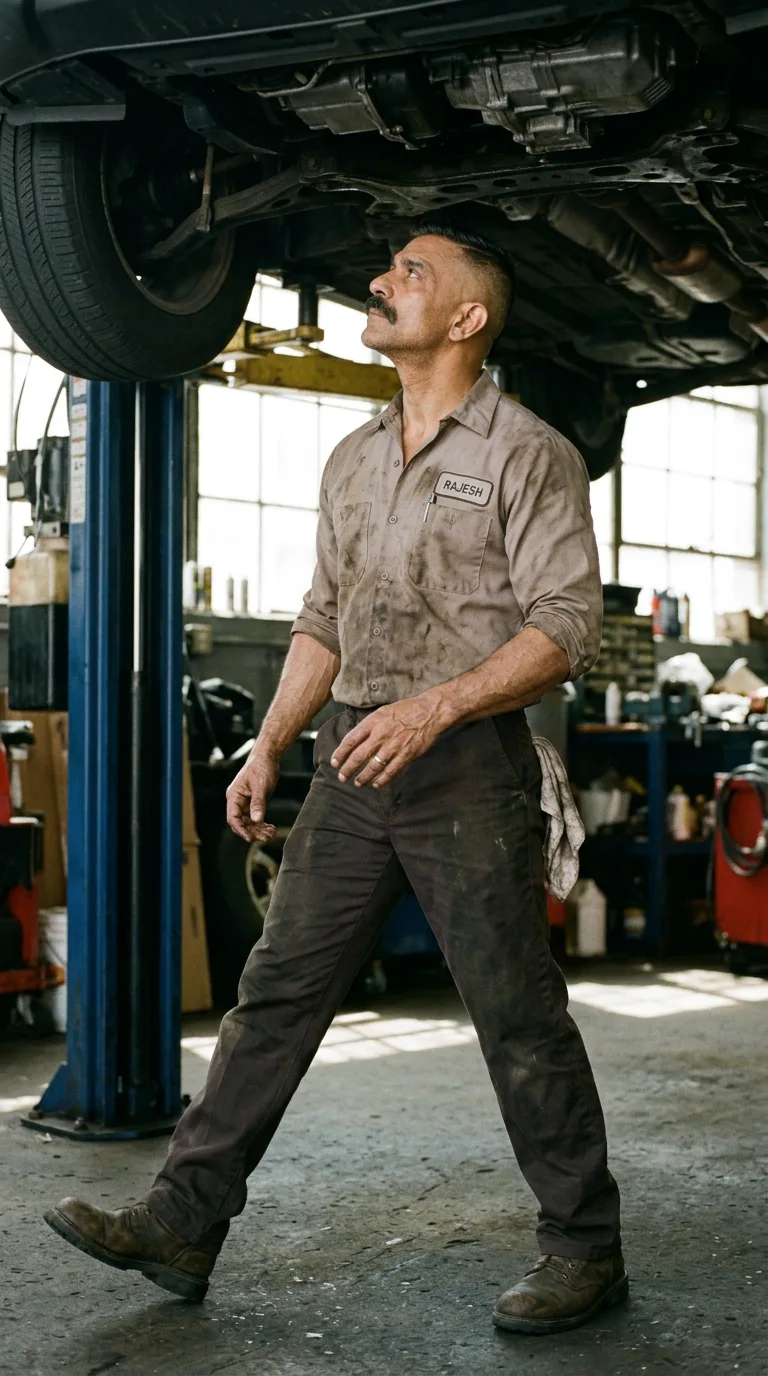
Rarest thing about him: South Asian — common, 1 in 26
Season 1seed 1502550338 · engine v11
Character card
lineage 2NZHHJ
His body-swap story
@colin.hasbrook, wearing an unnamed body, rolled the wheel on and woke up as Rajesh Koirala, spent under a minute in him, then spun the wheel and woke up as Brian Halloway
The office chair in Boston creaks the same way it has for eleven years, and you know its creak the way you know your own throat clearing. Silver hair, blue eyes, a nose broken once and never quite reset — this is the body you've been in long enough to call it *this body* instead of *me*, which is the tell, if anyone were watching for it. On the desk is a case folder gone soft at the corners, a woman missing since March, and you have read it fourteen times and you are not going to read it a fifteenth. That's the whole reason, if you're honest, which you have no plan to be with anyone. Not boredom exactly. More like the specific tiredness of a body that solves things slowly, on purpose, one dead end at a time, when you have 791 other lives on file that ended before the tiredness set in. You open the laptop. The wheel is already loaded from last night, spinning lazily in place like it's been waiting. You click before you decide to.
The wrench is already turning when you arrive, and your arm keeps turning it — a half-inch, then it stops, hangs there a beat too long, then goes back and does the half-inch again, slow, correct, checked. You are bent at the waist under the rear end of a Camry, fluorescent light broken into stripes by the lift's crossbar, and there is a smell of hot metal and old rubber filling a chest that is not the chest you had four seconds ago — wider, shorter, a moustache-line of sweat on the lip above it. Somewhere behind you a radio is playing something with too much bass for the hour. Your knees ache in a way that is new to you and old to him.
The wrench is the first thing that talks. Chrome-vanadium, taped grip, and it says *ten thousand mornings* in a language that isn't words — the particular give of this bolt, third one back on this exact model, a torque his hand knows before his mind does. You feel him arrive through his own competence, which is a strange way to meet a man, all muscle-memory and no face. The rag in your back pocket is next: cotton, oil-stiff at one corner, and it opens into his hand wiping down a distributor cap while a much younger man's voice — Dominic, floor manager, gone now, retired to Florida — says *you're the only guy here I don't have to check behind*, and the small glow that gives him lasts, apparently, for years.
The shirt is the deep one. Tan, name patch stitched crooked because his wife, Anita, did it herself the week the embroidery machine at the uniform place broke and he needed it by Monday — *RAJESH*, slightly uneven on the J, and just touching the collar brings back this morning whole: dark before the sun, the apartment quiet because his daughter Priya is twenty-six now and keeps her own hours across the bridge, Anita already gone to her shift at the hospital, a note on the counter in her handwriting that just says *chicken in fridge, don't argue.* He buttoned this shirt standing in the bathroom mirror with the overhead light too yellow, moustache combed the same three strokes it's had since 1994, wedding band clicking once against the sink edge the way it has ten thousand times, a small sound he stopped hearing years ago and his hand never stopped making room for. Ex-wife Meena crosses his mind unbidden and brief — a different decade, a different apartment, no anger left in it, just a fact with her name on it — and is gone as fast as it came, the way old weather is gone.
The boots ground it last, steel-toe, a decade of concrete through worn soles, and under everything is a body 56 years old and built like it works for a living: shoulders that don't quit by 3pm, a lower back that announces itself getting up off a creeper, forearms corded from turning things that don't want to turn. He quit cigarettes nineteen years ago on a Tuesday for no reason he can name even now, and something in the lungs still remembers the shape of the craving without the want. He has never prayed in his life and has never missed it. Numbers come with the tools too — a mortgage nearly done, a little put by that he doesn't mention to anyone, enough that Priya's tuition never once kept him up nights.
You straighten under the lift too fast and crack your head lightly on the crossbar, which he would have ducked, which you didn't know to.
You hold your hand up in the stripe of fluorescent light, turn it over, knuckles scarred small and pale in places, wedding band catching the light dead center, and something in you that is not him at all says, out loud, to no one, in a voice that comes out lower than you expected:
"Okay. Okay, let's see what you've got."