Rafael Coto
Fictional. Generated by AI — not a real person, and no likeness of one is intended.
46, nurse in New York · rolled by @colin.hasbrook · card — no film
History
who has worn him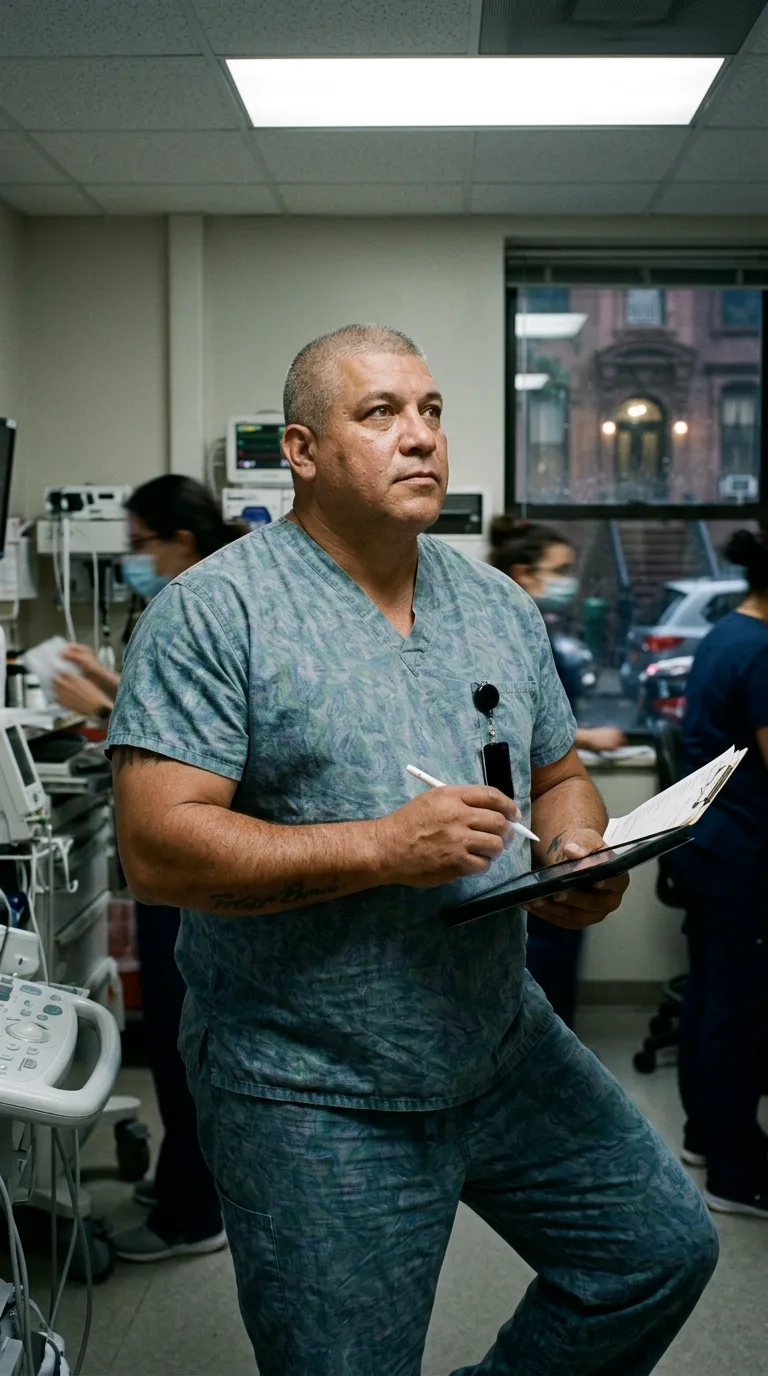
Rarest thing about him: A pack a day — rare, 1 in 17
Season 0seed 1421384699 · engine v10
Character card
lineage 2NZHHJ
His body-swap story
@colin.hasbrook, wearing Brian Costanza, rolled the wheel on and woke up as Rafael Coto, spent under a minute in him, then spun the wheel and woke up as Evan Sacharin
Brian Costanza's kitchen smells like protein powder and the candle someone gave him that he never blows out. You have been him for forty seconds, and already you know the whole shape of his boredom: the mirror by the door he checks without meaning to, the phone face-down on the counter because the last message on it is from a client cancelling again. There is nothing wrong with him. That's the trouble. Thirty-nine, symmetrical, easy in his own gym-built frame, and you have used him for exactly one thing — walking to the counter, opening the laptop, going back to the site — because a body with nothing left to discover in it stops being a body and starts being a room you're pacing in. You didn't come back for him. You came back because he was quiet enough to let you.
The wheel spins the way it always spins, no ceremony, a little dishonest wobble before it decides, and then there is no laptop, no candle, no Brian at all.
Your hand is already moving when you arrive, and it stops, wrong, mid-air — a pen an inch off the paper where the last motion set it down — and you feel the whole small machine of this body catch and correct, like a foot finding a stair tread it already knew was there. You are standing. You are shorter than you were a breath ago, and heavier through the middle in a way that sits low and solid rather than soft, and your knees announce themselves immediately, a dull permanent complaint from the floor up. Fluorescent light overhead, flat and a little green. A clipboard in your left hand. A pen in your right, held wrong for one full second, then right. Somewhere behind you a monitor beeps on its own schedule and nobody startles at it.
The badge reel at your chest is the first thing that gives you anything — a retractable clip, plastic, ordinary, and off it comes a smell of hospital soap and the particular ache of an ID photo taken on a bad morning three years ago, Rafael Coto looking like he hadn't slept, which he hadn't, because his mother had just gone into the ground and he'd come in anyway because someone had to hold the floor. That grief comes up fast and recedes just as fast, the way old grief does, worn smooth. The scrub top is next — cheap poly-blend, a print like a plaza fountain gone abstract, and pulling that thread back you get a whole morning: him standing in his bedroom at four-something in the afternoon because he works nights some weeks and days others depending on what the schedule gods decide, buttons of daylight coming wrong through the blinds, pulling the shirt over his head in one motion his shoulders know without asking, the waistband already loose because he'd lost a little weight and never bought new pants, patting the badge reel once against his chest like tapping a chest pocket for keys, out of habit, though there was nothing to check.
The clipboard gives you numbers you don't understand yet but he does, underneath, some patient in bed four whose vitals he has been tracking for six hours without once looking directly at his own hands doing it. The floor under your shoes — thick-soled, broken in at the exact spots his feet actually bear weight — gives you the specific fatigue of a twelve-hour shift, hour eight, the point where his lower back has started sending up the same complaint it sends every day around now, an old herniation from lifting a patient wrong nine years back that never fully quit on him. It isn't sharp. It's a tenant that pays rent on time. You know, the way he knows, that there's a heat patch in his locker and a pack of Marlboros in his jacket and that in forty minutes there's a window at the end of the hall where he'll stand for four minutes exactly, in the cold, and not think about anything at all.
More comes, unbidden, layered: a woman years back, not a wife, a fiancée who wanted kids and a house on the Island and got tired of waiting for a man who kept picking extra shifts over her, and the quiet unbroken relief he felt after she left that he has never told anyone, not even himself in so many words. A brownstone stoop two blocks from here where he sits some nights with coffee before walking home, sodium light turning the wet stone orange, smoking the day off him one cigarette at a time, no one waiting up, money in the bank he doesn't spend on much of anything, insurance he never uses. A leg, his left, jittering under the desk on slow nights until a coworker used to kick his chair and tell him to cut it out. He liked this job before he loved it. He is good at it in the unglamorous way — the checking, the re-checking, the steadiness that patients feel even when they can't name why.
The pen is still in your hand. The paper in front of you has one line written correctly and nine more to go, and you write them slow, checking each one against a chart he built for himself years ago and hasn't needed to consult in a long time, until tonight.
You set the clipboard down. You turn your hand over under the fluorescent light, study the small tattoo faded at the wrist you didn't put there, the calluses across the base of the fingers, the wedding-ring tan-line that isn't there because there was never a ring. Somewhere down the hall a woman in blue scrubs says something to someone else and doesn't look over.
"Okay," you say, to no one, in a voice pitched lower than the one you left in Atlanta. "Okay."
Your leg starts bouncing before you've decided to let it.