Peter Mikulski
Fictional. Generated by AI — not a real person, and no likeness of one is intended.
22, baker in Pittsburgh · rolled by @anthony.dcosta · card — no film
History
who has worn him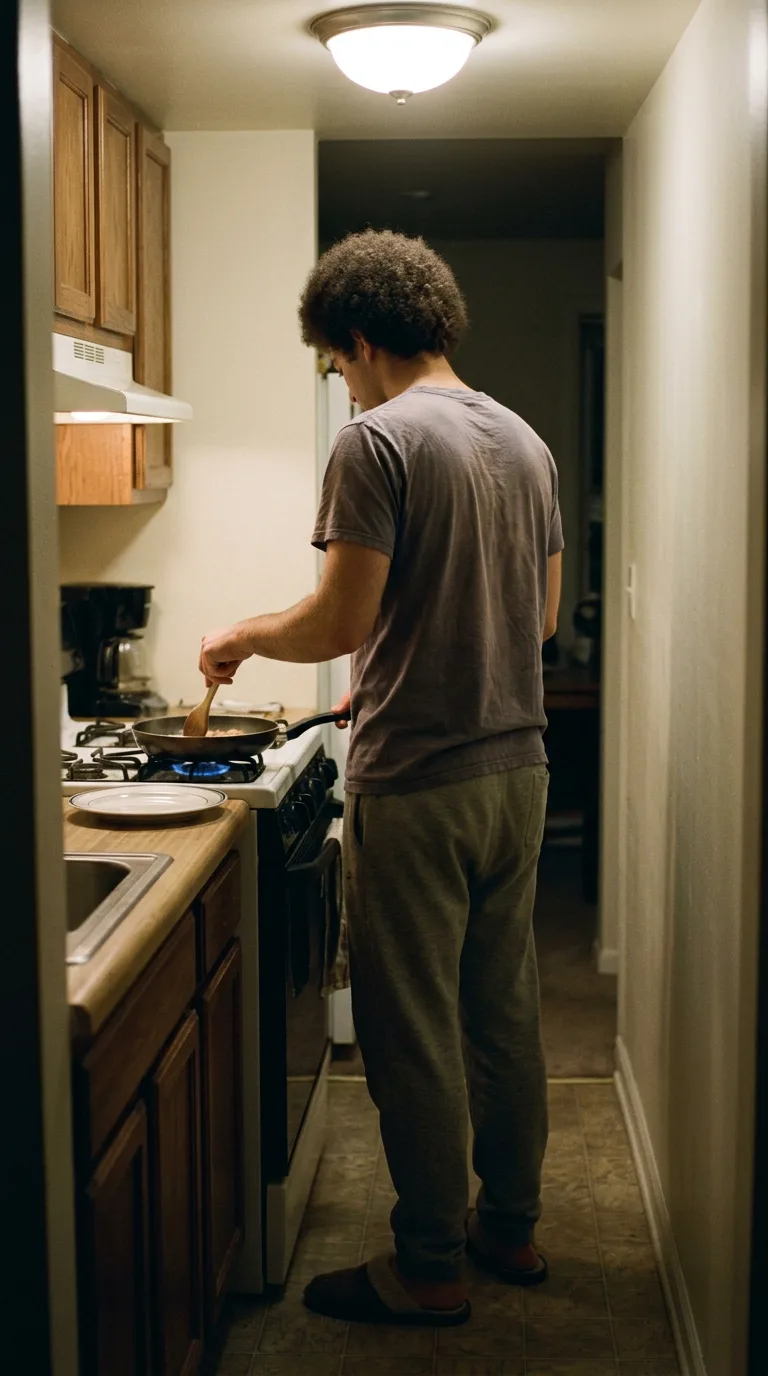
Rarest thing about him: Afro — epic, 1 in 1,011
Season 0seed 1942626875 · engine v10
Character card
lineage 10Z9BP
His body-swap story
@anthony.dcosta, wearing Gary Okabe, rolled the wheel on and woke up as Peter Mikulski, spent 4 minutes in him, then spun the wheel and woke up as Danilo Reyes
You are standing in Gary's break room, and Gary's knees hurt the way they always hurt, and that is reason enough.
Less than a minute ago you became him — 47, soft in the middle, silver at the temples, brown eyes that have looked at a lot of shelving under bad fluorescent light — and already you know you don't want this one. It isn't the knees. It's Marcus, two aisles over, who Gary has hated wordlessly for eleven years over some slight neither of you can name anymore, and who is going to walk past this break room in ninety seconds and say something about the Steelers, and Gary will laugh the way Gary always laughs, small and swallowed, and you cannot do that today. You did it for four minutes and it was already too long. The phone is right there in the pocket you have not earned yet. The site loads the way it always loads, patient, a little smug. You spin standing up, break room chair behind you, Gary's ID badge swinging on its clip, and you think: anyone else. Anyone at all.
The wheel decides you are a baker in Pittsburgh, mid-Friday, over a stove.
The stirring stops mid-circle in a hand that is not Gary's hand — narrower, younger, a burn-scar-less back of the wrist, a wooden spoon slowing in a pan that smells like butter going brown. You feel the new height first, the way the ceiling sits lower over you than it should, five-seven instead of five-six but wrong in a different direction, weight sitting differently on the balls of your feet. Green light behind your eyes for a second, gone. You salt the pan without tasting it because there is no reason yet to taste it — the reason is still arriving. Your other hand, unbidden, reaches into the cabinet and takes down a second plate and sets it next to the first, and you don't know why you did that, not yet, and neither does he, and he isn't here to ask.
The apron is the first thing that talks. It's hanging on a hook you can feel without turning — canvas gone stiff with old flour and butter that never fully washed out — and touching its strap where it crosses under your collarbone gives you four a.m., the walk-in door's rubber seal peeling back cold against your forearm, a hundred and forty croissants proofing under plastic, Denise from the counter singing badly to a radio nobody else likes. You have — he has — worked this since he was nineteen. Your hands know a dough's temperature by resting on it for two seconds, the way some people know weather. There's an ache low in the right shoulder, an old thing, repetitive, earned honestly by rolling and folding six days a week, and a callus track along both palms that this stove and its handle slot into without asking.
The t-shirt gives you more — worn thin at one shoulder seam, and putting it on this morning comes back sleeve first: he'd stood in the bedroom doorway of an apartment two flights up from a shared backyard, stairs slick with wet leaves outside the window, and pulled it over his head already thinking about the drive home from the shift that had ended at eleven, thinking about nothing, really, the pleasant nothing of a tired brain. He is off today, or was supposed to be off, which is why this is lunch and not the walk-in. A rare weekday with light in it. He liked that light. He didn't examine why.
The leg under the sweatpants is bouncing, has been bouncing since before you arrived, a motor that runs without him, and touching your own knee to still it gives you a flash of a waiting room, fluorescent too, a different one, a prescription refilled on time every month for three years now, a small steady discipline he doesn't tell people about because there's nothing to tell — it works, mostly, and the leg still bounces anyway, old habit outliving the reason for it.
The second plate is the strange one. Setting it down again — because you are, this second, setting it down again, the gesture already looping — brings back nothing specific. No name, no woman's laugh, no birthday. Just the plain fact of eating alone for the last eight months and, some Fridays, still setting two places out of a muscle memory nobody's told to stop. Comfortable, this life — the mortgage on the two-flat doesn't scare him, the bakery pays fair, he could afford wine he'll never buy because he never drinks, could afford anything you'd want if you meant to want something small. He isn't lonely exactly. He just hasn't unlearned the second plate.
The spoon is still in your hand. Your — his — fingers are shorter than Gary's were, quicker, sure of themselves in a way Gary's never got to be about anything.
You turn the hand over, palm up, spoon rolling loose against your fingers, and study the burn-shine along the base of the thumb, a baker's brand nobody gave him on purpose.
"Okay," you say, out loud, to the empty kitchen, to the second plate, to whoever isn't coming to sit at it. "Okay. Not Gary anymore."
You don't taste the eggs. You don't know yet how long you'll want this one.