Peter Lonetree
Fictional. Generated by AI — not a real person, and no likeness of one is intended.
25, store manager in New York · rolled by @connor.waskiewicz · card — no film
History
who has worn him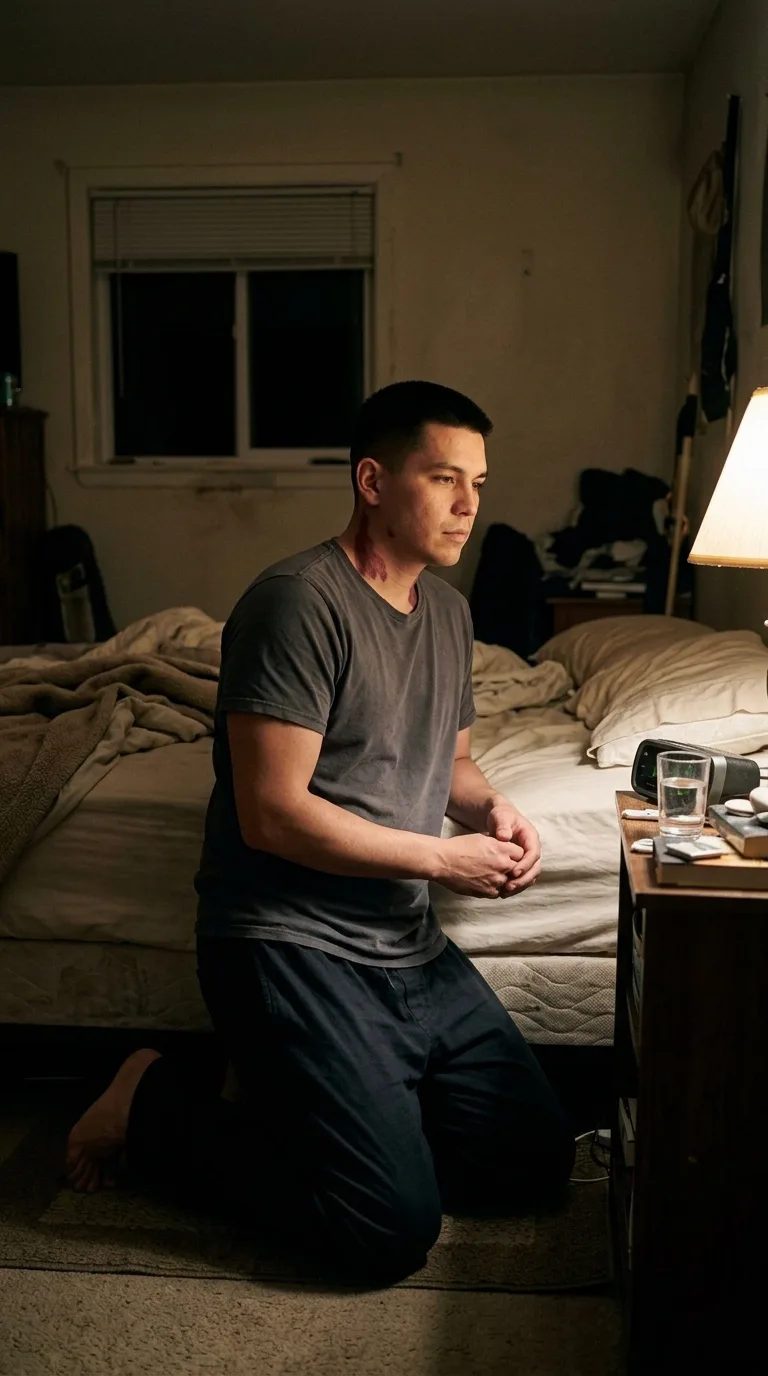
Rarest thing about him: An ancestral tradition — rare, 1 in 169
Season 1seed 1353778634 · engine v11
Character card
lineage 2NZHHJ
His body-swap story
@connor.waskiewicz, wearing Daniel Nakamura, rolled the wheel on and woke up as Peter Lonetree, spent 23 minutes in him, then spun the wheel and woke up as Kenneth Mori
You are leaving Daniel Nakamura because of a drawer.
It is the kitchen drawer, the one by the stove, and in it, under the twine and the dead batteries, is a folded square of paper with his daughter's handwriting on it. She is not yours. Nothing in him is. You have had his forty-one years for under a minute, and already the paper knows his thumb better than it knows you. Your thumb finds the fold and the whole drawer goes warm with a feeling that is not yours: a kid, a crayon, a Saturday. You close it. It is the third drawer in an hour that has done this to you. The house is asleep. Somewhere in the walls the furnace ticks. You stand in his socks on his cold linoleum, with a carpenter's shoulders and a carpenter's quiet, and every object here is a door you did not ask to open, and behind every door is someone who loves him. You came for a body. You did not come to be a guest in a man's grief. The laptop is already open on the table, and the wheel is already turning, and you tell yourself it is only to see.
Then there is a floor under your knees.
The carpet is thin and the cold of the room's floor comes straight up through it. Your hands are pressed together, and your breath is halfway out of a laugh you did not start. Your mouth is still bent around the word *amen*. You were rising. Your weight was already shifting to the balls of your feet, and now it falls back, and both knees take it. The smile goes out of your face like a lamp switched off. Your forehead drops to the bedspread, and the fabric is rough against the skin and smells of detergent and old smoke.
The clock on the nightstand glows at the edge of your eye. A glass of water sits beside it.
Your right leg is bouncing. You did not tell it to. The heel is lifting and dropping against the carpet, and you cannot make it stop, so you let it.
The T-shirt comes first, because it is against you. It is soft, washed to nothing, and it has a little give across the shoulders. Then it is a morning. He pulled it off the chair, sniffed the collar, and decided it would do. His hands were slow, because the night before was heavy. There was whiskey, then a cigarette on the stoop under the orange light, then another. There is a taste in the back of this mouth still, ash and something sweet. The head behind your eyes is dull and sore.
The bedspread under your forehead is next, and it gives you a woman's voice, tired and not unkind, saying *you can't keep doing this*, in a different bedroom, years ago. His wife. It lands as a flat ache under the ribs, and a man's wish to have answered differently. You do not get the answer he gave. You only get the wanting.
Your hands are still folded, and when you press them tighter, something rises through them: a grandmother's kitchen, cedar smoke, a low voice saying words you do not know but his body does. His mouth almost forms them. That is what the prayer was. It was not very serious, but it was old, and he did it anyway, a little embarrassed, and a little glad. The store comes then, in a flash. Pallets stacked in an aisle, shrink wrap cut with a box knife. The keys at his belt are heavy and loud. There is a number in his head, a debt, and it sits in his chest like a swallowed stone. It is not the biggest thing he carries, but it is the one he checks most often.
The knees ache. The neck is warm along one side, where the birthmark runs, and some part of him has always known when it is touched.
You lift your head. The room is brown lamplight and a dark window. Nobody is here. Nobody was ever here but him, and he is gone, and he never heard a thing.
You open your hands and look at them. They are broader than you expect, with a callus at the base of each finger from lifting, and the nails are cut short. You turn them over. The leg is still bouncing.
You raise your eyes to the dark glass of the window, where a face is waiting, and you say it quietly, to him, to no one, "Okay. Let's see how long you last."
Your thumb finds the pad of your finger. You wonder how long the wanting will stay quiet this time.