Patrick Landry
Fictional. Generated by AI — not a real person, and no likeness of one is intended.
23, stand-up comedian in New Orleans · rolled by @connor.waskiewicz · card — no film
History
who has worn him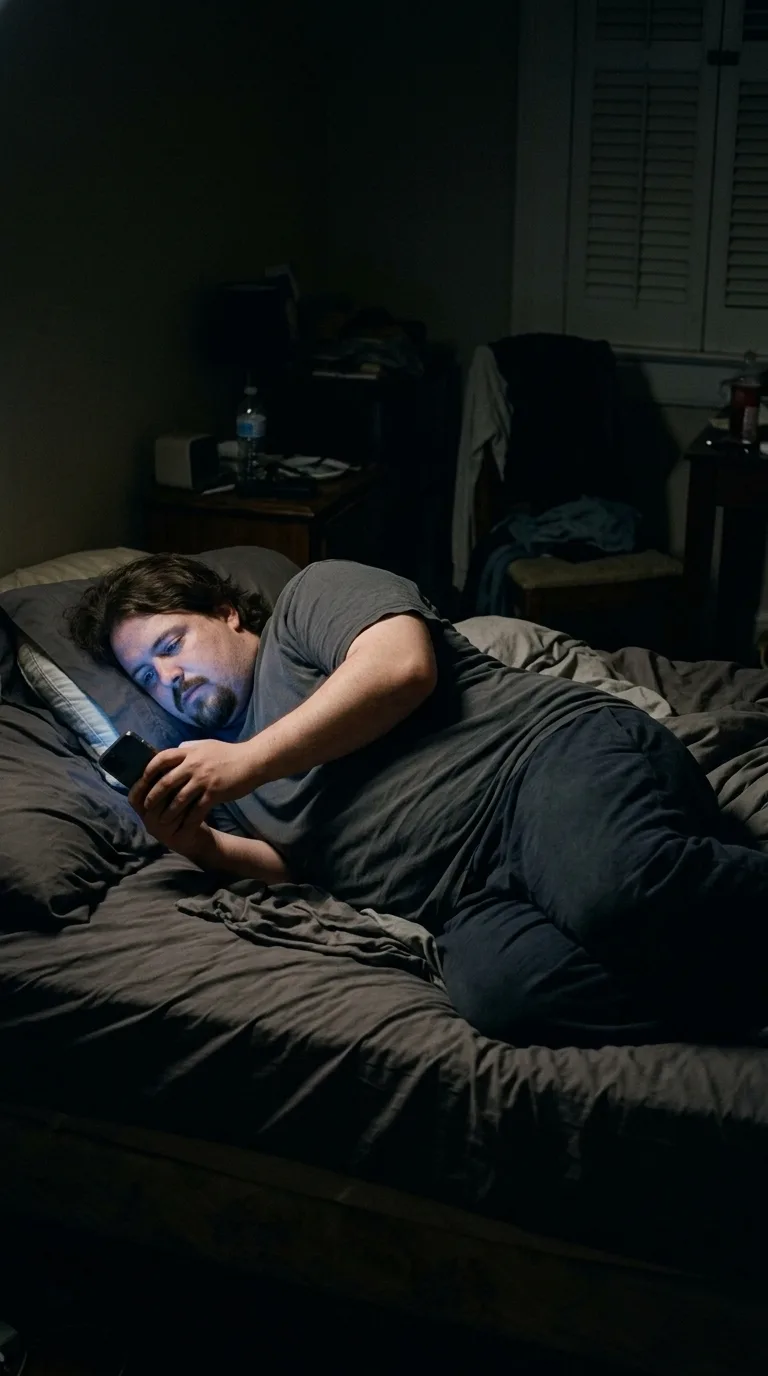
Rarest thing about him: Stand-up comedian — uncommon, 1 in 2,435
Season 1seed 715117918 · engine v11
Character card
lineage 2NZHHJ
His body-swap story
@connor.waskiewicz, wearing Wade Lindqvist, rolled the wheel on and woke up as Patrick Landry, spent under a minute in him, then spun the wheel and woke up as Mahesh Rajan
You are standing in a stockroom in Western Kansas, in the dead middle of the night, in Wade Lindqvist's body, and you have been him for two minutes. The shop is dark out front. The rolling door is down. His broken nose whistles faintly on the in-breath, and his shaved scalp is cold where the air conditioning finds it. His brown eyes are good. His shoulders are good. Nothing is wrong with him.
That is the trouble. You stood here with a box cutter in his hand and a pallet of pump parts to open, and you felt the whole clean, capable machine of him waiting to be asked for something, and you had nothing to ask. A man who can lift anything and fix anything and has a shop and a name people know in a town where everyone is asleep. You wanted to be somebody who was in the middle of something. You set the box cutter down on the shelf, very carefully, as if it were someone else's, and you went to the phone. The wheel was already open. It always is.
You pay. You spin. The wheel clicks down its pegs, slows, and stops.
Dark. Warm. A sheet under your hip, and a pillow gone soft and hot beneath your cheek. Your thumb is mid-stroke on glass, and you start it again, faster than he had it, flicking past everything he had paused on, a face, a clip, a stranger's joke. Blue light sits on one cheek. The phone is six inches away. You blink, and it takes a moment to remember how often.
Weight first. He is heavy in a way that is simply the shape of him: a soft, wide ballast pressing the mattress down, the belly warm against your forearm, the thighs heavy together. Your breath comes slow and shallow, from lower than Wade's did. You are shorter. The ceiling is farther away than it should be, and the room smells of old wood, damp air, and a window that has been open a crack all night. Steam is not rising off the street yet, but the shutters are bright at the edges where a streetlight leans in.
The shirt is the first thing that speaks. It is thin gray cotton, washed past softness, pulled over one shoulder where he lay on it. The collar has gone slack, and the hem curls against your belly. You hold the phone with one hand and press the other flat to your chest to feel the cloth, and the morning comes up through your palm.
It is not this morning. It is a night two weeks back, a Saturday, in a closet-sized green room with a bad fan. He pulls this shirt over his head because the blazer is going on top and the blazer needs a plain thing under it. One arm, then the other, his head catching in the neck. The jacket is navy and was cheap and has gone shiny at the cuffs. He rolls the sleeves once, then unrolls them, because rolled looks like trying. There is a mic cable on the folding chair, and he coils it over his elbow the way a man does who has been doing it since he was nineteen. Somebody laughs on the other side of the wall, and he feels the hot sick lift of waiting. Four minutes. He says the first line to the mirror with no sound. His mouth knows it.
The sheet under your hand brings a different kind of memory, flatter and heavier. Rent. The number sits in him like a swallowed stone, and under it other numbers, the ones that never get paid down. He is twenty-three and underwater, and he has made it a bit. He tells it from the stage, the card with the cartoon bird on it, the bank that sends him letters like a pen pal, and the room roars, and the next morning it is still the same number. You feel the exact shape of that gap between the laugh and the balance.
You turn a little, and the mattress sags the way it always has. His hip knows where the hollow is. Your thumb finds the edge of the phone case, worn smooth where he grips it, and there is a night in it: a long drive home on a night nobody came. Eleven people, and four of them were staff. He did the full set anyway, every pause in place, the way you do for a full house. The bartender clapped alone, slowly. He drove home with the windows down, and the air was thick, and he decided it was fine. He was nearly sure.
His beard itches along the jaw, the goatee thick against your lip. When you rub it, there is his mother's kitchen, a screen door, a voice calling him in off the porch. He is nine, doing her voice for the neighbors, and they are crying with laughter. It is the first time he understood that a room could be steered. Your throat tightens with something that is his and not yours. You let it go through.
Your legs ache faintly at the knee, the soreness of a man who stands too long on small stages and sits too long on small stools. Your belly rises and falls under the cotton. His heartbeat, unhurried, thumps against the mattress as if it still believes it has all night.
You lift the phone, turn it face down against the sheet, and the room goes nearly black. Then you hold up your hand in the light from the shutters. It is broad, pale, soft across the back, freckled at the knuckles, the fingertips slightly callused from a guitar he stopped playing. You turn it over. The palm is creased, warm, entirely his.
You raise your eyes to the dark and say, low, in his voice, "Well. Tough crowd."
It comes out of his mouth like a habit. Somewhere in the walls the old house ticks. You do not know if you will be here when the shutters go gray, or if the wanting will come back before the next breath, or if this is the one you keep until the light changes. You lie there with his heartbeat in your ears, waiting to find out.