Patrick Gallagher
Fictional. Generated by AI — not a real person, and no likeness of one is intended.
56, addiction counselor in Philadelphia · rolled by @caleb.dunham · card — no film
History
who has worn him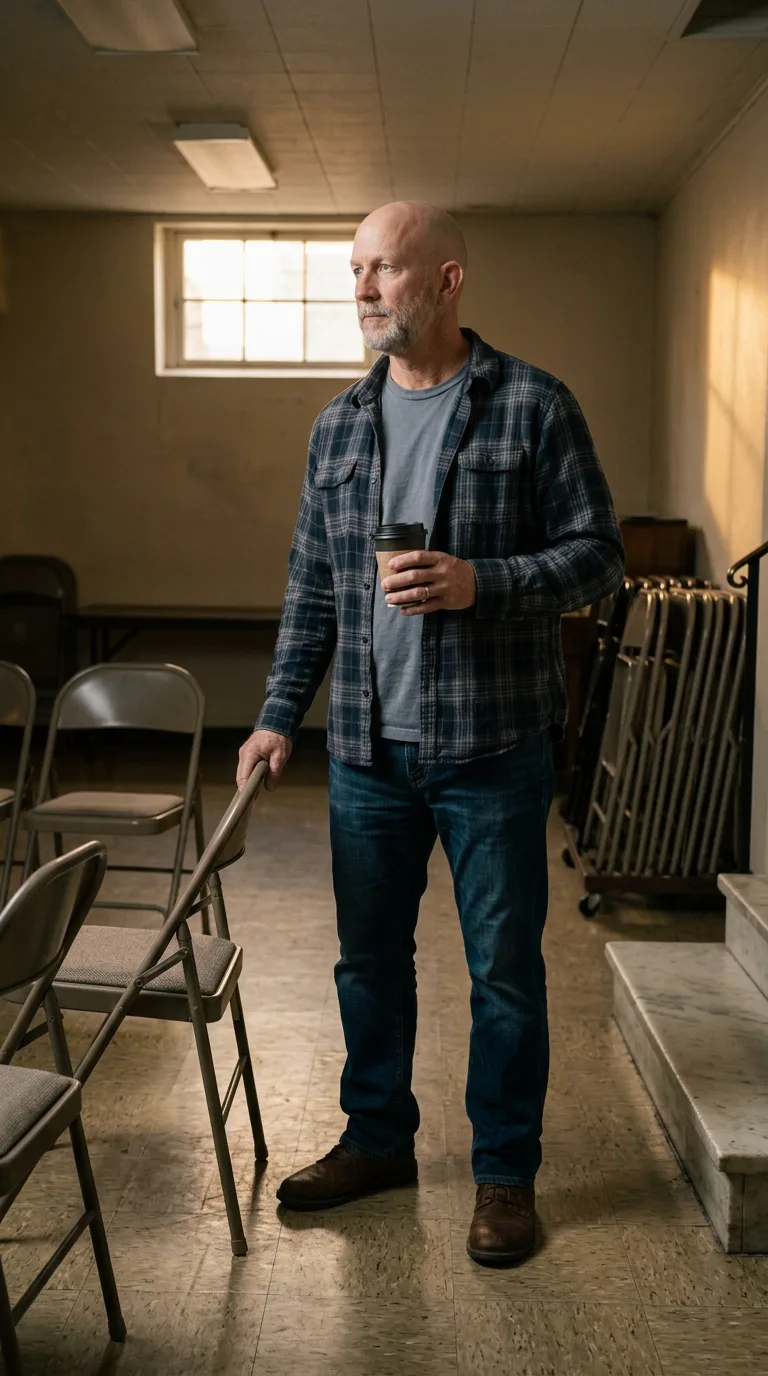
Rarest thing about him: Addiction counselor — uncommon, 1 in 2,382
Season 1seed 183536791 · engine v11
Character card
lineage 9IC4OB
His body-swap story
@caleb.dunham, wearing Thomas Brennan, rolled the wheel on and woke up as Patrick Gallagher, spent 3 minutes in him, then spun the wheel and woke up as Dustin Kessler
You are standing in a kitchen in Brooklyn with Thomas Brennan's thumb on the lid of a jar you cannot open. It is the afternoon, a Friday, and his wife's mother is in the next room telling someone about her knee. You have been him for thirty-three minutes. His wrists are sixty years old and they will not turn it. You run it under hot water. You try the dish towel. The jar stays shut, and the whole of him is arthritis and patience, and the patience is the part you can't stand. He would wait here all day and call it peace. You put the jar down very gently, because he would have, and you go into the bathroom and spin.
Then there is a hum, and a cold smell of floor wax and old coffee, and the jar is gone.
You are holding the back of a folding chair. The metal is cool and a little greasy under your palm. In your other hand a paper cup, still warm, the sleeve gritty against your fingers. Your right leg is bouncing. You did not tell it to. The heel taps the tile in a quick small rhythm, and it is the body's own, a thing it does when nobody is asking.
The room is a church basement, and the light from the high window lies on the wall like a slab of butter. Chairs in a circle, most of them set, some still stacked on the rolling rack by the marble steps. Those steps are worn into a shallow dish in the middle by a hundred years of shoes.
The chair back first. Your fingers close and it comes, not as a picture but as a feeling: a Tuesday, this same grip, a boy of nineteen sitting in the seat with his knees jammed together, saying he would rather be dead than say it out loud. The man whose hands these are did not look at him. He looked at the floor so the boy could have the room. Pride, dull and warm, and under it fear, the long old fear that he is only ever one phone call from the worst.
The cup. Black coffee, no sugar. It tastes like a decision. He has not had a drink in his life, he never started, because his father did, and the memory of the kitchen at four in the afternoon rises with the steam, a man asleep upright at the table with his hat on. And a cigarette that was the one thing he allowed himself, until the morning he stood on the stoop and counted forty years of them and stopped. Your tongue still goes looking for it. Your fingers want the shape of a pack in the shirt pocket.
The shirt, then, soft flannel, washed to nothing. This morning he buttoned it standing in a rowhouse doorway while the first sun came down the block and found the marble step. His wife, Maureen, was behind him with her hair wet, and she reached past and fixed the collar he'd turned under. Two kids upstairs, one thumping around, one pretending to sleep. He said nothing. He touched the ring on his left hand with his thumb the way he does, turning it once, a rosary of one bead. Her hand stayed on his back a second longer than the collar needed.
Jeans, stiff at the knee. Boots with the heels worn on the outside. Under the denim the thighs are strong, the back is not quite, a low ache like a hand pressed above the belt. His breath goes in deep and clean, a shaved head cool under the air from the vent, a beard trimmed close at the jaw that you rub with a knuckle and it is wiry, unfamiliar, his.
And then, uninvited, a woman who is not Maureen. Dark coat, a bus shelter in November, years before the wedding. He loved her, and he was drinking the other kind of drink then, the kind that comes in cups, the kind he counsels against. He never did tell anyone he still thinks of her when it rains. It sits in him like a stone in a shoe, and you are walking on it.
Nobody is coming through the door yet. The half hour is yours.
You let go of the chair. You turn your hand over in the light from the window: the pale band on the fourth finger, the knuckles broad, the nails clipped square. You look up.
"Well," you say, to the empty circle, and the voice is lower than you expected. "Let's see how long you last."
You do not know if that means him, or you.